Hansard Summary
Senators raised concerns about the lack of transparency in the Telkom Kenya‑Airtel merger, questioning the exclusion of real‑estate assets and undisclosed shareholding, while the Vice Chairperson defended the need for commercial confidentiality and promised in‑camera briefings. The afternoon sitting also featured a report from the Labour and Social Welfare Committee covering minimum‑wage guidelines, teenage pregnancy, cash transfers, disability inclusion and the regulation of digital ride‑hailing drivers, alongside updates on several petitions. Senators welcomed a delegation from the Nyandarua County Youth Empowerment Forum, expressing support for youth participation in legislative processes and sharing personal anecdotes. Light-hearted banter and laughter marked the exchange, while Senator Haji used the opportunity to affirm the non‑partisan nature of the Building Bridges Initiative and called for waiting on the forthcoming report. The session combined cordial hospitality with a brief, constructive reference to a national political issue. Senators debated the regulation of drones, urging the Kenya Civil Aviation Authority to submit comprehensive rules to Parliament and stressing the need for safety measures, especially in military airspace. They highlighted the potential of drones to create jobs in photography and film for youth, while criticizing existing policies that may hinder talent development and calling for investment in detection technology.Sentimental Analysis
MixedTHE PARLIAMENT OF KENYA
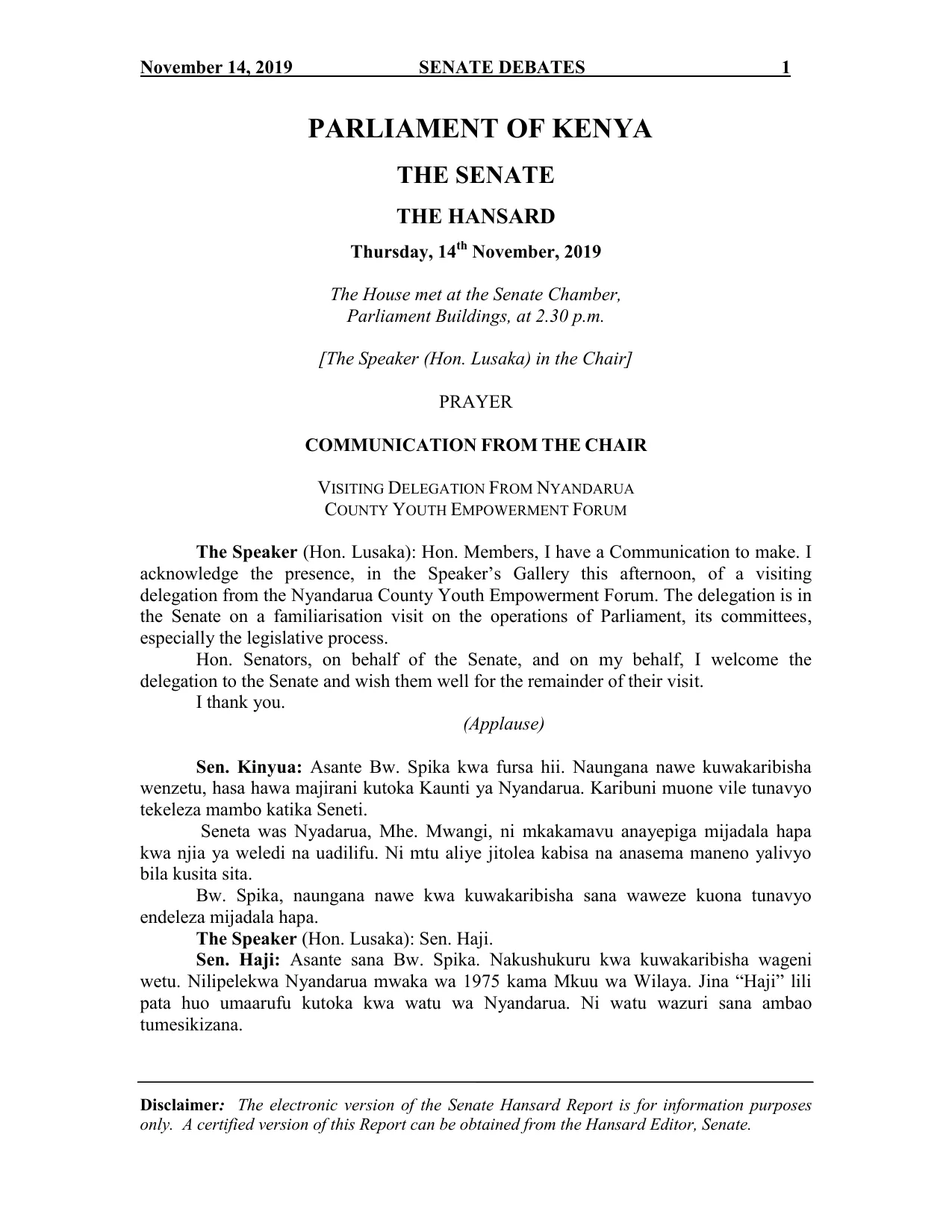
THE SENATE
THE HANSARD
PARLIAMENT OF KENYA
Thursday, 14th November, 2019
COMMUNICATION FROM THE CHAIR
VISITING DELEGATION FROM NYANDARUA COUNTY YOUTH EMPOWERMENT FORUM
Hon. Members, I have a Communication to make. I acknowledge the presence, in the Speaker’s Gallery this afternoon, of a visiting delegation from the Nyandarua County Youth Empowerment Forum. The delegation is in the Senate on a familiarisation visit on the operations of Parliament, its committees, especially the legislative process.
Hon. Senators, on behalf of the Senate, and on my behalf, I welcome the delegation to the Senate and wish them well for the remainder of their visit.
I thank you.
Asante Bw. Spika kwa fursa hii. Naungana nawe kuwakaribisha wenzetu, hasa hawa majirani kutoka Kaunti ya Nyandarua. Karibuni muone vile tunavyo tekeleza mambo katika Seneti.
Seneta was Nyadarua, Mhe. Mwangi, ni mkakamavu anayepiga mijadala hapa kwa njia ya weledi na uadilifu. Ni mtu aliye jitolea kabisa na anasema maneno yalivyo bila kusita sita.
Bw. Spika, naungana nawe kwa kuwakaribisha sana waweze kuona tunavyo endeleza mijadala hapa.
Sen. Haji.
Asante sana Bw. Spika. Nakushukuru kwa kuwakaribisha wageni wetu. Nilipelekwa Nyandarua mwaka wa 1975 kama Mkuu wa Wilaya. Jina “Haji” lili pata huo umaarufu kutoka kwa watu wa Nyandarua. Ni watu wazuri sana ambao tumesikizana.
Nakumbuka kila mara nilipotaka kupelekwa uhamisho kikazi walikuwa wakimwambia Mzee Moi: “Hapana, huyu atatoka hapa tuu kama atakuwa Mkuu wa Mkoa.” Mwishowe nikawa Mkuu wa Mkoa kule Mombasa.
Nawapongeza vijana hawa. Natuma salamu zangu kwa watu wa Nyandarua. Nawaomba vijana hawa wafanye kazi vile watakavyo ona tukifanya hapa Seneti.
Bw. Spika, asante sana.
Mr. Speaker, Sir, I join you in welcoming the youth empowerment team from Nyandarua. I am happy that Sen. Mwangi, who I appeared before when I was an intern in the year 2000, when he was the Chairperson of the Public Investments Committee (PIC) , is now here.
Mr. Speaker, Sir, it will be imprudent of us not to welcome Sen. Haji and hope that he has completed the ‘bridge’ he was building.
Proceed, Sen. Cherargei.
Thank you, Mr. Speaker, Sir. From the onset I join you in welcoming the youth empowerment group from Nyandarua County. I assure them that they can be the change they want to see. Some of us, as young people in this House, are leading the way. We are doing all that we can to ensure that the youth in this country have a space in terms of issues of legislation. I assure them of our full support.
My brother, a prolific Sen. Mwangi, is a very tough Chairperson. He is a good man---
On a point of order, Mr. Speaker, Sir.
What is your point of intervention?
Mr. Speaker, Sir, I heard the Senator say he is young and that Sen. Mwangi is his brother. I think he is supposed to say he is the father!
No, Mr. Speaker, Sir. I think he did not hear me. I said Sen. Mwangi is a prolific person. I did not say he is my brother.
Kenyans and not specific individuals as some of the Members have alluded to before in funerals, birthday parties and drinking sprees across the country.
Proceed, Sen. Mwangi wa Githiomi.
Thank you, Mr. Speaker, Sir. I would like to welcome the youth from the great county of Nyandarua. Great brains have come to this Senate today. The youth are capable of taking over the leadership of this country when their time comes. These are hardworking youths.
Mr. Speaker, Sir,I did not say what Sen. Poghisio said.
What is your point of intervention, Sen. Haji?
Mr. Speaker, Sir, I want to declare in this august House that we are not there for any individual interest. The Building Bridges Initiative (BBI) is there for the interest of Kenyans. We have gone round the whole country; we heard from thousands of people at the Kenyatta International Convention Centre (KICC) . The recommendations we made were based on what the people told us, including some of the Senators, who are here.
Therefore, this myth of politicizing the issue should cease. Please wait for the report to be released and then we can discuss it after that.
Thank you.
What is your point of order, Sen. Kinyua?
Mr. Speaker, Sir, I did not get on what point of order Sen. Haji arose, because it is Sen. Mwangi who was talking. There was nothing wrong with what he was saying.
What is your point of order, Sen. Mutula Kilonzo Jnr?
Mr. Speaker, Sir, so that Sen. Haji is not misquoted or misrepresentations are made on his behalf, perhaps you can allow him to issue a Statement on a matter of national concern, stating that they have completed their work and they will table a report. I am happy and I hope that since he is here, bridges have already been built.
This Senate donated you to the BBI, and we are owed just a one page report of something.
What is your point of order, Sen. Wetangula?
Mr. Speaker, Sir, I like what Sen. Haji has said. I agree with him and support him. However, both him and his Co-Chair have maintained a very loud conspiracy of silence to the effect that people are now running out there bastardizing, labeling and abusing others. They are labeling people as pro and anti BBI, and they are even appearing to know the content of the BBI Report, which has not been made public.
As we salute the good work that they have done, you are reaching an apollionic---
Order, Sen. Wetangula. We are deviating from welcoming the people of Nyandarua into the issues of the BBI.
Allow me a minute to finish, Mr. Speaker, Sir.
Okay.
The BBI was supposed to unite the country, but it seems to be dividing us even more. This House is so privileged, and you must be very proud as our Speaker, for donating two giants from this House to go and chair such an important process.
I want to shield Sen. Haji, unless he wants to say something himself. Say something, but be careful not to make it worse.
Thank you, Mr. Speaker, Sir. If the hon. Senators were following the happenings, I want to state here that at our press conference, I stated that all the allegations that are being made are a creation of politicians as well as the press. I said that we have finished our work, and the people should wait for the outcome. I also said that when we hand over the report to the principals, then everything will come out, and they will have the right to comment about it.
Thank you, Senator for Garissa. Let us conclude on that.
Not on the same. I have ruled; let the matter rest. I know that Sen. Haji has a lot of experience; he used to teach us something called “the need-to-know” principle. He knows
what to say, where and when. Let us, therefore, take his word, that the report will come out.
Sen. Mwangi, can you conclude so that we make progress?
The people of Nyandarua are strong, and that is why you heard that big noise.
Mr. Speaker, Sir, I wish to conclude and tell the youth from Nyandarua that they are welcome to the Senate. They should also work very hard, because we want a number of them to join politics in the very near future.
Thank you very much.
The Senator for Nyandarua and a few of us have done the welcoming. Let us now move on, in the interest of time.
Next Order. What is your point of order, Sen. Madzayo?
Mr. Speaker, Sir, I thought that this was very important, in view of the fact that I also wanted to join you in welcoming these youths. I will only take a minute.
I have already ruled on that.
With tremendous respect, Mr. Speaker, Sir, I will only take a minute, the way my senior also requested for a minute, and you granted it.
Okay, proceed, Sen. Madzayo.
Mr. Speaker, Sir, I seek your protection.
Order, Members. I have used my discretion.
I am obliged, Mr. Speaker, Sir. I also want to join you in welcoming the youthful persons from Nyandarua, who have come to witness how the Senate works, and how we are so civilized. In as much as we have our own disagreements, they are as a result of us debating national issues for the benefit of our entire country.
Mr. Speaker, Sir, Nyandarua has produced giants like Sen. Mwangi and Sen. Haji. We, therefore, have a lot of respect for the people from Nyandarua, and we wish them God’s blessings. Whatever you have come to learn here, you will learn and it will help you when you go back to mashinani.
God bless you.
Next Order. What is it, Sen. Omanga?
Thank you, Mr. Speaker, Sir. On Petitions, there is a Petition which has been on the Order Paper for the last two weeks, and which has been appearing,
reappearing and disappearing. It is a Petition from the County of Narok. I seek your advice on that Petition.
Sen. Omanga, we are now on Statements. We have passed Petitions.
It was a point of intervention when they talked about the Petitions.
But we had already passed the Petitions; we are now on Statements. We will deal with it next week.
Next Order.
STATEMENTS
ALLEGED GRABBING OF AN ECD CENTRE IN MUGOYA ESTATE, NAIROBI CITY COUNTY
Mr. Speaker, Sir, I rise pursuant to Standing Order No. 48 (1) to seek a Statement from the Standing Committee on Lands, Environment and Natural Resources regarding the alleged land grabbing of an Early Childhood Development Education (ECDE) centre and playground for children in Mugoya Estate, Nairobi City County, LR.No.Nairobi/Block 103/793.
In the Statement, the Committee should address the following issues-
Thank you, Mr. Speaker Sir. This matter has been lately hitting headlines in the news. The Governor of Nairobi County is being quoted as complaining that the EACC is pursuing him. I would like to request the Committee where this matter is being referred, to look into the measures that have been put in place to ensure that there is no abuse of prosecutorial powers by any institution, to the detrimentof the general public.
This is the one that is at the heart of the complaint. Secondly, the Committee should also tell us why quick and decisive action is not being taken against whoever is on the wrong, whether that person is the governor or some other person. As members of the public, we want the people responsible for this to be dealt with, whether they are small, fat, big or thin.
Thank you, Mr. Speaker, Sir. I want to thank the Senator for Machakos County, Sen. (Dr.) Kabaka for seeking this Statement on Nairobi City County. It is interesting that it is a similar issue raised by my governor, but they are all at liberty to consult either their City Senator or their rural Senator because he comes from Machakos as well. He is a resident of both Nairobi and Machakos counties. It is acceptable.
Hon. Senators, the Statement is committed to the Committee on Lands, Environment and Natural Resources, but the Committee on Justice, Legal Affairs and Human Rights, on its own motion can be invited to make comments.
On a point of order, Mr. Speaker, Sir.
What is your intervention, Sen. Omanga?
My microphone was not working. I just wanted to contribute on the Statement.
It is already committed Sen. Omanga.
It is because my microphone was not---
You will comment on the next one which is just coming.
No, Mr. Speaker Sir, being a Senator from the Nairobi delegation, I felt like I should comment.
I have already committed it. Let us make progress because I am alive to the comments that are on the WhatsApp group complaining about taking a lot of time on Statements at the expense of very serious business.
Sen. (Dr.) Ali, you may now proceed.
STATUS OF FUNDS DONATED TO COUNTIES BY DANIDA
Thank you,Mr. Speaker Sir, I rise pursuant to Standing Order No.48 (1) to seek a Statement from the Standing Committee on Finance and Budget concerning the status of funds donated by the Danish International Development Agency (DANIDA) to support gazetted Level 2 and Level 3 health facilities in Kenya.
In the Statement the Committee should-
Sen. Poghisio.
Thank you, Mr. Speaker, Sir. I support this Statement by the Senator of Wajir. All our counties which have been mentioned with regard to this particular Fund have to listen to this. I want to encourage the Committee that will take up this matter to pay great attention to those counties that have almost been blacklisted for not fully accounting for these funds.
This House should set a standard that grants that come from our partners should be used correctly. They should to be used for the purpose that they were intended and not to be misused. There is always a potential that they will be misused. As the Committee gets to the bottom of this matter, it should ensure that nobody loses this grant as a result of not being careful or not being able to account.
Sen. (Dr.) Lelegwe.
STATUS OF IMPLEMENTATION OF LAPSSET PROJECT
Mr. Speaker, Sir, I rise, pursuant to Standing Order No.48
Sen. Wamatangi.
Thank you, Mr. Speaker, Sir. In concurrence to Sen. (Dr.) Lelegwe who is a Member of the Committee, the Committee that I Chair will look into those issues.This is in light of the fact that news was released yesterday that funding that was set aside for the Lamu Coal Pant Project has been withdrawn.
In the conceptualization of the LAPSSET Project and, especially around Lamu, the provision of subsided power was earlier noted in conjunction with the coal power plant would have some effect on the viability and feasibility of some of the aspects of the project. The Senator has also raised serious issues as to whether this project affects his people positively, given the fact that there seems to be some skewed hiring.
As the Chairperson of the Committee, I want to commit that we will look into this matter and give a report to this House that will paint a correct picture of where we are with the LAPSSET Project, affecting the county and people of Samburu and all the counties within which the Project cuts across.
Sen. Wetangula.
Mr. Speaker, Sir, I support the Statement by the Senator of Samburu. When the Chairperson of the Committee comes to answer to this Statement, will he confirm that the LAPSSET Project that was the brainchild of retired President Kibaki’s Government has not been frustrated, abandoned and those who intended to finance the project have pulled put out?
Will he also confirm that, the LAPSSET Project which was supposed to create satellite cities, including Isiolo where there was to be an international airport has been abandoned.
Uganda, Rwanda and Burundi are constructing their own railway line and pipeline to the Port of Tanga in Tanzania, instead of going to Lamu. Ethiopia has constructed a Standard Gauge Railway (SGR) to Djibouti instead of depending on Lamu. South Sudan has negotiated and signed an agreement with Ethiopia to construct a pipeline from their oil fields to Djibouti, almost double the distance and abandoned the construction through Kenya to Lamu because of issues of governance, overpricing of land compensation and many other issues that cannot make this project viable and attractive.
Will the Chairman also confirm to the House that financiers have pulled out from the much talked about coal plant in Lamu? The railway line that was supposed to be the off take of cargo to make Lamu Port viable as a LAPSSET project, will not be constructed because nobody is ready to fund it. The upshot is that the LAPSSETcorridor project for Lamu, Isiolo, Turkana, South Sudan and Ethiopia is asdead as a dodo.
Thank you, Mr. Speaker, Sir. The Lamu Port-South Sudan- Ethiopia-Transport (LAPSSET) Project was supposed to be a game changer in this country. Energy sources like nuclear was predicated upon the operationalization of the LAPSSET corridor. We thought that LAPSSET would lead to sufficient demand for that kind of output.
I request the Committee that will look into this matter to look at the loses that we have suffered so far. They should also look at where the project is and report to the House the extent to which it is viable or also tell us if it is unviable. A lot of water has gone under the bridge. Expectations that were based on this project are now dwindling and
other countries have taken strategic decisions that put them at an advantageous position vis-a-vis the sighting of this.
This House will be interested in finding out the viability of this project and whether, in our speculative investment minds, we should continue thinking of investing in LAPSSET.
Thank you, Mr. Speaker, Sir. The distinguished Senator from Bungoma has gone ahead and given some answers albeit unsolicited. Those answers---
On a point of order, Mr. Speaker, Sir.
What is your point of order, Sen. Wetangula?
Mr. Speaker, Sir, I did not give any answers. I had no intention of giving any answers. I do not chair any Committee in this House to give answers. I was asking the Chairperson of the Committee some questions. If you watched him, you would have noticed that he was nodding his head with a lot of satisfaction as I was speaking. I was asking him to confirm or deny the facts that I was putting on the Floor. I was not giving any answers.
Is he in order to allude to this?
Mr. Speaker, Sir, the HANSARD will bail me out. It will prove that there was an attempt to provide answers. I did not say that in bad light. In fact, I was going to follow up on those answers. I wanted to seek that the Committee, given that information, should help us understand if at all we are still on course on LAPSSET. If we have lost the course, they should tell us if there is need to continue pumping in money. The LAPSSET project will lose the name if it does not go to all the other countries.
With the kind of information that has been provided, the Committee has more work to do in order for them to help us understand if there is value for money in the LAPSSET project.
Mr. Speaker, Sir, I was keen when the Senator for Bungoma was making his contribution. I wanted to understand all the facts that he was laying out. I also wanted to make sure that the questions that he wants answered do not escape my mind. He said that I was nodding in agreement, but I was actually nodding in acknowledgement.
This Committee will undertake to bring a comprehensive report on the viability, the current status of the LAPSSET project and we will also inform the House if we are still on course. There have been works carried out at the Lamu Port and this information is in the public domain. There has actually been an expansion of some berths and building of some berths which are supposed to be launched in the near future.
We shall answer all those questions in the Statement that we shall bring here. Allow me to commit that we shall bring the report in the next two weeks.
DEATH OF MARIAM KIGHENDA AND AMANDA MUTHEU AT LIKONI FERRY CROSSING
Mr. Speaker, Sir, allow me to ask this before the Chairperson of the Committee on Roads and Transportation leaves the Chamber.
A big tragedy happened in Likoni Ferry sometime back. I requested for a Statement from the Committee on Roads and Transportation led by the able effervescent Senator of Kiambu, Sen. Wamatangi. I am aware that the Committee visited the Ferry to establish the status. However, we get worrying statements everyday about the status of the ferry. Recently, somebody sent me a picture of MV Harambee leaking a lot of water. This week, a bus was stuck at the ferry.
It is important that you direct the Committee to tell us the status of those ferries.
Chairperson for the Committee on Roads and Transportation, I mentioned yesterday that some of the things that are occurring need very serious attention for tragedies not to occur when we know that we cannot be able to explain. Do you have something to say about the ferries?
Thank you, Mr. Speaker, Sir. I want to confirm that my Committee, led by myself and eight Members, visited the Kenya Ferry Services (KFS) after the Senator for Makueni County sought for a Statement on the status of the ferries. We invited the Cabinet Secretary who sent two Permanent Secretaries. We toured the ferry site and went to their offices. We even inspected the ferries.
Part of the resolutions that we made were that three of those ferries, in the view of this Committee, were not sea worthy. We only stepped short of declaring that they should not be used immediately.
Chairman, the House is asking you to make that Statement here.
Mr. Speaker, Sir, I want to confirm that we are compiling a report and we will table it here. Allow me to also confirm that out of the undertakings and the visit by this Committee, and after pronouncing ourselves that we will immediately recommend for the grounding of those ferries, the Ministry of Transport, Infrastructure, Housing and Urban Development reallocated Kshs2.1 billion the following day for purchase of new ferries. We were also informed that one ferry that had been earlier purchased will arrive in January. We expect to get a complete schedule on when the other ferries will arrive.
I want to assure the Senator that my Committee is not afraid. We will use the mantra that is used by lawyers which states that: “Even if the heavens come crumbling down; we shall take action.” We shall even recommend grounding of those ferries if they are not replaced to make sure that our people are safe.
We shall bring the report.
They say that the proof of pudding is in the eating. The House will wait for that report. You seem very determined.
I have a Communication to make before we move to the next Statement.
COMMUNICATION FROM THE CHAIR
VISITING DIGNITARY FROM THE ALLIANCE OF BIODIVERSITY INTERNATIONAL AND THE INTERNATIONAL CENTRE FOR TROPICAL AGRICULTURE
Hon. Senators, I would like to acknowledge the presence, in the Speaker’s Gallery this afternoon, of Mr. Gianpiero Menza, an international development professional. He is currently working as a UN JPO with the Alliance of Biodiversity International and the International Centre for Tropical Agriculture (CIAT) .
The Alliance of Biodiversity International and the International Centre for Tropical Agriculture (CIAT) operates in more than 50 countries and has had its Africa Regional Hub based in Nairobi for 30 years. The Hub is contributing to the efforts of reaching the Continent’s potential through innovative science to ensure agriculture is competitive, efficient and sustainable. The Alliance is strengthening the role of the Hub in Nairobi and aims to work more strategically with the Kenyan Government.
On behalf of the Senate and on my own behalf, I welcome him to the Senate and wish him well for the remainder of his stay.
I thank you.
Thank you, Mr. Speaker, Sir. I join you in welcoming my good friend, Mr. Gianpiero Menza. He is working on---
Take your seat.
It is important for us to think about food security and that is one of the things that the company that he works for is doing. He was actually seconded there by the Government of Italy. He is to come up with crops that are drought resistant. Considering the weather patterns in this country, it is something that we fully welcome.
In my county we have a challenge of drought sometimes and a lot of our crops are damaged. It is a good thing to have companies working on that and countries that will be help this country achieve food security. So, I hope that you will join me in welcoming him.
Thank you very much.
Next Statement, Sen. Sakaja.
PROHIBITIVE LICENSES AND OPERATIONAL COSTS LEVIED ON DRONE OPERATORS, PHOTOGRAPHERS AND FILMMAKERS
Thank you, Mr. Speaker Sir. Pursuant to Standing Order No.47 (1) , I rise to make a Statement on the prohibitive licensing and operational costs levied on photographers and drone operators by the Kenya Civil Aviation Authority (KCAA) and county governments.
On 7th November, 2019, the KCAA announced the prohibition of the use of drones by photographers and videographers. This follows the levying of an exorbitant fee of Kshs1 million for a licence for the operation of drones. In addition to this, county governments have been charging photographers and filmmakers exorbitant rates to operate within their counties. This is more so in Nairobi City County where photographers are forced to pay about Kshs11,000 to shoot on the streets of Nairobi per day.
Mr. Speaker, Sir, one of the greatest challenges in our society today is the high level of youth unemployment. Many of our young people who are talented and innovative have taken it upon themselves to pursue careers in the creative economy. In countries such as Nigeria, the creative economy has proven to be a frontier for job creation, being the sector that has the second highest employment rates for the youth.
In these countries, their governments have taken deliberate action to create a conducive environment to nurture and grow the creative industry. On the converse, it seems as if there are elements within the Kenya Government that have also taken deliberate action to stifle and slow down the sector. The creative industry is heavily taxed and hurdles are being placed daily on the path of young creative Kenyans who only wish to use their God-given talents to eke out a living.
A simple illustration would show that an average business operating a shop within the Nairobi Central Business District would pay an annual business permit of between Kshs10,000 to Kshs45,000 depending on the size of the entity. A photographer or videographer, on the other hand, who would wish to shoot once a week in Nairobi, has to pay about Kshs11,000. That comes close to Kshs400,000 a year. If they would further wish to employ the use of drone technology, they would need to pay Kshs1 million. That brings the total cost to Kshs1.4 million. This is definitely unfair to our young people.
The exorbitant fees charged to filmmakers and photographers have led to international filmmakers opting to look for other destinations to shoot films even about Kenya, Safari, Lion King and Maasai Mara. Even the film on Wakanda should have been done here. The opportunity cost to our economy and our youth is much greater than the revenue from these licenses.
Mr. Speaker, Sir, I am glad that the Chairman of the Committee on Roads and Transportation and the Vice Chairperson of the Committee on Information and Technology are listening. This is a matter that we must look into seriously. Government agencies such as the KCAA and county governments must not be allowed to remain stuck in the past in this day and age of technological advancement and high rates of unemployment. Drone technology is being used all over the world today. When some
appointments are made and some categories are given boards, we make noise because they cannot understand that the world is using drones.
Instead of simply prohibiting the use of drones, the KCAA must engage stakeholders on matters of safety and regulation, so as to come up with simple and clear regulations. Meanwhile, the notice banning the flying of drones must be revoked forthwith.
County governments, starting with the Nairobi City County, need to engage stakeholders in the creative industry - including the deejays who are harassed daily and performing musicians - and withdraw the prohibitive fees levied by them. If anything, the Nairobi City County would greatly benefit by engaging the stakeholders and partnering with them in showcasing the beauty of Nairobi City, as has been done in many other great cities around the world.
I am glad that the Chairman of the Committee on Roads and Transportation has shown a lot of confidence in that Ministry. I hope the confidence will also translate to lifting this ban, which is retrogressive. It sounds like we are in 1921, yet this is 2019.
Thank you, Mr. Speaker, Sir.
Thank you, Mr. Speaker, Sir. I rise to support the Statement by the Chairman of the Committee on Labour and Social Welfare and the Senator of this great Nairobi City County, Sen. Sakaja.
Mr. Speaker, Sir, you note that we are headed into the festive season, and the young people in this country cannot be absorbed into job market. Most of them are hustling their way and one of the ways they can earn a living is through entertainment. The entertainment industry is one of the biggest and creates most opportunities for the young people.
Whenever we attend many festive occasions, we notice that photographers and videographers use drones. It is the new norm in the modern day. It is, therefore, shocking that the KCAA that cannot protect us from a falling wheel of an airplane, can impose a Kshs1 million fine on some young people to make a living. There are not many job opportunities for them in this country. What do you want these young people to do to earn a living, when we cannot give them more opportunities through employment even in counties?
These exorbitant charges that we want to impose on the use of drones, especially during the festive season, are very punitive. The Committee concerned must come out to defend and protect the young people of this country. The KCAA should concentrate on making our skies very safe. Recently, there have been mishaps of local airlines within the country. They have a more important job to do than regulate drones used by young people to make a living.
I want to thank Sen. Sakaja because he feels the pain of the young people. We cannot allow young people, whom we are telling to look for opportunities, to be frustrated by the KCAA. I have heard many policy makers telling the young people to go out there and look for opportunities. They are now looking for opportunities through filmmaking, taking photos and videos, yet the same system is trying to punish them.
The young people should be protected from such punitive measures that are being imposed by the KCAA. If there are licensing procedures that should be there, they should
be affordable and reachable. We want to see the young people also prosper because Kenya is one of the leading countries in East Africa in the entertainment industry.
As the Committee on Justice, Legal Affairs and Human Rights, we are willing and ready to assist in formulation of legislation, to allow a simpler, faster and efficient licensing process for the young people. Let us stop tormenting our young people and give them an opportunity, so that they can prosper.
Thank you, Mr. Speaker, Sir.
Thank you, Mr. Speaker, Sir. It is unfortunate that somebody can ban drones. They are actually called unmanned aircrafts. For me to know how the migration happens in the Maasai Mara, somebody followed the Wildebeest using a drone until the crossing. It is possible that, that person paid a lot of money for the licensing. That is a job you can give young men to do.
Aerial photography is being done all over the world. To manage the traffic jam in Nairobi, we need aerial photography and drones to be able to fly over Uhuru Highway and identify where there are trouble spots. The only reason there is a prohibition is to make sure that only rich people in this country are the only ones who can fly drones.
If you go to shops all over the world, these drones are like toys; they are bought everywhere. It is only in Kenya where you would make a prohibition. Sen. Sakaja, maybe you are not aware the regulations were published recently in the Kenya Gazette, maybe three or four weeks ago. That is the place where we should go. If we cannot get a resolution, Sen. Sakaja, you are famous for going to court; go and get them nullified. That is what you need to do. Get an Omtatah somewhere because the regulation making process is not supposed to be a legislative making process. When I stood here and said regulations cannot substitute Parliament, this is what I meant. Sen. Sakaja, when you were voting for the ceiling, this is what I was stopping you from doing.
Thank you, Mr. Speaker, Sir.
Thank you, Mr. Speaker, Sir. I also rise to support this Statement by the super Senator of Nairobi, Sen. Sakaja, who is also the Chairperson of the Committee on Labour and Social Welfare, but also really known in this country for standing up for the youth.
When you look at this Statement, it is quite obvious that those who are in the KCAA, as well as the county governments, either seem to lack creativity in their thinking or they are stuck in the dark ages. They do not seem to have moved along with technology and realize that this is where the world is heading. So, when you see them come up with these exorbitant fees, an amount of Kshs1 million; how many Kenyans have Kshs1 million?
We just had the census results come out a few weeks ago and we saw that the youth are about 66 per cent in this country. We also know that there is a very high rate of unemployment in this country. So, when you have the youth, generally, who are trying to make a living and especially right now as we are coming up to the wedding season, birthdays, and Christmas holidays season, this is something that should make a lot of sense. However, when you charge them Kshs11, 000 per day to do this sort of thing on
the streets then you really wonder whether we have a crazy KCAA or the county government as well.
We expect the KCAA to be more concerned with other bigger issues that we have seen. We recently saw a man who hang on a plane and fell off in London. Those are the sort of things that they should focus their attention on and not just following these young men and women who are trying to make a living.
We have also seen many unregulated airlines with aircraft taking off and their wheels coming off; despite this they keep flying. Clearly, there is a problem in the sense that they are too caught up on little things and have lost sight of the big picture.
I am also concerned that as a country we seem to be really catering for the rich people. I am not so sure that many people can afford this sort of fees unless someone is very rich. Unless we want to kill the little fish and make them not be able to compete in this industry, then there is clearly a problem.
I support this Statement. I would like them to wake up and get on with technology so that they can move us forward and not backwards.
Thank you, Mr. Speaker, Sir.
Thank you, Mr. Speaker, Sir. I rise to make comments on this Statement. I hold a different opinion in terms of licensing of these drone operators.
When the KCAA published regulations, some of the things that I remember that they highlighted were that for one to be allowed to fly drones, someone must have some knowledge of how to navigate aircraft. We live in a city where we have planes crossing above the skies on a daily basis. I do not know whether we are thinking about the dangers that these drones can cause on aircraft which are flying in this country.
We do not allow drones to fly over the Maasai Mara National Park. I know that South Africa was actually one of the countries that banned drones in safari parks. I think that as we encourage creativity and entrepreneurship skills, we have to be very careful on what we are doing. Drones can cause a lot of damages---
On a point of information, Mr. Speaker, Sir.
Sen. Olekina, do you want to be informed?
Absolutely.
Mr. Speaker, Sir, information is power and I am glad Sen. Olekina is keen on that. Two things: First, there are different categories of drones based on the length of flying that they can go, time, size and the altitude. This is a blanket ban on all drones.
Secondly, Sen. Olekina has distinguished himself; he has gone round the world trying to plant trees and to protect the Mau. I want to inform you that in Australia and the United Kingdom (UK) , drones are being used to plant 400, 000 trees a day. How is Sen. Olekina speaking that they have banned the drones, yet we can plant 400,000 trees a day using drone technology? I thought you are 21st Century!
Mr. Speaker, Sir, I do not have a problem being informed and I appreciate Sen. Sakaja informing me. However, all I am saying is that we must be very careful because we are in a city. Let us not mix issues here. I have no problem with us regulating those drones, but as we proceed, we have to make sure that those people who
First, there are different categories of drones based on the length of flying that they can go, time, size and the altitude. This is a blanket ban on all drones. Secondly, Sen. Olekina has distinguished himself; he has gone round the world trying to plant trees and to protect the Mau. I want to inform you that in Australia and the United Kingdom (UK) , drones are being used to plant 400, 000 trees a day. How is Sen. Olekina speaking that they have banned the drones, yet we can plant 400,000 trees a day using drone technology? I thought you are 21st Century!
operate those drones do so following the regulations which have been set out by the KCAA.
One of the things that I agree with Sen. Sakaja and the other Senators who spoke on this issue is the prohibitive fees. Maybe, that is the area we can be looking at. However, in terms of safety, I would be very careful not to allow anyone who has no knowledge on how flights operate in this country to be able to operate a drone.
My view is this, although I support the Statement by Sen. Sakaja, I would want us to be very careful. The reason we do not allow drones to fly over the Maasai Mara is because we have balloons flying and someone could be sitting in a remote area and control a drone. I think the most important thing which we ought to do is to ensure that-- -
operate those drones do so following the regulations which have been set out by the KCAA.
One of the things that I agree with Sen. Sakaja and the other Senators who spoke on this issue is the prohibitive fees. Maybe, that is the area we can be looking at. However, in terms of safety, I would be very careful not to allow anyone who has no knowledge on how flights operate in this country to be able to operate a drone.
My view is this, although I support the Statement by Sen. Sakaja, I would want us to be very careful. The reason we do not allow drones to fly over the Maasai Mara is because we have balloons flying and someone could be sitting in a remote area and control a drone. I think the most important thing which we ought to do is to ensure that-- -
On a point of information, Mr. Speaker, Sir.
Sen. Olekina, do you want to be informed by Sen. Kabaka?
Mr. Speaker, Sir, I do not wish to be informed. I wish to end there.
Mr. Speaker, Sir, just in support, I would like to let you know that I have been the Chairman of KCAA and I know that it is a complex issue. There are two committees of interest regarding this matter; maybe one Committee will be Committee on Information and Technology. However, the other Committee is the Committee on Delegated Legislation because all regulations must come to the Committee on Delegated Legislation.
If they have not been to the House then the regulations will not function. That is one thing that needs to be told to the KCAA that regulations have to be ratified by both Houses. Maybe they have gone to the other House and have not been to this House. We will demand that the regulations come to this House so that we have a good way of looking at it. However, before that, the Committee might as well do good to visit the KCAA and understand their point of view.
There are points that arose when I was in the KCAA. I will not speak for the KCAA at the moment. However, as Sen. Olekina has said, there are some issues that need to be considered. Drones are not just the tiny little cameras that fly; the ones we are talking about may just be the ones that each family can have. Some drones are bigger and do greater things. They can also spy. So, we need to know, which categories are worth and it is good for the Committee to bring out all these issues.
Nairobi is mostly a military airspace. Maybe, the Senator of Nairobi City County needs to know that and that is not for use to change. So, I would like to say that as the Committee handles these matters, they should come up with a way of helping artists, people in photography and film making to make their work easier so that we can also build our capacities in that area. That is where most of the youth get employment.
I am in support of this Statement, but I hope that the Committee spends a lot more time and if interested, I can be a friend of the Committee.
We are in the 21st Century and Sen. Olekina is a true manifestation of this century, just looking at him. So, for him to imagine that we do not need these drones for us to have this photography licensed---
We are in the 21st Century and Sen. Olekina is a true manifestation of this century, just looking at him. So, for him to imagine that we do not need these drones for us to have this photography licensed---
Mr. Speaker, Sir, I have never at any time made a statement saying that we do not need these drones. All I said is that we have to be careful. I support Sen. Sakaja 100 per cent, but in Nairobi City County, just like Sen. Poghisio has said, it is a completely different airspace.
I totally support the drones, but we have to know which category to support because we cannot just have drones. I support 100 per cent any drone that is planting trees in the Mau Forest. However, drones flying anywhere where there the military is are dangerous.
What is your point of order, Sen. Olekina?
What is your point of order, Sen. Olekina?
On a point of order, Mr. Speaker, Sir. Sen. Sakaja used an example of the United States of America (USA) . However, it is important to note that in the USA, they have technology to detect any kind of drone in their airspace. We do not have that technology in this country.
I think if we invest in that technology, I will support that. We have to be careful because any information that goes out there is something which is going to help us. The best thing to do is for the Kenya Civil Aviation Authority (KCAA) to bring those regulations to this House so that they can become law. Just like Sen. Poghisio has said, we have to be careful not just to accept technology that can endanger our lives here.
Sen. Were, proceed.
Policies in this country seem to be fighting with wananchi; they seem to be fighting with the people instead of helping the people facilitate their work.
That is one area that shows talent. We are slow in this country in developing and encouraging talent. America is known worldwide for its talent development; their film industry is so huge. They even use that industry probably to sell their agenda to the rest of us, Hollywood as an example. It should not just end in shooting videos for weddings or birthdays, environment or in the Maasai Mara, but it goes beyond that.
We are looking at creating jobs for our young people. Where will these jobs come from if our policies are preventing them from doing so? If a young person receives Kshs1.5 million, that is a very high. When our young people go to ask for money from our Youth Enterprise Fund (YEF), there are other policies that are prohibiting them from accessing this money.
There are processes in developing policies. One of them is researching on who the target is. I wonder if the KCAA looked around to find out their target when they put in place these policies.
Mr. Speaker, Sir, I support this Statement and thank Sen. Sakaja for bringing it here.
Policies in this country seem to be fighting with wananchi; they seem to be fighting with the people instead of helping the people facilitate their work.
That is one area that shows talent. We are slow in this country in developing and encouraging talent. America is known worldwide for its talent development; their film industry is so huge. They even use that industry probably to sell their agenda to the rest of us, Hollywood as an example. It should not just end in shooting videos for weddings or birthdays, environment or in the Maasai Mara, but it goes beyond that.
We are looking at creating jobs for our young people. Where will these jobs come from if our policies are preventing them from doing so? If a young person receives Kshs1.5 million, that is a very high. When our young people go to ask for money from our Youth Enterprise Fund (YEF), there are other policies that are prohibiting them from accessing this money.
There are processes in developing policies. One of them is researching on who the target is. I wonder if the KCAA looked around to find out their target when they put in place these policies.
Mr. Speaker, Sir, I support this Statement and thank Sen. Sakaja for bringing it here.
Thank you, Mr. Speaker, Sir. I want to support this Statement because it is a very important issue. Unfortunately, I have seen a lot of misinformation in the course of the debate. I thought it wise to perhaps keep quiet, listen and see as people are being informed and misinformed as well on the importance of these unmanned aircraft and the purpose they are meant to serve.
I think the whole point on this debate is where the Government sits down and comes up with a blanket ban on an entire industry without thinking through a particular exercise. This is not the first time that this is being done.
Mr. Speaker, Sir, you are fairly familiar with various towns in the Rift Valley. If you go to Molo and Njoro today; those towns are completely dead. The reason is that somebody sat in a well air-conditioned office at the Kenya Forest Service (KFS) and thought that the people who are involved in timber and sawmilling business are a nuisance to this country and imposed a blanket ban.
Sen. Cheruiyot, do you want to be informed?
I accept. You know this is the former Chair of KCAA. He is part of the problem.
Thank you, Mr. Speaker, Sir. May I inform the House that if you google, you will realise that there are many near misses that drones almost hit aircrafts. This is all over the world. So, I do not think we should be told that they do not cause any danger.
I just want to help the young Senator to understand that this is a very serious matter. Drones are not the ones for photography only, drones get bigger, and they can fly and get completely lost. You can lose control of a drone completely and it can go anywhere. It is important that people know that drones can interfere with flights.
Thank you.
Proceed, Sen. Cheruiyot.
Proceed, Sen. Cheruiyot.
Finally, on that matter, Sen. Wambua.
Finally, on that matter, Sen. Wambua.
Thank you, Mr. Speaker, Sir. I also rise in support of the Statement by Sen. Sakaja. I want to begin by saying that the use of drones is the new reality in effective communication and messaging, not just in this country but across the world. You cannot talk about effective communication and messaging, and exclude the use of drones.
Mr. Speaker, Sir, the last time I checked – and the Senator of Narok County is walking out – he was very passionate about the conservation of the Mau Forest. There can never be a more effective equipment to use to gauge the extent of damage of a forest, not limited to the Mau, than the use of drones.
The Statement by Sen. Sakaja is very clear; it is the blanket ban on the use of drones. In September, as a Member of the Committee on Roads and Transportation, I attended a conference organized by the International Civil Aviation Organization (ICAO) in Canada. From that Conference, it is clear that the World has moved. The use of drones and new technology is doing very well in many countries outside this country.
Mr. Speaker, Sir, even those commercial drones used in dropping medical supplies in remote areas are a technology that has been used everywhere. For us, as a country, the authority concerned--- We are not opposed to doing regulation on drones, but we are saying why can they not bring those regulations on the use of drones debated in Parliament, and passed, so that we do not allow the KCAA to kill innovation and opportunities for young people to use drones for photography?
Thank you Mr. Speaker, Sir. I beg to support.
Where is the Chairman of the Committee on Roads and Transportation? I also wanted to direct, but Vice Chairperson, say something before I give a direction on that.
Order, Members. Since we are still on Statements, there were concerns that were raised---
Order, Sen. Cheruiyot! You are demonstrating something that you and the Senate Majority Leader seem to understand.
In view of the seriousness of the ferry matter, I want to direct the Chairperson of that Committee to bring a full report on Wednesday, next week. This should be a comprehensive report on the status so that we are able to move forward. Going forward, that is going to be the way we operate, so that we are seen to be serious.
ACTIVITIES OF THE COMMITTEE ON FINANCE AND BUDGET
considering the matters raised and will table a report once the matters have been concluded.
Mr. Temporary Speaker, Sir, in the period under review, the Committee held a joint consultative retreat with the Sessional Committee on Delegated Legislation and the national Treasury to deliberate on the Draft Regulations on the Public Procurement and Asset Disposal Act, 2015. Several issues that needed further considerations were raised and the national Treasury will get back to the Committee on the same.
The Committee has planned to undertake the following activities in the next month’s period:-
Consideration of the Public Finance Management (Amendment) Bill, (National Assembly Bills No.63); consideration of the criteria basis for allocation among counties, share of National Revenue allocated to county levels of Government, consideration of various proposals submitted by different stakeholders on provision of Public Finance Management Act, 2012, that require to be revised through necessary amendment.
Thank you.
considering the matters raised and will table a report once the matters have been concluded.
Mr. Temporary Speaker, Sir, in the period under review, the Committee held a joint consultative retreat with the Sessional Committee on Delegated Legislation and the national Treasury to deliberate on the Draft Regulations on the Public Procurement and Asset Disposal Act, 2015. Several issues that needed further considerations were raised and the national Treasury will get back to the Committee on the same.
The Committee has planned to undertake the following activities in the next month’s period:-
Consideration of the Public Finance Management (Amendment) Bill, (National Assembly Bills No.63); consideration of the criteria basis for allocation among counties, share of National Revenue allocated to county levels of Government, consideration of various proposals submitted by different stakeholders on provision of Public Finance Management Act, 2012, that require to be revised through necessary amendment.
Thank you.
Thank you, Mr. Temporary Speaker, Sir. I rise pursuant to Standing Order 51 (1) (b) to make a Statement on the activities of the Standing Committee on Information and Technology for the period commencing 1st July to 30th September, 2019.
During the period under review, our Committee held a total of seven sittings, considered two Bills and one Statement. The Committee also held three engagements with stakeholders and one county engagement.
With respect to Bills, The Data Protection Bill (Senate Bills No.16 of 2018) was considered. It was sponsored by our Committee, passed in the Senate and forwarded to the National Assembly. Unfortunately, another Bill was concurrently introduced by the Cabinet Secretary (CS) , and it has since been assented to by the President. In a bid to resolve the stalemate that ensued, the Committee held a couple of meetings and one consultative meeting with the counterpart, the Departmental Committee on Information, Communication and Innovation on 23rd September, 2019. I wish to report to the House that the committees did not reach an amicable solution, and this matter continues to generate a bit of discord.
Mr. Temporary Speaker, Sir, regarding Statements, the Committee has two Statements awaiting its consideration in the quarter under review. It considered the Statement by Sen. Olekina, on the protection of consumer data by telecommunication companies. The Committee met with the CS for Information, Communication Technology (ICT) , representatives of the national Treasury and the Central Bank of Kenya (CBK) to discuss responses to the Statement, where pertinent issues were exhaustively canvassed.
ACTIVITIES OF THE COMMITTEE ON INFORMATION AND TECHNOLOGY
The Committee established that most mobile money services offered by telecommunication service providers are often backed by banks, which are regulated, thereby, protecting consumers and their data. The Committee, however, noted that there are mobile only lenders, essentially “online shylocks,” who are not regulated. This then places the customers at risk and may end up exploiting them. This was canvassed and further action recommended, and it is being pursued by the Committee. Our Committee is holding consultative meetings to determine how best to regulate this sector for the purposes of protecting consumer financial information and data.
Mr. Temporary Speaker, Sir, with regards to the Statement by Sen. Kasanga, on the status of mobile connectivity for marginalized areas and special projects, the Committee has invited the CS to provide response in November, 2019.
The Committee has been engaging with stakeholders on the issue of the basic 2G connectivity across the country. Connectivity is a human rights issue which enables access to basic services, like contact with security services. The Committee met with the Communication Authority of Kenya (CAK) to discuss the implementation of the Universal Service Fund (USF), connectivity for marginalized areas and projects of Phase 1 and 2. It noted that the project was being implemented in collaboration with private sector partners, and encouraged CAK to ensure that the projects are implemented within the prescribed time.
The Committee has been engaging with Telkom Kenya on a series of issues surrounding the company. First, the Committee met with the company to discuss the progress of the implementation of its allocated projects under the USF Phase 1. The Committee also noted that the company had implement up to 80 per cent of its allocated sub-locations, and commended the company for its efficiency.
Secondly, the company was scheduled to merge with Airtel Kenya. However, the said merger has encountered some headwinds. The Committee is scheduled to meet with both Airtel Kenya and Telkom Kenya Limited to discuss the challenges facing the merger between the two companies. The Committee has since met, and this Report must have been done the week before we met. We have since met and many issues have been streamlined therein, with the view to meeting again for further discussions.
Mr. Speaker, Sir, in the execution of our broadcasting mandate, the Committee has been concerned about the state of the national broadcaster, the Kenya Broadcasting Corporation (KBC). The Committee met with the management of the Corporation to be apprised on their turnaround strategy. In a bid to support the process, the Committee established a sub-committee comprising of the three Senators to closely follow up on the implementation of the plans and to interface on legislative and policy interventions to help our broadcaster along.
Mr. Speaker Sir, with regards to our engagement with counties, the Committee, while in Kitui during the Senate sittings in September, 2019, met with the counterpart Committee of Kitui County Assembly and the CAK to discuss 2G connectivity in Kitui County. This was a review of the implementation meeting, following a visit to the county by the Committee in August, 2018. The CAK is in the process of implementing measures to improve connectivity in the county, following resolutions made at the meeting. The Committee also conducted a site inspection visit to a digital service mast site of the KBC
that enables digital television services to various underserved parts of the county and the country at large.
Mr. Speaker Sir, the Committee intends to carry out the following key activities during the next quarter:-
that enables digital television services to various underserved parts of the county and the country at large.
Mr. Speaker Sir, the Committee intends to carry out the following key activities during the next quarter:-
Proceed, Sen. Sakaja.
Mr. Temporary Speaker, Sir, I seek a quick clarification from the Vice Chairperson of the Committee on Information Technology on their Statement.
The Vice Chairperson has said they want to call Telkom Kenya and Airtel Kenya to inform them on the status of the merger, yet serious questions have arisen on the merger of Telkom Kenya and Airtel. One of those questions, for the benefit of the Chairperson, is that the scope of the deal is only involving mobile as well as enterprise, but not forming the real estate. Telkom Kenya has Kshs13 billion in real estate, land, buildings, sports clubs, et cetera. However, they are saying that the shareholding of the new firm will only be known at the end of that merger.
We need to understand this, because these legal entities have already existed. If the shareholding and value will remain unknown until the end of the transaction, is it correct to conceal this to the taxpayers, because there are Kenyans who are affected?
Mr. Temporary Speaker, Sir, could the Vice Chairperson just let us know, because there are so many issues that we have raised, including Helios Investment Partners shareholding, the British et cetera. Let it not just be them coming to brief you. If the Vice Chairperson can take the serious questions that this House has on that merger. We have seen how many public companies, where Kenyans have interest in, have gone through mergers. They come, offload and sell the assets. Here, we are talking about more than Kshs13 billion. Once they have sold it, they say that they are no longer interested in the new entity. They then sell their shares and leave after fleecing us. We have seen it in REA Vipingo.
Could the Vice Chairperson clarify that that is the kind of analysis they will do for this House?
Proceed, Sen. Halake.
Having said that, they have separated the businesses. What is being privatised are not the properties, but just the mobile business and some enterprise businesses. This is still ongoing, as you can see. We will give you a proper report. In fact, what we had was so as not to jeopardise the process and negotiations, because as you know, some of these things are commercially confidential and may form part of the negotiation process. We sort of gave them that leeway to finish.
They have assured and given us some stuff, in camera. I would like to assure this House and Kenyans that every interest of Kenyans has been taken care of, and we are satisfied. It is just that we respected the confidentiality of the commercial transactions. Rest assured and we can share this with you in camera.
Having said that, they have separated the businesses. What is being privatised are not the properties, but just the mobile business and some enterprise businesses. This is still ongoing, as you can see. We will give you a proper report. In fact, what we had was so as not to jeopardise the process and negotiations, because as you know, some of these things are commercially confidential and may form part of the negotiation process. We sort of gave them that leeway to finish.
They have assured and given us some stuff, in camera. I would like to assure this House and Kenyans that every interest of Kenyans has been taken care of, and we are satisfied. It is just that we respected the confidentiality of the commercial transactions. Rest assured and we can share this with you in camera.
Hon. Senators under Statements pursuant to Standing Order 51 (1) (b) the Statement c by the Chairperson Standing Committee on Justice, Legal Affairs and Human Rights stands deferred.
ACTIVITIES OF THE COMMITTEE ON JUSTICE, LEGAL AFFAIRS AND HUMAN RIGHTS
ACTIVITIES OF THE COMMITTEE ON LABOUR AND SOCIAL WELFARE
Thank you, Mr. Temporary Speaker, Sir, I wish to give the statement relating to the activities of the standing Committee standing Committee on Labour and Social Welfare pursuant to the provisions of the Standing Orders for the period commencing 1st July 2019 to 30th September, 2019.
I will move very quickly because as you know my Committee has done a lot of work. It is too much; I cannot read everything. I am glad the Senate Majority Leader can see the size of the document. If he was concentrating he would have noted.
Chair, you can proceed with the summary.
which we have concluded on such as Minimum Wage Guidelines by Sen. Khaniri, High Teenage Pregnancies. There was also one on Disbursements of Old Persons Cash Transfers. We also dealt with Registration of Persons with Disability and Protection of Kenyan Citizens Working in Saudi Arabia.
Mr. Temporary Speaker, Sir, we have also held and are continuing to deal with the matter of our drivers who operate under the digital hailing cabs such as Uber, Taxify, Little and Bolt. We are meeting them against next week. We gave them a timeline and they agreed on regulations. They are coming back to us next weekend to give us the progress on how we will have minimum charges that will make sure that our drivers in this country are protected and that the consumer also enjoys affordable services.
There were a number of Statements where we sort responses for example, Sen. (Dr.) Musuruve on the issue of Article 54. There is another Statement on PWDs who brought honour to the country. Sen. (Dr.) Ali brought a Statement on pension plans as well as one on hiring of public servants on contract basis. There was also Inclusion of PWDs in the Labour Market by Sen. (Dr.) Zani among others that we have been able to conclude.
Mr. Temporary Speaker, Sir, as Chairs there is something we must say because I have experience this both in this Committee on Labour and Social Welfare and the Committee on Defence, Security and Foreign Relations. It is that we try to make the work easier for those who ask questions. When they request for Statements we invite them to the Committee to interrogate the response but many are not showing up.
We have decided that we will give you the response and invite you. Whether or not you show up we will continue. Member kindly, do not raise that matter on the Floor of we have invited you and you have refused to come because Committee waits for no man.
We have dealt with five Petitions conclusively as a Committee. There was one Petition by Sen. Kihika which we are tabling a report next week on the dumping of street children. We have dealt with Sen. Seneta’s two Petitions, one, on the issue of Nolturesh and another one on non-recruitment of flower farms. She is so excited and has said that she is going to call for a rally next week on Wednesday in Kajiado with the report of the Committee.
There is one by Sen. (Dr.) Mwaura and I am glad he came and joined us on the clearance requirements. Our young people are being asked too many requirements before applying for a job. One is asked for clearance from the Higher Education Loans Board (HELB), the Kenya revenue authority (KRA), Credit Reference Bureau (CRB) and the certificate of good conduct, all of them coming to around KShs5000, yet you are a jobseeker.
We held a very successful meeting last week but one, where we had the Governor of Central Bank of Kenya (CBK) in attendance. On top of that we had HELB director and the Commission. We also had the Directorate of Criminal Investigations (DCI). As a result of that meeting the Governor of CBK has issued a position that they will be soon announcing that for every jobseeker and anybody who is seeking their first ever CRB clearance, it will be free of charge. Every year they will have a free clearance report courtesy of the petition by the Committee.
The DCI has also proposed to waive charges for jobseekers as well as HELB because HELB charges you Kshs1,000 if you did not get their loan which does not make sense because maybe the reason you did not get the loan was because you did not go to university. Why are you then being charged for not having a loan? We have agreed that in the first quarter of next year they are going to withdraw that fee of Kshs1,000 because of the information technology systemic they are putting in place.
Labour and social welfare issues are unique because they deal with intricate matters of day to day life of Kenyans; especially the Petitions and Statements. Even when we table our reports our Committee has continued to follow up the relevant government agencies to ensure directives are implemented and we will continue following up those agencies.
Mr. Temporary Speaker, Sir, going forward, the issues we are focusing on now are as follows -
Let us have the Statement pursuant to Standing Order No.52 (1) from the Senate Majority Leader.
Mr. Temporary Speaker, Sir, pursuant to Standing Order No. 52 (1) I hereby present to the Senate the Business of the Senate for the week commencing Tuesday, 19th November, 2019.
On Tuesday, 19th November, 2019, the Senate Business Committee will meet to schedule the Business of the Senate for the week.
Subject to further directions by the Committee, the Senate will consider Bills due for Second Reading, and those at the Committee of the Whole stage. The Senate will also continue with the consideration of Business that will not be concluded in today’s Order Paper.
Mr. Temporary Speaker, Sir, the following Bills are due for Second Reading and at the Committee of the Whole stages respectively, and will be scheduled accordingly by the Senate Business Committee –
Bills at Second Reading Stage –
BUSINESS FOR THE WEEK COMMENCING TUESDAY, 19 TH NOVEMBER, 2019
Mr. Temporary Speaker, Sir, pursuant to Standing Order No. 52 (1) I hereby present to the Senate the Business of the Senate for the week commencing Tuesday, 19th November, 2019.
On Tuesday, 19th November, 2019, the Senate Business Committee will meet to schedule the Business of the Senate for the week.
Subject to further directions by the Committee, the Senate will consider Bills due for Second Reading, and those at the Committee of the Whole stage. The Senate will also continue with the consideration of Business that will not be concluded in today’s Order Paper.
Mr. Temporary Speaker, Sir, the following Bills are due for Second Reading and at the Committee of the Whole stages respectively, and will be scheduled accordingly by the Senate Business Committee –
Bills at Second Reading Stage –
Next Order.
NOTING OF REPORT ON THE GLOBAL SUMMIT ON OPEN GOVERNANCE PARTNERSHIP
29th to 30th May, 2019, laid on the Table of the House on Thursday, 11th July, 2019. I will just highlight a few issues on the report of the Committee on the Open Government Partnership Summit (OGP), that was held in Canada; while my seconder, Sen. Kihika, will handle the rest.
Mr. Temporary Speaker, Sir, the OGP 2019 Global Summit that was held from 29th to 31st May, 2019, at the Shaw Conference Center in Ottawa, Canada. The Summit brought together the 79 member countries and 20 local governments of the OGP. It also brought together participants from local and regional governments. The local participants included county governments, civil society groups, academia and beyond.
This year’s OGP Summit focused on participation, inclusion and impact. It provided an opportunity for parliamentarians to exchange with peers, civil society actors and other open government stakeholders on important policy issues of relevance today, such as disinformation, beneficial ownership, transparency, gender equality, participatory and inclusive policy making; public sector innovation, anti-corruption, artificial intelligence, access to justice, among others.
The meeting was opened by Robert Norlt, a Member of Parliament and the President of PalAmericas from Canada, and Ms Blanca Ovelar from Paraguay, Senator and President of the Pal Americas Open Parliament Network. In his opening statement, he emphasized the need for Members of Parliaments to make efforts to transform the relationship with the public by promoting transparency, accountability, participation and high ethical standards.
On the other hand, Ms. Blanca, in her opening remarks, averred that in a bid to contentiously improve the representation on oversight role, Parliaments should collaborate with civil society actors and other stakeholders in order to undergo continuous parliamentary strengthening. She also noted that Open Parliament action plans co-created by Parliament and the civil society have been an important mechanism that many parliaments have used to this end. Therefore, she suggested the Parliamentary Strengthening Initiative (PSI) that has been in contributory.
Furthermore, the Summit provided an opportunity for parliamentary delegations to exchange with peers, civil society actors and other stakeholders on participative and inclusive practices to identify sustainable solutions to problems that impact citizen’s daily lives.
Mr. Temporary Speaker, Sir, during the Conference, parliamentarians’ acknowledged that Parliament is a key actor in societies’ transformation, as many relevant reforms require new legislation or legislative amendments. Through their role of representation and oversight, which the Senate of Kenya oversights the county governments, parliaments observed that they have the responsibility to promote and engage in public policy issues that affect their constituents.
Parliamentarians also noted the critical role of parliaments in identifying key development priorities in their countries, and overseeing implementation. This was particularly asserted during the various sessions in the Summit. Parliamentarians also discussed how citizen involvement in decision-making can be harnessed, fostered and strengthened.
It is worth noting that, as we speak, Parliament is processing the Public Participation Bill, which has been transmitted to the National Assembly. Our Constitution, as given, is a people-centered decision, especially at county governments through public participation. We have seen that our courts have been focusing on ensuring that they make decisions to meet the public participation and citizen-centered decisions. This is one of the ideals of OGP programmes that we have. Parliament, being critical both in oversight and legislation, the decisions being made should be given an opportunity.
Mr. Temporary Speaker, Sir, the delegation from the Parliament of Kenya comprised of the following -
An hon. Member: Wamama!
No, it is not about wamama; but embrace. I am trying to get a better word.
The county governments should welcome the issue of open governance. I am happy that in the convention that is being chaired by the Deputy President, (Dr.) William Ruto, and we had a conversation about it the other day – Sen. Dullo is one of the core conveners - to allow the county governments, like Nakuru County Government and Nakuru County Executive should be ready to face the decisions that they make.
Therefore, I challenge governors, county governments and even our county assemblies, to stop this issue of making decisions in the dark, or having village gatekeepers or adjusted decisions.
Mr. Temporary Speaker Sir, I would like to tell you for a fact that most of the court cases that county governments face is because they have not involved the people. People are just questioning on public participation, people’s interests and citizen participation. That is why most county governments are in court. They have been taken to court even on budget and policy issues. There are also a few legislations that have been taken to court on a few occasions by the public. This shows that public participation space in Kenya, especially in this region and the entire Africa, has been the leading light in terms of opening space for citizen engagement. I know that governors fear that when they engage the people and the population, it is as if they are doing them a privilege, yet it is a right.
It is good that one of our delegation, the Deputy Speaker (Hon.) Moses Cheboi, was the leader of our delegation, as the Parliament of Kenya. I want to challenge my colleagues in the National Assembly to fast track the Public Participation Bill. This bill will allow our county governments to have a uniform legislation they can rely on in terms of making decisions, and ensuring that we open the space that we are talking about. I would like to challenge the Parliament of Kenya, especially the Senate, to support anything that ensures that we have open governance programs within our system.
Even as we call upon the national Government and the county governments to provide, I also want to do so to the private sector, which plays a critical role. They should also share information. Under Article 34 and 35, on the right to information and media freedom in this country, we want to challenge other stakeholders, who are non-State organs, to be part of the entire process of opening up their spaces, sharing information which is a constitutional right and ensuring that we move forward on some of these issues.
As a Committee, we are ready to come up with legislations, policies and regulations that will be in place to ensure that we are seized in open governance. I want to challenge all these State organs that if you make decisions in an open, transparent, fair, citizen or people centered, and there is public participation, we will have many Kenyans being happy to be part of that decision making process.
An hon. Member: Wamama!
As we talk about the Big Four Agenda, we need to ensure that we bring everybody on board, so that on some of these decisions we make, we let people know what is happening. Before I forget, with your guidance, we have the Senate Mashinani program. The other day, you led us to Uasin Gishu County and now Kenyans know the role of the Senate, as provided for under Section 96.
I am happy that the House leadership is here, because they have been instrumental in opening the Senate so that people can understand. I know that there are some organs before, especially the Executive, who have been having a narrow interpretation of what the role of the Senate is on many issues. This ranges from the budgetary process, which was put in Petition No.2, when the Senate moved to court.
Mr. Temporary Speaker, Sir, allow me to say this. Most of the State officers are in confusion. They need to understand that the narrow definition, under Article 96 of the Constitution, does not mean the Senate only. That is where there has been this misnomer that is going around the country, that the Senate only comes in when it is on issues of counties. When we talk about security issues, if there is insecurity in Nandi, Nakuru or Samburu, those are counties.
We want to ask State officers, the functionaries and the Executive to be alive to the issues that we provide, and ensure that we move forward. The Senate of the Republic of Kenya is very instrumental in ensuring that the people of Kenya know what the Government should provide for.
We also want to challenge the Judiciary – I know they are facing budget cuts – to ensure that they lead in terms of ensuring open governance. I have seen the Supplementary Budget on the budget cuts and the austerity measures that have been introduced by Cabinet Secretary, Ukur Yatani. We must also be alive to the fact that it should not threaten the right to information of the citizens, which is a constitutional right. It should not threaten the openness, transparency, accountability, access to information, access to justice and administration of justice that has been provided by our Constitution.
Mr. Temporary Speaker Sir, yesterday you hosted us to a Foundation Leadership Dinner, and one of the winners of Leadership Talbak Foundation. You mentioned that the Constitution of Kenya is so progressive, and that it is being admired across the world. It is important that we have such forums – not necessarily dinners – so that we can engage and ensure that we exchange information. These are some of the issues that we want to see and ensure that we provide information, as necessary. I know that because of the nature of information, the Government sometimes has classified information, and we appreciate that. But there is always the Access to Information Act, which was assented to in 2015.
If I am right, those pieces of legislation; the Access to Information Act and the Public Participation Bill, which is in the National Assembly should be fast tracked to ensure that we create open governance. I want to call upon the Senate to use this forum and other open governance programs to ensure that we open up our spaces and share with people, because they say information is power.
As I conclude to allow my seconder, Sen. Kihika, to proceed, when you read about the history of Singapore, the founding father said that before doing anything, you should sell the vision to the population. How do you sell the vision of Samburu County, if
they do not know the vision and they do not have the information that you want to change them through. This could be the annual development plans, county integrated development plans and the processes that we have. Therefore, I want to challenge all the stakeholders to be open, and to ensure that we engage the Government and various agencies.
Finally, the custodian of public interest is no longer the Attourney-General. Anybody can walk to a court of law or any Government institution, and demand for information, as provided for under this Constitution. I challenge the citizens of Kenya not to sit back; they should look for this information because it is their right and not a privilege. Therefore, I call upon the citizens of Kenya to be responsible and look for this information.
Mr. Temporary Speaker, Sir, I can see that my time is almost over. The delegation is grateful to the Speakers of the two Houses, Hon. Kenneth Lusaka of the ‘upper House;’ and Hon. J.B. Muturi, of the National Assembly of Kenya. We thank them for allowing us to attend the conference by facilitating travel and accommodation, and providing logistical and technical support, in liaison with the offices of the Clerks of the two Houses.
It is now my pleasant duty, on behalf of the delegation, to present this Report. Sen. Kihika, the Senator for Nakuru County, and of course, the next Governor of Nakuru County will second.
Thank you, Mr. Temporary Speaker, Sir.
they do not know the vision and they do not have the information that you want to change them through. This could be the annual development plans, county integrated development plans and the processes that we have. Therefore, I want to challenge all the stakeholders to be open, and to ensure that we engage the Government and various agencies.
Finally, the custodian of public interest is no longer the Attourney-General. Anybody can walk to a court of law or any Government institution, and demand for information, as provided for under this Constitution. I challenge the citizens of Kenya not to sit back; they should look for this information because it is their right and not a privilege. Therefore, I call upon the citizens of Kenya to be responsible and look for this information.
Mr. Temporary Speaker, Sir, I can see that my time is almost over. The delegation is grateful to the Speakers of the two Houses, Hon. Kenneth Lusaka of the ‘upper House;’ and Hon. J.B. Muturi, of the National Assembly of Kenya. We thank them for allowing us to attend the conference by facilitating travel and accommodation, and providing logistical and technical support, in liaison with the offices of the Clerks of the two Houses.
It is now my pleasant duty, on behalf of the delegation, to present this Report. Sen. Kihika, the Senator for Nakuru County, and of course, the next Governor of Nakuru County will second.
Thank you, Mr. Temporary Speaker, Sir.
important that even as we fight corruption, the citizens are aware of what to report, and have the proper institutions in place to have this fight against corruption. That is one of the things that really stood out, given how much of an issue corruption is in our country, as we stand.
One of the major objectives of the Summit was to provide peer learning. I recall some members from Georgia talking about how, in their different local governments – that may be equated to the counties in our system of governance – the citizens are so engaged and aware of what is happening. For example, if the governor was supposed to put up a hospital and the county assembly had passed a budget for that hospital to be built, the citizens in that area would be aware of that. They would know what the budget is, and what the timelines are. Beyond knowing, they would go a step further and have a telephone number, where they would call the county, which would give the progress of the project.
I thought that was amazing, since it was the citizens who were monitoring this project. They were not just waiting until nothing is done, and then a year or two later, complain that money was spent but they do not see the project. When they are involved from the beginning to the end, it seems to go a long way as far as curbing corruption and also making sure that there is proper public service delivery.
On another level, we also talked a lot about having an open government. That is obviously a very important objective in governance – even as the name of the summit sounds ‘Open Government Partnership’ – especially when we talk about democracies. When have an open government where the citizens are able to know what is happening and what is going on, and can walk into institutions and get information, that strengthens governance in any country. It also strengthens institutions, especially where they know that they are required to be open to public scrutiny, and always give information and feedback. They also provide data and whatever is required of them by the citizens or by any other intuitions. Open governance would ensure a very inclusive, just and sustainable democracy.
We also heard quite a bit from many delegations on the universal right to access to information. That is something that we are also catching up on, as a country. A few years back, it was impossible to get information. However now, due to the new Constitution, is seems a lot easier to access information, but we still have a long way to go. As long as we have that, it will open up our Government affairs, make it easier to scrutinize the public officers and hold them accountable. We cannot say that we are a democracy, yet we are unable to hold people accountable or at least know what is going on at any given institution, and have the ability to access that information.
There was also quite a bit of conversation around leveraging on technology and media, so that we are able to bolster citizen engagement and enhance public integrity. Once again, that goes to open governments, because once the media is reporting on what is going on, you have citizens who are informed, engaged and know what is going on. Integrity then becomes a norm. However, as long as we have a closed system, we can never get there.
Mr. Temporary Speaker, Sir, this was quite an amazing Summit. Given that our role is protecting and also providing oversight to counties, the Summit really adds value.
I recommend that as many Senators as possible attend it in the coming years. This Summit was in Georgia and another one was held in Canada the following year. There are others coming up, year after year. Therefore, there is a lot to learn, especially with regard to effective oversight on our institutions, Government, and also being held accountable by the people, as their representatives.
Mr. Temporary Speaker, Sir, I beg to second.
I recommend that as many Senators as possible attend it in the coming years. This Summit was in Georgia and another one was held in Canada the following year. There are others coming up, year after year. Therefore, there is a lot to learn, especially with regard to effective oversight on our institutions, Government, and also being held accountable by the people, as their representatives.
Mr. Temporary Speaker, Sir, I beg to second.
Thank you, Mr. Temporary Speaker, Sir. This was a mistake, but thank you for the opportunity.
I support the Motion and I want to comment on open governance. Open governance plays well with our public participation, citizen engagement as well as accountability to our citizens. This is something that we need to participate in robustly. The team that attended the summit should perhaps come up with key issues around transparency, participation and accessibility.
I am the Vice Chairperson of the Committee on Information and Communication Technology (ICT) , and I could not help but agree with the Mover and the Seconder, that this will make a good source of legislative initiative for our House with regard to open data policy and legislation and the open data guideline. It will also help us come up with appropriate laws for transparency. We should also think of legislation around social media, which will help us collaborate with the public. We should also legislate around accessibility for open standards policy, intellectual property and related legislation.
Mr. Temporary Speaker, Sir, our Parliament should continue engaging with open governance, because it gives us a lot of ideas and opportunities. It also helps in our accountability mechanism when it comes to our counties.
I beg to support.
Our experience in the County Public Accounts and Investment Committee (CPAIC), where we are required to open up the ‘servers’ or the books of counties, is that we sometimes find that the county governments do not want to be open and transparent with the auditors. They do not want to be open with the auditors who are mandated by the Constitution to confirm that public resources have been applied in a prudent manner.
This country has never seen the prosecution of a person who has violated Section 62 of the Public Audit Act. The Public Audit Act states that any person who holds any information and refuses to provide it to an auditor or to any other person who is lawfully authorized to get that information, commits an offence. Subject to conviction, he will be jailed for a number of years, or fined several millions of shillings.
The counties that have adopted a much more open approach to governance, and are miles ahead of the requirement of Section 62 of the Public Audit Act. In fact, that particular provision was put there knowing fully well that many governments would want to be opaque; and that many governments would want to treat information as a favor that would be dished out to citizens at the whims and at the mercy of those who are in government. The Senate, particularly the Committee on Information, Communication and Technology (ICT), must start looking at the frameworks that will facilitate openness and bring about transparency. It should come up with an architecture that can be adopted across county governments.
Beyond the frameworks that would promote openness, allow me to veer off a little bit, and talk about the frameworks that would also ensure that our county governments are able to operate in a seamless and interoperable manner. The Committee on Information, Communication and Technology (ICT) has been talking about an enterprise architecture that ought to be defined by the Ministry of Information, Communication and Technology (ICT). In the Fourth Schedule of the Constitution, matters of policy were left to the national Government, and implementation was largely left to county governments.
Policy around ICT still lies in the hands of the national Government. The national Government has not responded very well when it comes to integration, frameworks that can allow county governments to talk to each other, and frameworks that can enable integration. They have published a Government enterprise architecture framework, but it is just lying somewhere on a piece of paper. It has not been cascaded across all counties.
The county governments must have captured data through certain processes by the time they are publishing it on projects, if they are to undertake their operations in an open and transparent manner; and I am saying that as an ICT profession insider. They must have a procedure through which they aggregate data, put it together and have it in a platform which can be a database or a data warehouse, where it can then be manipulated to produce the kind of information that would be important. That is what would give rise to the kind of open frameworks that Makueni and Elgeyo Marakwet counties are using. It is not just a matter of publishing results or progress. It is about capturing data, defining data sources, having the right technologies that can capture that data, manipulate and convert it into information.
To promote openness, there are a lot of things that we can do. We can go for some of these functions, but there are things that we can do locally. We must ensure that we have proper frameworks and enterprise architecture that county governments and county
government entities can adopt so as to convert the data that they have into a form that can then be published to the public in the form of information.
The national Government once invited developers in this country to build Application Program Interfaces (API) that would plug into the Government data stores and generate all sorts of data simulations.
One of the most valuable sources of data at that point – and I do recall I was in the industry then – was what we call the Integrated Personnel Registry System (IPRS). The IPRS is managed at the Ministry of Immigration, and it was established during the days when my namesake was the Minister for Immigration. What it does is to aggregate the details of citizens – this includes birth records, death records, motor registration records, passports, National ID records – and it puts this information in one place.
When you send an MPESA message and then it returns the name of the person, sometimes it returns names that you would never know. For example you are sending an MPESA to someone who, for a long time you have believed is called Sue Kihika, then the MPESA returns a name like Susan Wanjiku Gathoni Kihika. That is when you get to know the real names of people. That translation from an ID number to the real name that sits in the registration database was facilitated through the IPRS. A lot of corporates like Safaricom, banks and insurance companies are plugged into the IPRS. It enabled organizations and institutions in this country to make use of the data that we have to innovate and ensure secure provision of services.
Mr. Temporary Speaker, Sir, it has been said that data is the next frontier, the next fuel and the next gold mine. I do not get impressed much by British Prime Ministers, but I was quite impressed when the Prime Minister of the United Kingdom went to the United Nations General Assembly (UNGA), and instead of talking about the war in Syria, the situation in Iraq, the situation in China and the problems with India; he talked about a future driven by data technology. This is data technology which demands greater openness, a future where governments, open governance frameworks and open Government standards would be at the center of each and every decision. I suspect that Prime Minister Boris could have seen the future. I suspect that the scientists and innovators in his country have told him that the future is not about the war in Syria or the oil prices and trade wars with China, rather the future lies in technology and innovations that will be driven by data.
In that future, we are already generating tonnes and tonnes of data. Every single moment you wake up, you are generating data unknowingly. Your phone will be logging your location, what time you woke up and even how many steps you have taken. At the end of the day, that phone will have generated megabytes of data about you. Over a lifetime, there will be gigabytes of data about you. When you put that together for the 5 billion people in this world, there will be trillions and trillions of gigabytes of data. The question is; will that data be used for good or will it be used for bad?
Mr. Temporary Speaker, Sir, from this data, it will be possible to build trends. People will know which your favorite hotel is, and which areas you go to. In fact through data, it will be revealed if you have a second wife. If your usual residence is in Lavington, and every day at around 9.00 p.m. or 10.00 p.m., you are somewhere in South B or South C, those trends will be able to tell a lot of things about you. We are already
heading into that generation and future. Open governance, data-driven decisions and processes are things that we need to be embrace.
Finally, Mr. Temporary Speaker, Sir, I noticed that this report talks about an event that is clearly way in the past; if this is what happened in the Republic of Georgia between 17th and 19th July, 2018. It is about one year ago. I have previously talked about whether reports on Committee visits need to come to this House for debate.
I have seen what happens in other Parliaments is that when a Committee does a foreign visit, it will bring a report. However, that report will be served to the House in the form of a Statement. This is to prevent the Order Paper from being clogged with too many reports of Committees. However, I also appreciate that the fact that a committee can bring such a detailed report, which is part of accountability. It confirms to the public that the resources that were spent by Members of this Senate to go to an overseas country were properly utilized. We must find a middle ground of ensuring that we account, whenever we travel outside, and also ensure that these reports do not block other legitimate business.
I want to congratulate the team that went out and brought back this detailed 32 page report. I also want to congratulate the members of staff who are usually very dedicated in making sure that these reports come back to the House. I want to appeal that we find a framework for implementation of some of these reports that come from foreign visits. Many-a-times, we go out there and make promises. The other day, we went to Russia and we agreed that we will form a Kenya-Russia parliamentary friendship group. However, sometimes things get stuck at the Ministry of Foreign Affairs or here. Let us ensure that whatever commitments, resolutions and recommendations we make whenever we go for these foreign visits, are things that make sense.
Finally again, these foreign visits are a form of parliamentary diplomacy. As a Senate and as Parliament, we need to have some very in-depth review of our parliamentary diplomacy and whether it works. We have seen some very embarrassing situations whenever we travel, where what was supposed to be parliamentary diplomacy ends up being something akin to parliamentary insult, because of issues of cultural differences, etiquette or sometimes lack of understanding and poor preparedness on the part of the delegation coming from Parliament. However, looking at this report, I am convinced that the delegation was very well prepared, and that is why they have been able to bring back this useful report.
Mr. Temporary Speaker, Sir, I beg to support.
heading into that generation and future. Open governance, data-driven decisions and processes are things that we need to be embrace.
Finally, Mr. Temporary Speaker, Sir, I noticed that this report talks about an event that is clearly way in the past; if this is what happened in the Republic of Georgia between 17th and 19th July, 2018. It is about one year ago. I have previously talked about whether reports on Committee visits need to come to this House for debate.
I have seen what happens in other Parliaments is that when a Committee does a foreign visit, it will bring a report. However, that report will be served to the House in the form of a Statement. This is to prevent the Order Paper from being clogged with too many reports of Committees. However, I also appreciate that the fact that a committee can bring such a detailed report, which is part of accountability. It confirms to the public that the resources that were spent by Members of this Senate to go to an overseas country were properly utilized. We must find a middle ground of ensuring that we account, whenever we travel outside, and also ensure that these reports do not block other legitimate business.
I want to congratulate the team that went out and brought back this detailed 32 page report. I also want to congratulate the members of staff who are usually very dedicated in making sure that these reports come back to the House. I want to appeal that we find a framework for implementation of some of these reports that come from foreign visits. Many-a-times, we go out there and make promises. The other day, we went to Russia and we agreed that we will form a Kenya-Russia parliamentary friendship group. However, sometimes things get stuck at the Ministry of Foreign Affairs or here. Let us ensure that whatever commitments, resolutions and recommendations we make whenever we go for these foreign visits, are things that make sense.
Finally again, these foreign visits are a form of parliamentary diplomacy. As a Senate and as Parliament, we need to have some very in-depth review of our parliamentary diplomacy and whether it works. We have seen some very embarrassing situations whenever we travel, where what was supposed to be parliamentary diplomacy ends up being something akin to parliamentary insult, because of issues of cultural differences, etiquette or sometimes lack of understanding and poor preparedness on the part of the delegation coming from Parliament. However, looking at this report, I am convinced that the delegation was very well prepared, and that is why they have been able to bring back this useful report.
Mr. Temporary Speaker, Sir, I beg to support.
Hon. Senators, since there are no more requests, I now proceed to put the question. However, before I put the question, the matter raised by this Motion does not affect counties.
Hon. Senators, regarding the Communication of the Speaker yesterday regarding orders that are present in the Order Paper and Members present, we warn Members that we will today defer Orders Nos. 9 and 10. This is the last time we are deferring these Orders.
NOTING OF REPORT ON THE 3RD STATUTORY MEETING OF THE FP-ICGLR COMMITTEE ON ECONOMIC DEVELOPMENT
NOTING OF REPORT ON THE 6 TH ORDINARY SESSION OF THE 4TH PAP AND 1 ST ORDINARY SESSION OF THE 5TH PAP
Mr. Temporary Speaker, Sir, I beg to move the following Motion - THAT, the Senate notes the Reports of the Parliament of Kenya Delegation to the 139th Assembly of the Inter-Parliamentary Union, the IPU and Related Meetings, held in Geneva, Switzerland, from the 14th to the 18th October, 2018 laid on the Table of the Senate on Thursday, 6th December, 2018, and the 140th Assembly of the Inter-Parliamentary Union (IPU) and Related Meetings held in Doha, State of Qatar, from the 6th to the 10th of April, 2019 laid on the Table of the Senate on Tuesday, 23rd July, 2019. The IPU is one of the oldest world organizations. Indeed it is older than the United Nations (UN) . Its membership is 178 world parliaments where the Members of Parliament come together so that they can dialogue, cooperate as well as exchange best practices. At the end of the day, they come up with some resolutions to be adopted by
NOTING OF THE REPORTS ON THE 139 TH AND 140 TH ASSEMBLY OF IPU AND RELATED MEETINGS
individual parliaments. It help us move together as parliamentarians and also know what is going on across the world.
The 139th IPU Assembly was held in Geneva in Switzerland. The Speaker of the Senate was the Chair of the Kenyan delegation which comprised both the Members of the National Assembly and the Senate. In the days that the Assembly took place, which was the 14th to 18th of October, quite a bit was discussed.
The IPU Assembly has Standing Committees just like we have here in the House. Substantive issues are discussed in those Standing Committees. The Kenyan delegation participated in all the Standing Committees. We participated in the Peace on International Security Committee. Members participated in panels on Comprehensive Disarmament and Non-Proliferation of Arms. That is an important issue in the world. That is why I am talking about IPU really does deal with real time issues that are going on around the world.
We, as parliaments, were able to come up either with legislations that sorts out some of problems around the world. We were be able to persuade those involved to either cut back or in some case, just not continue with the problem. Delegations are normally send to those countries so that the situation can be cured.
There was a panel on Combating Sexual Violence in United States (US) peace keeping operations and beyond. This has also become a problem in some of the countries around the world where there were wars and sexual violence or there was instability. Sexual violence was a big issue such that the international community had to be involved to get this stopped because some governments were unwilling to stop those issues on their people. As a world community, then, it becomes necessary to raise our voices so that we are able to put pressure on those governments to stop those bad practices.
There was also the Standing Committee on Sustainable Development, Finance and Trade. Some members of the Kenyan delegation also participated in that committee. Our delegation had ten Members of Parliament from both the National Assembly and the Senate. They would split between the different committees and they made substantive contributions to the Standing Committees.
There was also a panel on Fair, Free Trade and Investment in achieving the Structural Development Programmes (SDGs). They discussed issues to do with economic equality, sustainable infrastructure, industrialization and innovation. As we all know one of the Big Four Agenda of Jubilee Government is industrialization.
Mr. Temporary Speaker, Sir, some of these panels made presentations on the best practices of what other countries do to have economic growth and sustainable infrastructure. At the same time, promoting and establishing industries so that they can create jobs for their people through innovation. That just brings me back to what was being discussed in the Senate earlier today where we need to be more innovative in order to create more jobs for our youth given the high numbers of unemployment in the country.
We also talked about sustainable infrastructure. I know that is also a very live issue here with the infrastructure that we have seen going on around the country. Currently, we are having debate on borrowing and whether it is important to continue borrowing so that we improve our infrastructure and spur our economic growth. Are we
able to sustain it or is the cost too much? Do we need to continue borrowing so that we can continue building on these infrastructure? Once again, a country needs infrastructure in order for it to grow. We are able to ask ourselves those questions and determine at what point do we continue borrowing. We must continue improving our infrastructure so that we achieve in the industrialization in this country. We want to see our people moving from one area to another carrying out their activities. Those were some of the big issues that came up out there.
There is also the issue of climate change. For the last few years and right now, it is a big deal in the world. That was discussed substantially on what is it as a world that we can do to address this issue. For us, we may not be dealing with it as much as other countries are dealing with it. Right now, we may not be able to see climate change as one of the most important and immediate crisis that we have when we talk about putting food on the table. It does not stop that from being a discussion at world stage in almost all of the panels that were held during the IPU meetings.
There was also the Standing Committee on Democracy and Human Rights, which is really important. One of the bigger things that IPU deals with is to make sure that it helps to promotes and defend democracy around the world. This is really central and key to IPU. So, this was one of the Committees where our Members participated. The major topic was on Strengthening Inter-Parliamentary Cooperation on Migration and Migration Governance in view of the adoption of the Global Compact for safe, orderly and regular migration.
Mr. Temporary Speaker, Sir, international migration is a big deal. It is a big issue given the conflicts that are going on all over the world. In 2013, the UN estimated that - that is pretty old in terms of numbers, but just shows you what kind of numbers we are talking about. There were about 232 million people who were living outside their countries of birth or citizenship for more than one year due to these crisis.
The discussion ranged from the causes of international migration and it boils down to economic, political and social factors. We, as a country know a lot about this migration because we have had many refugees. I do recall the distinguished Sen. (Dr.) Zani was able to do a presentation on that or participate in a panel regarding it. In 2018, Kenya was hosting up to 486,000 refugees and asylum seekers in Kakuma and Dadaab refugee camps. Clearly, it is one of the problems around the world. It is also affecting Kenya.
When we talk about the refugees, not just in terms of opening up our country to refugees, but also making sure that they are taken care of as they settle in camps waiting to be settled or moved to other countries. We must make sure that their rights are protected. If it is children, they are able to go to schools. If they are sick, they get medical attention. That is just what is expected of any country that hosts refugees or asylum seekers.
We acknowledged how much of an impact migration has on the refugees and asylum seekers. Therefore, there is need to make sure that their rights are protected as migrants in whichever country that they are.
That was a general overview of the 139th Assembly that was held in Geneva in October, 2018. There was the parity debate on ensuring that children enjoy their rights
and grow up protected from violence. This was an issue because in some of these countries, especially war torn countries. Children in those unstable counties are not able to enjoy their rights. Many times, there is a lot of violence meted on them. In addition to that, they are being used as soldiers. The issue was on how to make sure that in our individual countries, our children are able to grow up in an environment that is free from violence.
Mr. Temporary Speaker, Sir, at the tail end of the conference, there was a workshop on how a good Parliament is able to hold the government to account. I know as a Parliament here, it is one of the things that we struggle with. Our key role is to hold the Government to accountable, but usually we are pulled in so many directions that sometimes fall through the cracks.
It was an awakening call of what our roles are as parliaments. It seemed that most parliaments across the world face the same challenges when it comes to holding their governments accountable. I do not need to spell that out as we have lived it. It was also obvious that it varies depending on the dynamics of individual countries.
This was a session where we deliberated a lot on coming up with ways of making sure that we are able to hold our governments accountable, regardless of what our situations are be they party loyalties or whatever they issues are, because that is our primary role as parliamentarians.
There was also the 140th Assembly which was held in Doha on the 6th to 10th April, 2019. I do agree with my Chair here of CPAIC, the great Senator from Homa Bay, that maybe our reports have been a bit delayed as far as tabling them and bringing Motions. However, we have tried to be as comprehensive as we can. Probably, we would do better if we were to be timely on tabling them. I acknowledge that fact.
The assembly that was in April in Doha, had the same setup, apart from being a different assembly. During this assembly, the general debate was on platforms to enhance education for peace, security and the rule of law. We all are aware that without having that platform for good education within our country, it will not be easy to enhance the rule of law.
Education helps towards peace and security. This is because we are exposed and socialised a bit differently, then maybe we are able to see the world for what it should be and to get away from violence. Our mind-sets are a little bit more open and that helps in keeping our country stable as well as having peace. It was the same Standing Committee on Peace and Security, but with different topics.
The delegation was made up of the Senate and the National Assembly led by our Speaker, the Rt. Hon. Lusaka. When I think about Qatar, I also think about one of the Senators who talked on the Motion before, being able to follow up on what it is that we talk about out there in these international conferences or summits.
During this assembly in Qatar, I do recall that as a delegation, we began a process of having a friendship group between the Parliamentarians of Kenya as well as those of Qatar. We talked a lot about our common areas of interest and where we can be of value to each other and vice versa. However, it has not come to be and sometimes I believe the red tape maybe a bit too much. We have to do something about that so that we make sure that when are done with this debate and come back home, we are able to follow up on
promises made. We should also come up with ways of entrenching this; whether they be caucuses or whatever they would be, so that we are able to harness those relationships and get an advantage or benefits for our people.
Mr. Temporary Speaker, Sir, the Kenya Parliament delegation to both the 139th and the 140th inter-Parliamentary union (IPU) Assembly and related meetings, pursuant to Article 7 of the IPU Statutes, urges the two Houses of Parliament to note this Report and follow up on the implementation of the declaration and resolutions of the 140th IPU Assembly and related meetings.
In that 140th Assembly meeting, there were some declarations that the Parliamentarians agreed to that we are to bring to our own individual Parliaments so that they can go a long way if the individual Parliaments are able to implement the declarations as well as the resolutions. They are included on the Report, but I will briefly outline them.
First, there was a concern on the communities about the impact of globalisation in terms of workforce, displacement and other harmful distortionary effects. One, the parliamentarians reaffirmed the vital importance of the rules-based, transparent, equitable and non-discriminatory multilateral approach to trade and investment. This is centred on the WTO and arbitration mechanisms.
Two, to reaffirm the contribution that fair, free and sustainable trade and properly regulated foreign investments can lead to reducing poverty, inequality, instability and conflicts in our different countries. It also underlined the importance of integrating sustainable consumption and production into trade and investment, legal frameworks, policies and regulations.
There was a panel discussion on food safety in our countries. When I talk about that, I recall a few days ago that in our country, we have seen things like flour being recalled from supermarkets. We have all heard of other food substances not being safe for consumption. That was one of the issues that was dealt with at the Assembly. It is important that we protect our citizens by making sure that there are some regulated standards in the foods that are sold in our markets.
We do not want to be so specific that we have a uniform sort of laws, but it now makes it very important in our country to have that sort of law. This is because we seem to be at the mercy of various cartels in different fields. In the maize sector, we hear about the ugali flour, which many of our people depend on. Other times we have heard that our vegetables are grown on sewages. I do not have the evidence for that, but I am sure we have all read about it in the social media, which makes it extremely scary.
We, as a Parliament, cannot also just sit back and fold our hands. A couple of days ago, I heard on the Floor of the Senate that the issue was referred to the Committee on Agricultural, Livestock and Fisheries. I look forward to seeing what it is that they will come up with, so that be it the Kenya Bureau of Standards (KeBS) or any other institutions, they regulates what gets on the cabinets in our houses. This will ensure that we do not have products with cancer causing carcinogens without any sort of regulations.
It has been very free for all market and it is time we regulated it. Food security was one of our discussions in the IPU Assembly. One of our Members of Parliament was in that panel. As we move forward, we must have a healthier world.
Mr. Temporary Speaker, Sir, I beg to move and request Sen. Halake to second.
Mr. Temporary Speaker, Sir, I beg to move and request Sen. Halake to second.
legislators were on the table at this important forum, where climate issues, challenges, resolutions and discussions were taking place.
In terms of security, migration, rights issues to education, humanitarian law and emergencies, all these that affect us disproportionately, as people that live in this country, were discussed. I pray and hope, and having the presidency, especially for the Forum of the Bureau of Women Parliamentarians, that we have the favour and political will to implement a lot of the resolutions, especially as affects women, children, education and our humanitarian needs as a result of the climate and other causations.
What was also quite impressive is the in-depth analysis of the related meetings. There was a women’s forum where women’s issues were canvassed and brought to the fore. There was also a youth forum where youth issues were canvassed very well and brought to the fore. My hope and prayer is that these good ideas and resolutions will be implemented. I have faith that this will be done, given the high level delegation and given our own seat at the helm of the Women Bureau.
Mr. Temporary Speaker, Sir, I know these are some of the things that Sen. Kihika, the team and ourselves will support to ensure these resolutions see the light of day and are implemented. Usually, we, as Kenyans, are very good at analysis, strategic documents and documentation, but the implementation sometimes falls short. In this case, my prayer and hope is that given the fact that the people that hold the resources and decisions were at the table and that we were at the helm of leadership of the IPU; we are then favoured. I am hopeful that these resolutions will definitely be implemented.
We have also seen the issues of the Sustainable Development Goals (SDGs). In fact, as I was reading this, I noted that the SDGs are cutting across a lot of the resolutions, especially with regard to the investments and international trade resolutions. I am happy to have seen it.
Mr. Temporary Speaker, Sir, since I have a bit of background in international trade, I was trying to look for areas that we may want to improve. I am glad that a lot of the international trade issues with regard to sustainability and rules and free trade principles have been taken care of and the work is upon us to ensure that we follow up on the resolutions and implement them.
One of the key issues of the resolutions that was very important was the issue on education where enabling equitable access to education for all was recognised. Access to education as limited by the barriers to the significant disparities in education were also identified. Adoption of national legislation that guarantees education as a universal right was discussed. Where legislation is lacking or where there are gaps in this legislation, we, as Parliament, now have the opportunity to ensure that we legislate for this and also make sure that our policies are robust and adequate to ensure that particular right for our children is guaranteed.
By ensuring that by 2030 all children and adolescents complete a full cycle of Early Childhood Development (ECD) primary and secondary education in line with SDG 4 and target 4.1 is very important, especially for the Senate given that ECD is a devolved function. It is an area for the Senate to keep an eye on and ensure our counties are able to fulfill this resolution and, perhaps, hopefully by 2030, all our children, especially the ECD and SDG 4 are met.
Again the issues around educational facilities, you and I come from northern Kenya where facilities do not exist. Infrastructure for education is almost nonexistent. Our children learn under trees. From where we sit as legislators, decision makers and policy makers – I hope that we will ensure that education infrastructure is put in place. That way, our children who are learning under trees in northern Kenya are able to compete.
Right now, we have examinations going on. Students doing experiments in biology, chemistry and using laboratories. I shudder to think what infrastructure exists, especially in the parts of the world that you and I, come from. We need to ensure that these resolutions see light of day so that our children are able to compete on level ground.
Mr. Temporary Speaker, Sir, I do not want to go into the resolution on non- admissibility of using mercenaries and foreign fighters as a means of undermining peace, international security and territorial integrity of states without violating human rights. This is an important issue internationally and even in our country as the world has become a very unstable place where there is strife. We need to make sure there are rules around engagements in war.
As regards to resolutions on the role of fair trade, I am glad, especially with regard to sustainability and fair trade and the rules that are fair even to Third World or developing countries were canvassed and resolutions made. We, as parliamentarians, will be watching out for the implementation of these resolutions and making sure that our local investments adhere to these standards.
There was a resolution on a call for urgent international action to support Mozambique, Malawi and Zimbabwe that were hit by a cyclone. Humanitarian response is needed. Again, these cyclones are more frequent and, perhaps, may have a direct link to the climate issues that were canvassed. It is our hope that all these good things will be implemented.
With those few remarks, I second the Report of the 140th Assembly of the International Parliamentary Union (IPU) and Related Meetings.
Again the issues around educational facilities, you and I come from northern Kenya where facilities do not exist. Infrastructure for education is almost nonexistent. Our children learn under trees. From where we sit as legislators, decision makers and policy makers – I hope that we will ensure that education infrastructure is put in place. That way, our children who are learning under trees in northern Kenya are able to compete.
Right now, we have examinations going on. Students doing experiments in biology, chemistry and using laboratories. I shudder to think what infrastructure exists, especially in the parts of the world that you and I, come from. We need to ensure that these resolutions see light of day so that our children are able to compete on level ground.
Mr. Temporary Speaker, Sir, I do not want to go into the resolution on non- admissibility of using mercenaries and foreign fighters as a means of undermining peace, international security and territorial integrity of states without violating human rights. This is an important issue internationally and even in our country as the world has become a very unstable place where there is strife. We need to make sure there are rules around engagements in war.
As regards to resolutions on the role of fair trade, I am glad, especially with regard to sustainability and fair trade and the rules that are fair even to Third World or developing countries were canvassed and resolutions made. We, as parliamentarians, will be watching out for the implementation of these resolutions and making sure that our local investments adhere to these standards.
There was a resolution on a call for urgent international action to support Mozambique, Malawi and Zimbabwe that were hit by a cyclone. Humanitarian response is needed. Again, these cyclones are more frequent and, perhaps, may have a direct link to the climate issues that were canvassed. It is our hope that all these good things will be implemented.
With those few remarks, I second the Report of the 140th Assembly of the International Parliamentary Union (IPU) and Related Meetings.
Sen. M. Kajwang', proceed.
meetings, she is discharging a mandate that is much bigger than Nakuru, Kenya and Africa.
Being President of the Bureau of the Forum for Women which brings together 179 member States is no mean task. Doing so in an organisation that is 130 years old makes it even much more of a rare opportunity. I, therefore, congratulate her.
I also take this opportunity to congratulate my friend and my running mate Hon. Patrick Mariro who was also appointed the Third Country-Rapporteur in the Standing Committee on Sustainable Development, Finance and Trade.
Mr. Temporary Speaker, Sir, it appears there is something about these people who love running because Hon. Maurine Osoru, a young Member of Parliament from Uganda is also the President of the Board of the Forum of Young Parliamentarians. I have seen in the Report that she was chairing a forum of young Parliamentarians of IPU. I have met Hon. Osoru several times whenever we go for the East Africa Legislative Assembly (EALA) Games. In the last EALA Games, the 100 metres race was between Moreno Soru and Sen. Mercy Chebeni, the youngest Senator.
To be honest, Hon. Moreno Soru won that race. It was only that she had a false start. She had a good run. Unfortunately, she injured herself in the process. They had to go for the second round where Sen. Chebeni took the gold.
I congratulate her on being elected President of the Board of the Forum of Young Parliamentarians. I hope no one will ask why I know so much about Moreno Soru. All we share is a love for athletics. We also go for EALA Games to deepen and widen integration.
Mr. Temporary Speaker, Sir, the delegation that went for this meeting was 19 Member strong. It was led by the Speaker of the House who is also an Executive Committee Member. I believe that Kenya has a very enviable position in the IPU. I said it earlier that these are forms of parliamentary diplomacy. It appears that parliamentary diplomacy does not have a place in the strategy and policy of the people sitting at Harambee House. I am assuming that is where the Cabinet Secretary for Foreign Affairs sits.
When we go to these global events, where we are sitting with people from 178 other countries, we are there representing Kenya and not ourselves. Sometimes the manner in which parliamentary delegations to these very important events are treated leaves a lot to be desired. You will find sometimes even the Speaker of the House arrives in a foreign country and has to organise ubers to take him to the meetings. You will find hon. Members of Parliament representing the country getting into those countries and even our ambassadors are nowhere to be seen.
You will find the itinerary of parliamentarians during other events will be managed exclusively by Parliament without any interface with the persons who represent our countries in the embassies in those countries. There is need to marry parliamentary diplomacy, trade diplomacy, political diplomacy and other branches of diplomacy in this country so that we have a coherent approach of representation.
Mr. Temporary Speaker, Sir, Members of Parliament do so much more in representing this country in various bodies, be it the IPU, the Commonwealth Parliamentarians Association or other bodies that Members of this Parliament subscribe
to. This then would be a challenge that goes to the Committee on National Security, Defence and Foreign Relations.
Many times when I am having lemonade with Members of the National Assembly, they ask why the Senate should be having a Committee on National Security, Defence and Foreign Relations because they are convinced that defence is national Government function. I have told them not to look at the description of the Committee. This Committee does a lot of things. When Sen. Kihika as President of the Bureau of the Forum of Women Parliamentarians goes out there to do whatever she does, it is part of diplomacy which would then fit neatly within the mandate of that Committee that we call Committee on National Security, Defence and Foreign Relations.
I hope they will be picking some of these reports and look at the resolutions coming out of them and help to influence Kenya’s diplomacy, policy, strategy and practices to ensure that the good work of Sen. Kihika, hon. Patrick Mariru and Prof. Oduor in the National Assembly and many others who hold leadership positions in some of these international organisations is harnessed and tapped to contribute to Kenya’s prosperity out there.
Mr. Temporary Speaker, Sir, right now, Kenya is angling for a seat at the United Nations General Assembly. I am impressed with the approach that Kenya has taken by not projecting politicians as the face of the campaign, but by using our successful athletes, sports persons and people who have performed very well in the arts and in the intelligentsia as the face of Kenya. All that is laudable, but all these need to be integrated.
When Members of Parliament go to international forum, it must be part of the agenda that once you are done with your presentation; the last agenda would be to make an appeal on behalf of Kenya for that seat at the UN General Assembly. If you do not involve us, yet every other day Members of Parliament are going into these global bodies and meetings, we will have missed an opportunity.
Let us go there to do parliamentary business and that of the Republic of Kenya in terms of convincing the other countries and delegations to look at Kenya favourably.
I believe that Sen. Kihika in her position can do a very excellent job in that campaign for Kenya’s position in the United Nations (UN) General Assembly because she is able to interact with 179 Member States. That would be a very influential position. I hope the diplomats sitting on the House on Harambee Avenue will listen and will come and tap into the competencies of this House.
The IPU is a focal point for worldwide parliamentary dialogue. It is 130 years old and the question would be its continuing relevance in today’s world. In 1889 when the IPU was established, there were many forces that are alien today. We had forces of colonialism; remnants of slavery; the civil rights movement in the United States (US) which had not even been born and apartheid in South Africa (SA) too. The world had not even gotten into the world wars.
Mr. Temporary Speaker, Sir, the IPU was established at a time that was completely different from today; 130 years down the line. Has it been able to transform itself to respond to global realities? The wars of the 1880s, 1900s and 1940s are not what defines the world today. We have new threats. I am happy that during this particular meeting, the Convention discussed some of these new emerging threats.
Yesterday, we went to Strathmore University to attend the Talberg Foundation Conference which was convened by the Talberg Foundation, Strathmore University and the Senate. The professors and the intellectual community at the university were extremely impressed that Members of the Senate had the humility to go and sit with them on a roundtable meeting to discuss contemporary issues.
I told them that we do not suffer from no-crisis-of-confidence. If they call for a round table discussion, we shall appear. They said the other House has never made an appearance. I told them that they needed to manage their confidence issues. We had a discussion on the relevance of regional organisations or cooperative organizations like the IPU in the age of Brexit, Donald Trump and what we call ‘Trumpism’ and rising nationalism.
You have seen the United Kingdom (UK) is withdrawing from the European Union (EU). They are pulling their representatives from the European Parliament, but we are still sending our representatives to the East African Legislative Assembly (EALA), to the Pan African Parliaments (PAP), IPU and to other cooperative legislative arrangements. We seem to be going against the tide. The tide is that of rising nationalism, but we seem to be converging even much more.
I want to give certain proposals to President Kihika--- I believe that is a rightful title because within the IPU she is called President. Thank God the title is not governor; otherwise, she would have been in serious problems when she goes back to Kaptembwa. The IPU must embrace technology. Technology is now a disruptor.
In 1889, you could do a meeting by all sitting in one hall. Today, I saw the Secretary-General of the UN address a conference via video link. Why can we not develop this Parliament to a level where we do not have to troop 19 people to Qatar to attend a meeting? We can sit here and debate in front of a video camera that connects us to the rest of the 179 member States. However, we should also be aware of the disruptive effect of technology. Those relationships and objectives that you had in 1889 will definitely change.
More importantly, how does the IPU resonate with the youth? Do they feel and know it? Must you be a Member of Parliament to know the Inter- Parliamentary Unit (IPU)? You need to get the activities of the IPU outside the Chamber of Parliament and make it relevant to the needs of the people.
How do we deal with issues of nationalism? How do we ensure that democracy which is one of the goals and ideals of the IPU is enforced and observed by member states? At the end of the day, I am sure you do not care how people are elected? Once they are elected and they become Members of Parliament, then they can subscribe to IPU. Could there be minimum standards that member states must subscribe to or you have taken a policy of see no evil, hear no evil, and say no evil? I believe that if IPU is going to look at democracy as one of the focal points, representative democracy, then it needs to do something about it.
Mr. Temporary Speaker, Sir, on immigration, it is an embarrassment that Eritreans and South Sudanese would struggle to go into another country. It is also an embarrassment Libyans would feel that they are being offered a favour to go to Rwanda. We must have a conversation around immigration. I am convinced, the way Peter Tosh
once sang, that no matter where you come from, as long as you are a black man, you are an African.
We must dismantle these artificial borders and immigration policies. The IPU should be at the forefront of this. By bringing together 179 states, you must also be advocating for the eradication and elimination of borders and artificial immigration policies that separate us, instead of bringing us together.
Finally, peace and security must be a focus for the IPU. Some of the 179 member states are embroiled in war. How will the IPU partner with United Nations and other regional bodies to ensure that the guns are silenced? These are some of the things, which if you put on the agenda, would form part of the reform proposals for the IPU.
I want to encourage you, the same way President Kagame did when he was President of the African Union in 2018. He came up with a reform agenda. I would be extremely pleased and proud if President Susan Kihika would influence the IPU to come up with a reform agenda that would clearly ensure that the IPU lives beyond its 130th anniversary. We want to it going into the future with a clear mandate, lean structure and with an actionable work plan that will remove the IPU from the Chambers of Parliament and take it to the people, where Parliaments really derive their mandate.
Mr. Temporary Speaker, Sir, with those many remarks, I support.
once sang, that no matter where you come from, as long as you are a black man, you are an African.
We must dismantle these artificial borders and immigration policies. The IPU should be at the forefront of this. By bringing together 179 states, you must also be advocating for the eradication and elimination of borders and artificial immigration policies that separate us, instead of bringing us together.
Finally, peace and security must be a focus for the IPU. Some of the 179 member states are embroiled in war. How will the IPU partner with United Nations and other regional bodies to ensure that the guns are silenced? These are some of the things, which if you put on the agenda, would form part of the reform proposals for the IPU.
I want to encourage you, the same way President Kagame did when he was President of the African Union in 2018. He came up with a reform agenda. I would be extremely pleased and proud if President Susan Kihika would influence the IPU to come up with a reform agenda that would clearly ensure that the IPU lives beyond its 130th anniversary. We want to it going into the future with a clear mandate, lean structure and with an actionable work plan that will remove the IPU from the Chambers of Parliament and take it to the people, where Parliaments really derive their mandate.
Mr. Temporary Speaker, Sir, with those many remarks, I support.
I now call upon the Mover, Sen. Kihika, to reply.
power is diluted because they do not have a gender sensitive delegation. That is one of the things that we can force parliaments to be cognizant of. As I speak, women are just as many as men. The census just came out, we saw that the women are about 51 per cent. There is no reason why we cannot have more woman at the table. We are working extremely hard to do so. As the President of the Bureau of Women Parliamentarians, that is one of my major priority.
As far as the youth are concerned, Sen. M. Kajwang’ you are very right. By the way, the IPU is one of the first places that I went to and discovered that youth means up to 45 years. For the first time, we were all youth. However, we are also working with parliaments to put in place laws, because there are some countries where you cannot run for office, even as a member of parliament, unless you are 30 years old. I know Nigeria had that rule but they did away with that.
We are working with parliaments that have those sort of limitations to take those out and just leave it to 18 years. This is to ensure that even younger members are able to represent. As we know, for example, here in Kenya, the youth make up 66 per cent of the population going by the recently released census results. We would be disenfranchising them if we required that only people above 35 years would run. Granted, we do not have those sorts of laws in our country the youth are able to run. Those are some of the things that we are trying to do so that we can enhance democracy across the world.
There is also the issue of human rights. I wanted to point that out for your information and for all the other parliamentarians that we also work with human rights for parliamentarians. We are not just talking about human rights for the citizens of a country, but for parliamentarians. A few months ago, I went to the US Congress in Washington D.C. where we were able to present cases for some parliamentarians in some countries in the world where maybe you have been put under house arrest so you cannot go to parliament; or some trumped up charges have been brought against you and you are not able to go to parliament because now you have been detained. So, here we are talking about protecting our parliamentarians so that they are able to dispense their mandate.
Sen. Halake did very well in pointing out the education issues on the 140th Assembly. Education is a universal right across the world. We should not have a world where anybody is unable to access education. That is one of the places I would say Kenya has really done quite well, beginning with having free primary education. When you sit there with 178 other parliamentarians, you will be surprised to realize that in some areas we are really doing well.
Yesterday I also attended the Tallberg Dinner in the evening. As speaker after speaker spoke, many of them were not even from the African continent. Some were from the African continent, but they continuously praised Kenya. Sometimes I have often wondered, we do not seem to really appreciate what a beautiful country we have.
We seem to be doing very well when it comes to parliamentary diplomacy at the Inter-Parliamentary Union (IPU). When you walk to many of the IPU panels, you will find Members of the Kenyan delegation giving substantive engagements.
We have also held good positions because we have put ourselves forward. In my case, I had to, first of all, be elected by the African Geo-political Group from East, West, South and North. The elections are very political and they at times become the politics of
the East vs the West or the French speaking countries vs the English speaking countries. From there, I had to be elected by all the women parliamentarians and the committee that then elected me as the president. To do so, it means that they regard Kenya so highly.
We also had a similar election in the last assembly and Prof. Jacqueline Oduol was elected as the vice chair of the advisory committee on terrorism and extremism. Hon. Patrick Mariru is a rapporteur and Sen. Mutula Kilonzo Jnr. has also been a rapporteur. All these are good because it helps put the name of Kenya out there.
On the sidelines, the position has enabled me to chair women meetings of the United Nations General Assembly. We have brought the name of our country forth. Kenya is respected and I wish that our citizens could be more patriotic. I wish that the citizens knew of how beautiful and great our country is.
In conclusion, I beg to---
the East vs the West or the French speaking countries vs the English speaking countries. From there, I had to be elected by all the women parliamentarians and the committee that then elected me as the president. To do so, it means that they regard Kenya so highly.
We also had a similar election in the last assembly and Prof. Jacqueline Oduol was elected as the vice chair of the advisory committee on terrorism and extremism. Hon. Patrick Mariru is a rapporteur and Sen. Mutula Kilonzo Jnr. has also been a rapporteur. All these are good because it helps put the name of Kenya out there.
On the sidelines, the position has enabled me to chair women meetings of the United Nations General Assembly. We have brought the name of our country forth. Kenya is respected and I wish that our citizens could be more patriotic. I wish that the citizens knew of how beautiful and great our country is.
In conclusion, I beg to---
On a point of order, Mr. Temporary Speaker, Sir.
What is it, Sen. M. Kajwang'?
Mr. Temporary Speaker, Sir, will it be in order for me to request that Sen. Kihika confirms if the 143rd IPU Assembly shall be held in Kenya and whether I am invited?
Mr. Temporary Speaker, Sir, Sen. M. Kajwang' is well informed. That was an issue that was raised in the previous assembly and they were interested in having Kenya host the next meeting. However, finances may make it impossible for us to host. We are waiting on the Parliamentary Service Commission, and it is good that our Commissioner is here, Sen. Mugo, to advise on that.
It is good that I mention that Sen. Mugo has previously held the position that I am holding right now. She is one of the ladies that I look up to. I am trying in my own little way to follow her footsteps. She held this position a few years ago and presided over those meetings when Kenya hosted IPU.
On a point of information, Mr. Temporary Speaker, Sir.
Sen. Mugo, are you on a point of information?
Thank you, Mr. Temporary Speaker Sir. I just want to inform the Senator and the Chair of a very important Committee of IPU that I also presided over - the big Committee of four nations - for four years. I was elected a second time, that time we were elected by the whole world. I was the second woman to hold that position since its formation. The first one was Helga of Finland in 1956. Also the late Hon. (Dr.) Godana Bonaya held a position in the three major committees, but as a subcommittee which is also important. Kenya has shown that she has talent. We are proud of you.
I beg to move.
I beg to move.
Hon. Senators, this Motion does not affect counties.
Hon. Senators, I defer Order No.12, 13, 14, 15, 16 and 17 as earlier directed by the Chair.
NOTING OF REPORT ON THE UN CONFERENCE ON CLIMATE CHANGE (COP 24)
NOTING OF REPORT OF THE 8TH WORLD WATER CONFERENCE
NOTING OF REPORT OF THE 14 TH AGM OF THE INTERGOVERNMENTAL FORUM ON MINING, MINERALS, METALS AND SUSTAINABLE DEVELOPMENT ON MODERN MINING LAW AND POLICY
NOTING OF REPORT OF THE 18 TH MEETING OF CITES OF WILD FAUNA AND FLORA CONFERENCE OF PARTIES
Convention on International Trade in Endangered Species of Wild Fauna and Flora (CITES) Conference of Parties (CoP 18) held in Geneva, Switzerland from 17th to 28th August, 2019. (Motion deferred)
NOTING OF REPORT OF PARLIAMENT OF KENYA DELEGATION TO THE 64 TH CPC
NOTING OF REPORT ON THE CONVENTION OF RIGHTS OF PWDS
EXERCISE BY THE DEPUTY COUNTY GOVERNORS OF THE POWERS AND FUNCTIONS VESTED IN THE OFFICE OF THE COUNTY GOVERNOR IN THE ABSENCE OF THE SUBSTANTIVE HOLDER OF THE OFFICE
Hon. Senators, there being no other business, it is now time to adjourn the House. The Senate, therefore, stands adjourned until Tuesday, 19th November, 2019 at 2.30 p.m.
The Senate rose at 6.22 p.m.
ADJOURNMENT
Hon. Senators, there being no other business, it is now time to adjourn the House. The Senate, therefore, stands adjourned until Tuesday, 19th November, 2019 at 2.30 p.m.
The Senate rose at 6.22 p.m.