Hansard Summary
Senators highlighted alarming cases of children being forcibly removed and abandoned in remote areas, urging stronger regulation and funding for child protection as outlined in a Bill to give effect to Article 53 of the Constitution. The debate also touched on alleged misuse of city‑status ambitions, tribal bias in child handling, and the need for integrated children’s homes across counties, interspersed with light‑hearted remarks. Sen. Sakaja highlighted the untapped potential of children with autism and other neurological disorders, urging the government to provide tax relief, specialised training and equipment for their care. He also called for proper engagement and remuneration of community health volunteers to strengthen primary healthcare and reduce hospital costs. The session ended with procedural disputes that deferred the motion, reflecting both advocacy and legislative friction. Senators debated a Bill aimed at establishing and standardising children’s homes, urging county customisation, stronger implementation mechanisms and adequate financing. They highlighted implementation bottlenecks, called for a Committee on Implementation, and proposed site visits to assess conditions before the Committee stage. The discussion was collaborative but underscored concerns over penalties, budget allocations and legislative clarity.Sentimental Analysis
MixedTHE PARLIAMENT OF KENYA
THE SENATE
THE HANSARD
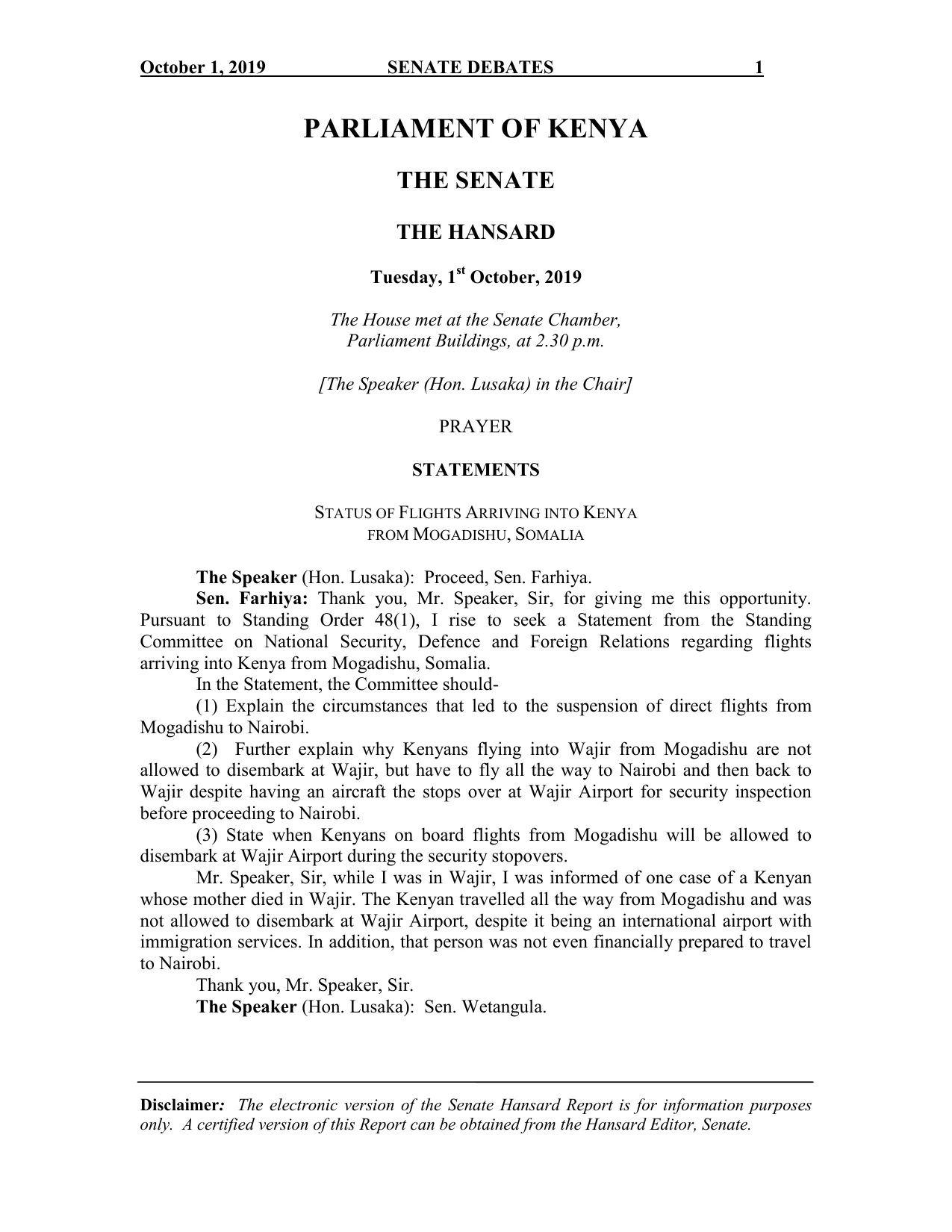
PARLIAMENT OF KENYA
Tuesday, 1st October, 2019
STATEMENTS
STATUS OF FLIGHTS ARRIVING INTO KENYA FROM MOGADISHU, SOMALIA
Proceed, Sen. Farhiya.
Thank you, Mr. Speaker, Sir, for giving me this opportunity. Pursuant to Standing Order 48 (1) , I rise to seek a Statement from the Standing Committee on National Security, Defence and Foreign Relations regarding flights arriving into Kenya from Mogadishu, Somalia.
In the Statement, the Committee should-
Sen. Wetangula.
Thank you, Mr. Speaker, Sir. I belong to the Committee that she is probably directing the question to, if it is a matter of security. However, if it is an issue to do with transport, it belongs to another Committee.
Mr. Speaker, Sir, as I support her Statement, I think she should have even gone further. The most important issue is that Somalia and Kenya are neighbours with very strong cultural and economic links; and friendly governments, notwithstanding what is going on in the Indian Ocean. The current Somali Government was born in Nairobi. When Siad Barre was overthrown, he fled to Nairobi. When our Somali brothers leave Mogadishu, their first point of call is Nairobi.
The Committee should engage the Ministry concerned, whether it is security or transport, and ask the sense of directing flights from Mogadishu to Wajir then to Nairobi. Are we saying that if such planes are carrying any hazardous material or are a danger to security, the security of the people of Wajir does not matter, and it is the security in Nairobi that is important?
More importantly, Mr. Speaker, Sir, the Government must engage the Government of Somalia. If we want to do thorough and proper security checks in bilateral arrangements, the Government of Kenya security agencies can collaborate and cooperate with the security agencies of Somalia. That way, they will participate in security checks in Mogadishu, before the planes take off, so that they land in Nairobi in real time for people to do their business.
Mr. Speaker, Sir, I am now told – and the Committee that will deal with this matter must also check – that in reciprocity, which is negative reciprocity, the Somali Government is now saying that any planes from Kenya to anywhere in Somalia must also first land in Mogadishu. So, you cannot fly directly to Hargeisa, Kismayu or Baidoa. You must also go through the same inconvenience of flying to Mogadishu for alleged security checks before you go wherever you want. This is not how neighbours should conduct their business. The two governments and the Committee – if it is our Committee - and the Vice-Chairperson – who is my distinguished nephew – who is here, must engage the Ministry to understand that security is not about preventing people from travelling. Security is about doing everything possible to make it easy for people to travel in a cost effective and real-time way.
Thank you, Mr. Speaker, Sir.
The next Statement is by Sen. Loitiptip.
ECONOMIC BENEFITS OF THE LAPPSET PROJECT TO RESIDENTS OF LAMU COUNTY
Thank you, Mr. Speaker, Sir. Pursuant to Standing Order 48 (1) , I rise to seek a Statement from the Standing Committee on Roads and Transportation regarding the economic benefits of the LAPPSET project to the residents of Lamu County.
In the Statement, the Committee should-
I see no interest. You can continue with your next Statement.
REMUNERATION OF POLICE RESERVISTS
Mr. Speaker, Sir, the second Statement is on national security. Pursuant to Standing Order 48 (1) , I rise to seek a Statement from the Standing Committee on National Security, Defence and Foreign Relations regarding the remuneration of National Police Reservists (NPR) in Lamu County.
In the Statement, the committee should-
Mr. Speaker, Sir, it is always a great pleasure to see Sen. Loitiptip in the house representing his people very well. Sen. Loitiptip is a Member of the Standing Committee on National Security, Defence and Foreign Affairs. The matter he has asked has been canvased before, but we will still get that specific response for Lamu County. We dealt with it when we invited the Cabinet Secretary (CS) and his team when we were dealing with the issue of the North Rift reservists and the withdrawal of the guns. However, it does not hurt to get a specific response on that matter.
Mr. Speaker, Sir, there needs to be a clear standard across the country when it comes to NPR, how they are deployed and who is given ammunition and guns. Additionally, there are other sentiments that also came to the Committee. For instance, we have heard from Sen. Wetangula, who is very experienced on these matters, being a former Foreign Affairs Minister.
We have just come back from the United Nations Security General Assembly (UNGA) , and we have seen the need for Government to let us know the true state of our diplomatic relations with our neighbor; a country whose hand we have held for a very
long time. Beyond the maritime dispute, we have seen nuanced campaigns against us at the United Nations (UN) Security Council, where we intend to sit. We want to understand the true state of those diplomatic relations, more than just the security and defence issues on the maritime and flights, but also the state of our relations with the Federal Republic of Somalia.
In due time, we will come back to the House with appropriate responses. Thank you, Mr. Speaker, Sir.
Mr. Speaker, Sir, the questioner is already running out of the chamber.
Although you have not said so, may I join you in receiving the distinguished young Senator from Lamu County back to the House. We have not seen him for many months. In fact, the last time I saw him was October last year, when we were together in Canada. Welcome back my son, and we hope you will be here to pursue what you have started.
Thank you, Mr. Speaker, Sir. My good friend, the Senator for Lamu, has brought a very serious issue to this House. I have noticed a certain trend in this House; unfortunately, the rest of the country takes us very seriously, save for us ourselves. It is either that we do not believe how powerful an institution we are, or we are sometimes too casual about how we treat many of these issues that are brought here.
The reason I say this is because last week, as the Committee on Energy, Roads and Transportation, we made an enquiry about the oil spills that happened in Makueni County by the Kenya Pipeline Company (KPC) . Today, in preparation for what the KPC will come to tell us, when appearing before our Committee on Thursday, I saw the entire management issuing a press conference trying to justify it. Of course, the rest of the country does not understand why they are giving that communication. However, I know – because I am a Member of the Committee – that the Senate Committee on Energy, Roads and Transportation has presented before them a list of demands of certain information that they need to present before this House.
This points to the fact that any issue that is brought by members of the public – by way of a Petition or a Statement by my colleagues – should never be treated casually. We should always endeavor to ensure that we follow any particular issue brought before us to its most logical conclusion.
On this issue that Sen. Loitiptip has brought before us, it will be important for us, as Sen. Wetangula has said, as the representatives of the people, to understand what the overall Government policy on police reservists is. Why is it that certain sections of this country deserve it while others do not? It is an important Statement because – and I have said this to the CS in charge Security when they came to this House before – if you go to Vihiga County, people know that the Government is Sen. Khaniri. They do not know that county commissioners or chiefs feel that they need to be the centers of disseminating information. Therefore, when things go wrong in Bungoma, people call their Senator or their Member of Parliament.
Therefore, if this House is not properly briefed on matters policy, and on something as cardinal and sacred as security, then there is nothing else we are doing, as an institution. Therefore, Sen. Sakaja, it is, my sincere hope that this particular issue will be dealt with together. This is because I know that earlier on, during the last session, the Senate Majority Leader or the Senator for West Pokot, Sen. Poghisio, brought the issue of the unanimous withdrawal of police reservists from that region, and the effects that that particular exercise ended up causing.
Therefore, Mr. Speaker, Sir, the standard practice is that perhaps this House can be given information in 14 days. However, if the Committee is able to bring back the response after seven days, it will serve us better, because security is a very important issue.
Thank you, Mr. Speaker, Sir.
Thank you, Sen. Cheruiyot. Hon. Senators, we have to rearrange the Order Paper. We shall come back to Order No. 8 when we have quorum.
Let us move to Order No.9.
THE ESTABLISHMENT OF CHILDREN’S HOMES BILL (SENATE BILLS NO. 12 OF 2019)
Thank you Mr. Speaker, Sir, for giving me the opportunity to contribute to this Bill, which has been sponsored by Sen. (Dr.) Zani, the daughter of Zachariah.
society in this county who would like to take care of an extra child, but are unable to do so.
Mr. Speaker, Sir, apart from providing the physical needs of a child – clothing, shelter, food and healthcare – the emotional needs of a child are equally extremely important. A child needs to be brought up where there is some parental care, whether it by their own parents or by foster parents. Children need to be brought up in an environment where they have siblings and establish real connections, instead of putting 1,000 or 2,000 children in an accommodation which should ideally have 100 or 200 children.
There has been hesitation by the Ministry of Labour, Social Security and Services towards enacting legislation to monitor the children’s homes that are in existence. The Committee advised the Ministry to stop the registration of new children’s homes until there is a framework for proper foster care and integration of children. There must be a framework to monitor the children’s homes that exist currently. Sen. (Dr.) Zani defended this Bill by saying that we cannot say that we are moving to a foster care system, yet there are currently children who are suffering in the unregulated children’s homes.
Mr. Speaker, Sir, this is a function that is almost concurrent. In the Fourth Schedule of the Constitution, there are some children’s homes that are under the national Government, while some are under the county governments. In Nairobi County, there is a boys’ children’s home in Bahati, which is under the county government; and girls’ children’s homes in Kayole and Kariokor. The county governments are trying, but we do not have a standardized operating procedure between the national and county governments.
Mr. Speaker, Sir, I was recently accompanied by a group of people who refer to themselves as ‘Team Sakaja’ to Bahati, where we went to share a meal with a children’s home. We took gifts, cooked for the children and had a very good time together. However, when we posted the photos of the visit on social media platforms, some people commented that they knew some of the children from different parts of the country, such as Eldoret. After that, I concluded that there is no such thing as street children. The children on the streets are our children. The children on the streets were not given birth to by the streets, but by our sisters and mothers. There is no parent who willingly wants their child out on the streets.
Mr. Speaker, Sir, some parts of this country have strong cultural values, such that even after the post-election violence of 2007/2008, no Internally Displaced Persons (IDP) camps were set up there. It is not because there were no persons who were displaced there, but because it is taboo to leave people to suffer out there. Consequently, the IDPs from some communities were integrated. Unfortunately such IDPs never became beneficiaries of compensation. For instance, there were IDPs from Kakamega, Bungoma and Vihiga, but they were taken up into families. The families that took in the IDPs do not necessarily have the resources, but they have strong family values. I do not mean that strong family values do not exist in other parts of the country, but it seems that it is stronger in some parts of our country.
After that, Mr. Speaker, Sir, it was really heartbreaking, because when we went back to those children – and I know many of them – some of them told me that they
actually came from Eldoret, but they were dumped here in Nairobi. They also said that they were afraid that if they went back there, they would not get food the way they are getting it here in Bahati, Nairobi. Therefore, what do you do, because this is just a child; and what they want is just a chance at life? We must be a country that is able to guarantee our children, at the very minimum, a fair shot at life. Those children in our children’s homes, will tomorrow become presidents, governors, doctors or lawyers. They can be anything that our own children in our private homes aspire to be and would want to be.
Mr. Speaker, Sir, the need for this regulation was highlighted recently. I remember that I was with Sen. Pareno, Sen. Mutula Kilonzo Jnr. and a few colleagues in Nakuru County, where we had gone to follow up on the Solai Dam issue. We found out that 51 children were rounded up by the county government and dumped in a forest neighboring Baringo County because they looked like they came from Baringo. This was done in the middle of the night, and they were dropped off using force so that they could not congregate. They were actually left to whatever the world in the forest had to offer them.
These children started calling each other, and they later regrouped. As we they were approaching one of the villages, they were about to be attacked, because the villagers thought that they were criminals. However, they were lucky because one of them could speak the local dialect of Kalenjin. He was able to explain that they were street children who were picked up in some vehicles, kept without food for the whole day and dumped there at night.
Mr. Speaker, Sir, I want to thank the former MP for Naivasha, Hon. Mututho, because these children found solace in his home. He has a Children’s Rehabilitation Center which was originally a centre for drug abuse victims. He gave them solace and found a home for them. However, Mr. Mututho’s Rehabilitation Centre is not getting a shilling of support from either the national Government or the county government, yet he is taking care of these 51 children.
To date, six of those children have still not been found, yet no one is talking about this matter or raising a storm about it. Somebody mentioned that the reason why this was done – I would like to get confirmation that it is not the reason – was because the town wants to get conferment of city status. That is shameful, if proven to be true. We want to look at it because we think Nakuru should get city status, but not through this method.
Mr. Speaker, Sir, the same thing happened in Uasin Gishu, where children who looked like Luhyas were sent to Bungoma, Trans Nzoia, up to Busia. When we start classifying children based on tribe, when you say they look like Sen. Wetangula or his nephew---
What is your point of order, Sen. Kabaka?
Mr. Speaker, Sir, what I know is that biologically, human beings are classified into three forms; Africans, Caucasians and Asians. Out of the three, how do the Luo and the Luhyas look like? When you mention Sen. Wetangula; is he synonymous to Luhyaism? The Speaker is also a Luhya.
You know it can be interpreted in many ways, but I do not want to get into it.
Mr. Speaker, Sir, that was on a light note. However, the general standards associated with Luhya people is that they are very handsome, strong, have a good appetite, are very loving and tall.
Thank you, Mr. Speaker, Sir. This is a Bill that Sen. (Dr.) Zani has brought to give meaning and effect to Article 53 of our Constitution, which is very clear in its wording. It states that:-
“Every child has the right––
America carrying pictures of malnourished and dying children. In fact, if you look at some of those pictures, they are clipped from the disaster that befell Ethiopia some time back; they are not Kenyan children. Those pictures are picked from all over. They pick a very malnourished child, put him or her next to a child who looks a little better and another one that looks good. They then say where they have picked the child and where they have taken it to.
Mr. Speaker, Sir, when you look at the people who purport to run children’s homes, they live like kings. They drive big cars and live in posh areas. I know one who runs a children’s home in a poor neighbourhood in Isinya, and he lives in Lavington. He does not do any other job, apart from running a children’s home. The children are his tools of trade. This is how inhuman we have become.
Mr. Speaker, Sir, if this Bill by Sen. (Dr.) Zani has to be given full effect, this House must, in our budgeting process, acknowledge that we have a serious problem of disadvantaged children in Kenyan families in each county that needs to be looked after, and provide resources for them. There is absolutely no reason why each county cannot do that.
I am not advocating for children from poor families to be put together in one institution; that is not the way to integrate children. In Bungoma County, I would want to see children from disadvantaged families mixing with children from schools like Marell Academy, Misikhu Boarding School, Lugulu Boarding, and others. This can be seen in the legacy left in Starehe Boys Centre by the late Dr. Griffins, who routinely picked children from the poorest of the poor and put them in Starehe Boys Centre. He allowed the children of Annuars, Cheruiyots, Mbitos and Beth Mugos to go to the same school; and obligated them to pay fees that would cover three or five other children from poor families in an endowment process.
Mr. Speaker, Sir, one of my sons went to Starehe Boys Centre, and I was paying fees for five other children whom I did not know of, from form one up to form four. That is what Dr. Griffins did, and he left Starehe Boys one of the top schools. Of course, the story of Starehe Boys is not the same today, because those who came in after him were more interested in titles and many other trappings. You would find Dr. Griffins, with all his knowledge, walking from Starehe Boys Centre to the City Centre; while these people cannot walk from Starehe Boys Centre to Kariokor because they are ‘big’ people. That is the pain that Africa goes through.
Mr. Speaker, Sir, I urge that when we pass this Bill, Sen. (Dr.) Zani obligates the national Government, in cooperation with the county governments, to provide a special vote in the budget for setting up a children’s homes in each and every county. They will not be for children from poor backgrounds, but for the children to integrate. Whether a child is from Mathare, Kibra, Muthaiga or Lavington, they must meet and integrate, as Kenyans. In fact, most children from those poor neighbourhoods are hard working in school than some of our children.
Mr. Speaker, Sir, I want Sen. (Dr.) Zani to strengthen the criminal responsibility of charlatans who turn children into instruments of trade. One bishop and his wife are in jail for routinely trafficking children from here to the United Kingdom (UK) every time they come to Kenya, including the extreme criminality of faking pregnancies and telling
people that they can be pregnant, have a gestation of three months and deliver a child against all the norms of science. Miracles stopped at the time of Jesus; there are no miracles anymore. Anybody who tells you of creating and performing miracles today is a fraudster. Nobody can walk on water like Jesus did.
On a point of order, Mr. Speaker, Sir.
What is your intervention Sen. Cheruiyot?
Mr. Speaker, Sir, I may need the help of Sen. (Rev.) Waqo, whom I thank God is in the room today, to confirm to my good friend, Sen. Wetangula, that he excels well in other things; but he should leave religion to her. To the best of my knowledge, miracles still exist.
Mr. Speaker, Sir, I will invite the distinguished Senator for Kericho to read a book called The Heart of the Matter by Graham Greene, where there is a bishop who tells a trader that when people are shaken and are in trouble, they do not come for me; they look for you. This is because a bishop is just a title; they are not free of human frailties, and you know that.
Mr. Speaker, Sir, Sen. Cheruiyot has never been, to the best of my knowledge, appointed on this Floor to represent Sen. (Rev.) Waqo. She can speak for herself. We know that people cheat in the name of religion.
On a point of order, Mr. Speaker, Sir.
What is your point of order?
Mr. Speaker, Sir, I am above 18 years and I can speak for myself. I want to confirm that miracles do happen. The fact that we cannot walk on water today does not mean that miracles do not happen. Jesus said that we will do greater things than what he did if we have faith. We cannot walk on water because we have no faith. If we had enough faith, we would have done everything that Jesus did.
Mr. Speaker, Sir, the more they try to dispute what I am saying, the more they prove it. She has said that we do not have enough faith and that is exactly what I meant. Jesus did miracles such as feeding 5,000 people with five loaves and two fish, walking on water, bringing Lazarus back to life and saving a son of the man who went to Jesus at night because his child was dead, but Jesus said the child will live. There are many other great things that Jesus did.
Last year, but one, there was a scandal of some fraudulent churchman who used to hire girls from Koinange Street and take them to his church until they bust him on television. He used to take them there and ask them to prostrate on the floor and appear to be dead by twisting their mouths as if they had had a stroke. He would then engage in some very hilarious prayers and command them to stand up. It was choreographed for them to stand up. Thereafter, he would claim that he had performed a miracle.
When he failed to pay them, they bust him on television. That is the church we have today. That is why the church I belong to today does not believe in miracles, but faith. Faith is what will take us to the next world.
Mr. Speaker, Sir, allow me go on with the Bill.
On a point of order, Mr. Speaker, Sir. Could the Senator for Bungoma County stop misleading Kenyans by saying that they are asked to pay fees? We all know that there is capitation.
I was the Assistant Minister for Higher Education, Science and Technology. Basic education is and used to be free during the period when my colleague here was the Minister. Basic education is free unless you take your child to a private school because you will have to pay school fees. Therefore, he should stop misleading Kenyans and say facts as they are.
Mr. Speaker, Sir, even her own colleagues on the Jubilee side look horrified with what she has said because it is not true. I invite my distinguished friend and colleague, Sen. Mugo, to read a book by Chinua Achebe called The Trouble With Nigeria. In that book, he says that if you cannot see what he is seeing, then you are either a fool, a crook, or you do not live in Nigeria. I know that Sen. Mugo is not a fool and a crook. Perhaps the only alternative is that she is stranger to Kenya.
If you go to the villages, even Grade One and Grade Two children pay fees. The philosophy of free education---
On a point of order, Mr. Speaker Sir. Can Sen. Wetangula produce proof of request for payment of fees for Grade One children to prove his point? Unless he lives in another Kenya, which I do not live in, Grade One pupils do not pay school fees unless they go to academies or private schools which is still okay. He should not mislead this House by saying that Grade One education is not free because that is not true. He should produce evidence.
Mr. Speaker, Sir, I do not want to engage in altercations on an issue that is not an issue. What is free education? When we were going to school, free education meant that when you joined Standard One, you were given a slate and a slate pencil. You were given an exercise book, ink in an inkpot, a pen and a uniform. Ideally you were given everything.
Education is not free because parents buy uniforms and books and pay for lunches. Basically they buy everything. Sen. Mugo should walk around and go to even Kibera or Mathare with Sen. Sakaja and she will see how people are suffering to take their children to school. She will realise that education is not free. In fact, the freedom of education promised by the Jubilee Party is extremely fallacious.
Mr. Speaker, Sir, even in first world countries where education is free, children do not get uniforms for free because parents pay for them. Therefore, we should stop exaggerating. Maybe there are a few things here and there parents are paying for, but the major issue is fees which they are being paid for. I would like to know which country in the world provides uniforms and kila kitu. That is not true.
Mr. Speaker, Sir, it is obvious even from where you are that my distinguished colleague does not believe what she is arguing because it happens. Activity fees, lunch fees, water, books and uniform fees are paid by parents. Academies are for rich people, but I am talking about the ordinary people who vote for us in the villages.
My dear sister, Sen. Mugo, take time from the ivory town, go to the villages and see these people. See how they suffer.
Mr. Speaker, Sir, I beg to support this---
On a point of order, Mr. Speaker, Sir.
What is your point of order, Sen. Mugo?
Mr. Speaker, Sir, I know the lowest of the lowest of this country. He cannot teach me.
On a point of order, Mr. Speaker, Sir.
Sen. Sakaja, what is your point of intervention?
Mr. Speaker, Sir, mine is a request. The point made by Sen. Wetangula is an important one that should not go unchallenged or that this House should not fail to look into. The policy is that education needs to be free from primary up until secondary level. It true that schools find some crafty ways of getting charges out of parents. In as much as the Jubilee Government’s intention is very clear on free primary education, there are certain unscrupulous school administrators who are levying some funds on parents, especially in the slum areas.
Mr. Speaker, Sir, would it be good to request that either Sen. Wetangula or the Committee on Education, if there is any Member here, come back to the House on that matter, in as much as it has not come up as a Statement, but is subject of the debate of the House today and it needs to be ventilated further? Would it not be prudent if we actually get to the bottom of that because it is not a matter where Sen. Wetangula wants to score? It is not for political banter, but because he actually cares, as we all do, for our children in the country. It would be useful to do so. If that is not possible, I will bring the statement.
Your time was up, Sen. Wetangula.
On a point of order, Mr. Speaker, Sir.
Sen. Kinyua, what is your point of intervention? I will give Sen. Wetangula one minute to conclude.
Thank you, Mr. Speaker, Sir. I am a Member of the Committee on Education and have heard what Sen. Sakaja has said. I have taken note of it and we will respond accordingly.
My request is to contribute to the Bill.
I have given Sen. Wetangula one minute, but do not open up the---
Mr. Speaker, Sir, I appreciate the concerns by the Senator for Nairobi, Senator for Laikipia and my distinguished colleague, Sen. Mugo. This is a matter that the Committee needs to look into. Pronouncement of policy and implementation of policy is not one and the same thing.
I do not fear to be contradicted because I know it is a fact that education in this country is neither free nor compulsory. That is why we find small boys looking after cattle in the villages, when chiefs who earn salaries are there to force them to go to school. Education is not free because there are children who stay home and the parents will tell you: “I cannot raise Kshs200 to take my child to Grade One or Two.” It is in the villages.
Sen. Cheruiyot, contribute to the Bill.
Thank you, Mr. Speaker, Sir. It is a very interesting afternoon. Before I make my contribution, I want to note that there is no way that the distinguished nephew could disagree with the distinguished uncle.
passage and attain 100 transition from children who are in the streets to these homes, we should not tire in trying to setup structures.
Mr. Speaker, Sir, the laws that we will continue to enact in this House, like someone observed last week, are software that governs how we run our country. We should never be discouraged with the fact that as many times we continue to pass laws, yet those in positions of power and authority do not implement them fully as they are supposed to. At least be proud. Remember the story of the hummingbird that we are so often reminded; that in so far as it is possible, just try to always do your best where you are able to do.
We may not sit in some of the Cabinet offices and make decisions, but we should not be discouraged. We may not be involved in budget making process and say this financial year, we will set aside X, Y or Z amount of money to set up children’s homes across the country, but we have provided the legislative framework in the form of a Bill before us.
We, as a House, should not tire trying to bring forward such legislations. This is because with the right leadership in place, we will have a better and more cohesive society as the one that we aspire.
Mr. Speaker, Sir, last year, I cannot remember exactly where it was, I said if you travel out of this country, you will find that in other similar societies, they do not just think about homes for children, but even for adults. I remember being taken around and being shown one such facility.
When I inquired if it is a children’s home, they said that it was just out of appreciation that sometimes in life people go through a rough patch. These are people who are employed and have their homes, but sometimes because of one reason or the other, they find that it is no longer conducive to stay in one’s home. They go to that place and they are provided with a warm bed, are able to shower, have a warm meal and move on with their life.
That is the kind of society that we aspire to have. If we can begin, at least, for our children, so be it. We should not be comfortable and just be assured that it is a normal site for us, as we drive down while leaving Parliament, we see a four or five year old boy lying idly on the streets. We should not be okay with that. It should not sink down with us and appreciate and say; “never mind these are street children”. We, as leaders, it should continue to bother us until the day that we establish a solution for these children.
The proposals that are in this particular Bill make a lot of sense. Clause 8 of the Bill that speaks about the supervision and monitoring of people that want to establish children’s homes is very important. This point cannot be gainsaid. Each one of us knows, at least one or two people that purport to be running children’s homes, but all they are doing is fending for themselves using the children as a shield or source of income. People set up children’s homes in certain parts of the country and use the proceeds and gains that they make from that. It is a business.
Mr. Speaker, Sir, this Bill is, therefore, right in proposing a mechanism through which each children’s home in the country shall be monitored and supervised. I like the word ‘supervision’ because it just does not end at registration or at being approved that there is an X, Y and Z children’s home in such and such a place. Supervision includes
even impromptu visits just to ensure that the children living there sleep in a clean environment, go to school and get meals as is expected of young people. If you cannot provide for them, then do not set up a children’s home.
This law provides for county governments to be able to set up children’s homes of their own. For example, Kericho County, the county I represent in this House, is able to set up a Kericho County Children’s Home. That way, we will not have racketeers who will round up children, put them in a particular place, pretending and masquerading as if they are looking after their needs, but all they are doing is attracting investments in the name of donations.
This element of supervision is extremely critical. This is one of the reasons why I hold this Bill as a brilliant piece of legislation. It is because it will ensure that only those children’s homes that meet the standards which are listed here are approved and monitored from time to time to ensure that these children lead a decent life.
Clause 4 is about licensing which is another important issue. I do not have the statistics, but maybe as the Committee tables its report, it should be able to tell us how many children’s homes are owned by locals or Kenyans. We understand the way the world is. I cannot think of any particular part of the globe where you cannot find destitute children to take care of. Growing up as an African child, you imagine that the rest of the world is so advanced and civilized that they do not need these kind of services. As you grow up and as the world continues to become a one simple global village, you appreciate that these challenges that are in Kenya are virtually even in the first world countries.
Mr. Speaker, Sir, for people to come and set up children’s homes here, they need to give justification. For one to leave their home country in the United States of America (USA) and come and set up a children’s home in Kenya, they must provide good reason and justification. That way, we will not end up with the case as was with that gentleman whose name I cannot recall, but as I speak, he is serving his term in jail because he used to pretend to run a children’s home in Bomet County. It was a place to organise how to traffic children. They would move these children from Kenya all the way to the Democratic Republic of Congo and different parts of the globe.
I want to charge Sen. (Dr.) Zani and the Committee that will consider the amendments to make the regulations for licensing to be a bit more stringent than is being proposed here. It should not be as easy as getting a permit or license to operate a business. We are talking about the lives of young people. Therefore, it will be important that before one is granted a license to start a children home, that all kinds of checks are done on him. We need to establish whether that individual is of sound mind and of good moral standing.
The world continues to face very difficult and different forms of challenges. Sometimes even the well-meaning or well-looking people end up being the most hurting and end up doing not very nice things to these children. The element of licensing is important. It will be good to propose that the people that sit in the licensing approving board in the various counties, be men and women of integrity. Let them be people who will not be easily bribed with Kshs5,000 or Kshs10,000 as is the case with our county. I do not want to be obsessed with figures. If there is a lesson that we have learnt as a nation is that no amount is too high for many of these people who want to do some of these
things. Human life is priceless. You cannot put an amount and say Kshs100,000 or Kshs1 million will be an enough deterrence for people who want to engage in these mischievous activities. Therefore, licensing is critical to me.
Mr. Speaker, Sir, finally, it is unfortunate I came in contact with the Bill just a few minutes ago and have not finished reading it. However, it will be interesting to know the deterrent measures that have been put in place for people who violate some of the clauses in this Bill. I hope you have put stringent measures to ensure that the conditions for taking away a license, for example, should be an on and off issue, just the way you switch electricity on and off in the house.
If I walk in as an inspector of a county department of children’s homes and find children are not being taken care of; not being given food, accessing education or a place to sleep, I should be able to write there and then that I have revoked the license for X, Y and Z children’s home forthwith because of the following reasons. It should not be a complex process where there are issues of litigation. People going to court and saying that they had a license and it cannot be easily cancelled.
It should be made simple. This Committee should be able to walk to a children’s home and inspect. If they find that they are not in compliance with the regulations that have been set forth, let the license be cancelled. If there are people who were found to be well-meaning at the point of registration, but as time goes by, they end up doing certain things that are not in tandem with what is expected of a person who is taking care of children, send them straight to jail.
It is unfortunate how our judicial system works. This gentleman that was running a fake children’s home in Bomet County was never jailed for all the 29 years that he lived in this country. It is only at the time that he returned home to USA that people did a proper check on him. It was established that he had been molesting children who were living in his children’s home. As I speak, he is in jail. Let it be properly spelt out in this legislation, what will be done to these kind of people.
With those many remarks, I beg to support.
Sen. Shiyonga, proceed.
Thank you, Mr. Speaker, Sir, for giving me this opportunity to support the Bill on establishment of children’s homes by Sen. (Dr.) Mzungumzishi.
Order! What did you say?
On a point of order, Mr. Speaker, Sir.
What is your point of order, Sen. Farhiya?
Mr. Speaker, Sir, I would like to know whether the use of the word ‘Mzungumzishi’ was allowed or it is still banned in this House. There was a very clear Statement by the Speaker regarding that word.
That is why I wanted to know from Sen. Shiyonga what she said.
Mr. Speaker, Sir, I just quoted. The same way they normally say “super Senator.” So, I was just relating to Senator Mzungumzishi, but I withdraw.
If you look at the other section that promotes and protects the status and well- being of these children, the safety and security of these children is important. Just as my colleagues have said, most of the children have been molested. We need these homes to be totally secure and be homes where a child can be well brought up. This Bill will ensure that the children who are raised in these homes do not regret the life that they lived there.
Mr. Speaker, Sir, I support the Bill and I urge that when it is assented to, be implemented fully. It should not just be a Bill on paper, but a Bill in practice.
Thank you, Mr. Speaker, Sir.
I now call the Mover to reply.
What is it, Sen. Malalah?
Thank you, Mr. Speaker, Sir. Just before the Mover comes to reply, allow me to make my comments as pertains to this Bill. First of all, I want to congratulate Sen. (Dr.) Zani for this noble cause.
Our children are part of our society that has been neglected for a very long time. As a leadership, it is very important for us to look into the welfare of our children. The gist of this Bill is that we need to have a legal basis to establish children’s homes in our counties.
We have had so many children’s homes coming up and they are anchored either in churches or in a foreigner’s establishment. It is now important for us, as the Senate, to come up with a legal framework of establishing these children’s homes.
Mr. Speaker, Sir, what makes me feel secure with this Bill is Part II on the Care and Protection of Neglected Children. Clause 6 is very specific on the issue of the rights of a child. Our Constitution is very vivid as regards to the rights our children in Kenya which are not limited to education, nutrition just to mention, but a few. Many children not able to access education just because they are orphaned. It is a high time county governments provided some funds that will cushion these children to ensure that they go to decent schools not just any school.
Mr. Speaker, Sir, we have had problems in our county establishments regarding the way we provide healthcare to the vulnerable in the society. In Kakamega County, I am glad to state here that the County Assembly of Kakamega considered budgeting for issuance of NHIF cards to the less fortunate people in the society. This gesture should be extended to the children who live in these children’s home.
I will support this Bill because it a very important to these children. Kenya is not short of legislation. We have done so many good legislations in this Assembly, but our challenge has been the implementation bit.
I urge the implementers of the laws that we pass in this House to be very keen and passionate about our country because we have had so many brilliant ideas being legislated in this House and in the National Assembly. However, when it comes to the implementation bit, we do not see any success stories. As we debate this Bill by Sen. (Dr.) Zani, let us push for its implementation.
As the Senator for Kakamega County, I would like to take a version of this Bill to the county assembly. We shall customize it to ensure that it suits the needs of the people to ensure the children are secured and the establishment of the children’s homes in Kakamega County are done in a unique way. Next year or next year, but one, when this Bill will be operational, leaders such as Sen. Sakaja should go to Kakamega County to benchmark on the success of the implementation of it.
Mr. Speaker, Sir, this reminds me of the bottleneck of the implementation of various decision and resolutions of this House. The previous Senate had the Committee on Implementation. It is high time we had that committee because most of our resolutions here end up being archived in the Office of the Clerk. Nothing comes out of the resolutions that we make in this House. We shall, therefore, look at ways of restructuring the formation of committees in this House so that we introduce the Committee on Implementation.
I congratulate Sen. (Dr.) Zani for this noble cause. I assure her that we shall walk with her in this journey and ensure that this Bill is implemented to the letter.
May God bless the people of Kenya and specifically the people of Kakamega County.
I now call upon Sen. (Dr.) Zani to reply.
Mr. Speaker, Sir, I beg to reply. I will start by thanking all Senators who have contributed to this Bill, beginning with Sen. (Rev.) Waqo who seconded it, Sen. Mutula Kilonzo Jnr., and Sen. Sakaja, also known as the “Super Senator” whose Committee this Bill resides in.
I am sure that during public participation, there were proposals that we should visit some of the homes as we continue to work on the Bill in order get the real issues on the ground and interact and see what is happening because that helps. When we were in Kitui, we went to some of the homes. If you see the suffering, you become passionate about trying to make a difference to our children.
The views of Sen. Wetangula who is the uncle of Sen. Sakaja, Sen. Cheruiyot, Sen. Shiyonga and Sen. Malalah were spot on because they spoke about key issues of this Bill. There must be standards of the homes and specific input and development that counties can make because we have homes at the national level, but very little effort is being done at the county level, especially in terms of standardising the procedures for setting up the homes.
A lot of delegated legislation will be given to the county assemblies so that they customise their provisions depending on circumstances and situations to make the homes run as best as they can. Various concerns also came up when this Bill was being debated. For example, there is need to ensure that the penalty is harsh enough. In the Bill, a custodial penalty of Kshs1 million and/or two years imprisonment has been proposed. That is something to be considered in the Bill.
What came out clearly is the need for both levels of government and the children’s homes to take full responsibility. Earlier on, a Motion on street children, touching on the same specific issues was brought to this House. We know that a country is as good as its children. It is foolhardy to do a lot of work in ECDEs and leave out a large portion of children who can make a difference.
The other day Sen. Omanga brought a Motion on young people with neurological and mental disorders. It belongs to this category. Unfortunately, most of those children are taken to children’s homes because sometimes when countries go through difficult socio-economic situations, the children become the first casualties of such circumstances. The first call of action is for us to enable families to take care of their children.
On a point of information, Mr. Speaker, Sir.
Sen. (Dr.) Zani, would you like to be informed?
Yes, Mr. Speaker, Sir.
Mr. Speaker, Sir, I am sure Sen. (Dr.) Zani would not mind to be informed. She has just mentioned the possibility of visiting some of the homes. Before we get to the Committee Stage of this Bill, we would like to invite her as well as other Senators who have expressed interest in this legislation to see some of the children’s homes that are working in Nairobi City County and those which are not.
New Life Home Trust in Dagoretti North Constituency is one of those which are working well. We can also visit Mama Ngina Children’s Home which has had an issue and then Soweto and Mathare slums to see the contrast. We would have gone to Kibera because I know a few homes there, but we understand that currently there are certain activities there that Senators would not like to be part of.
That is what I wanted her to know so that before we have the Committee Stage, those who have contributed can have amendments they would want to bring on to this Bill by looking at the dire situation of some of the children’s homes in the country, especially in Nairobi City County. I hope Sen. (Dr.) Zani will be gracious enough to accept that invitation.
I will be more than happy. In fact, I had already accepted the invitation before it was made since it is important to see exactly what is happening because it brings it altogether.
Another important point that has been made is the need to create a special vote in the budget to ensure that money is given to the various homes in the counties because the issue of financing keeps coming up. It came up in Kitui when we visited some of the homes. There is some contradiction on who should be in charge of the vote. Should it be at the national or county level? That is a substantive issue that the Senate Committee on Education has taken up.
Sometimes it is just legislation or policy lapse in terms of implementation, but it is the children who suffer because their rights are taken away. They suffer because they do not even have enough to eat. Sen. Wetangula said that they are given pieces of meat the size of his thumb nail whereas somebody else could be having a half a kilogramme of meat. There is also the question of them being taken to hospital when there is need and being exposed to role models and their aspirations and dreams. That is what life is made of so that they feel they can get to important places.
Another important issue that has been raised is ensuring that we have county legislation. The concerns of some Senators who spoke have been addressed to some extent. Others pointed out that various clauses need to be streamlined further, but the Bill has thoroughly looked at the whole issue of how the homes will be established.
Another important point is the issue of vetting of owners of those homes even before the licensing is done, so that we do not have people that can harm the children. There is also the need to provide for cancellation of licenses where there is need to.
Inspection and the welfare of the children in the homes in terms of their education and socio-cultural outcomes should also be taken care of. There is the issue of delivery of childcare, who should be in charge and how a child should be admitted into a home. All these very detailed processes have been put into this Bill just to make sure there are no gaps because somebody could say that a particular provision is not there.
Issues of monitoring and surveillance and risk management within the homes have all been taken into consideration. The Bill has also taken care of the safety of the children, the location and the environment and everything that needs to go into it. In the first instance, the best place for a child to grow is within the environment of their family, but that might not happen to all the children. For those who end up in homes, we should be sure that they are safe.
[The Deputy Speaker (Sen. (Prof.) Kindiki) in the Chair]
It is so ordered. Thank you.
Order, Senators! We will apply Standing Order No.40 and defer Orders No.10 and 11.
THE STREET VENDORS (PROTECTION OF LIVELIHOOD) BILL (SENATE BILLS NO. 10 OF 2019)
THE STATUTE LAW (MISCELLANEOUS AMENDMENTS) (NO. 2) BILL (NATIONAL ASSEMBLY BILLS NO. 13 OF 2018)
LEGAL AND POLICY INTERVENTIONS FOR CAREGIVERS OF PERSONS WITH PERMANENT MOTOR AND NEUROLOGICAL DISORDERS
they take care of, and are exposed to stresses and pressure that have an adverse impact on their mental and physical wellbeing; CONCERNED that, while a lot of progress has been made in taking care of other vulnerable and disadvantaged members of the society, equivalent efforts have not been made to recognize the important role that caregivers play, to create, through policy and legislation, a conducive environment for the provision of adequate, safe and informed care to persons with these disorders; NOW THEREFORE, the Senate resolves that the Ministry of Labour, Social Security and Services, together with the County Governments, formulate a policy framework for the recognition, training, empowerment and protection for caregivers of persons with permanent motor and neurological disorders, including: -
Sen. Pareno, the last time this matter was being debated you were on the Floor. Unless you had finished, you have a balance of 13 minutes.
Thank you Mr. Deputy Speaker, Sir. I had just started and still have a little to say about this Motion.
Is network on what you had intended to say that time still there?
Yes, Mr. Deputy Speaker, Sir. This is a very interesting Motion. I strongly support that we have a legal framework and policy intervention for caregivers for persons with permanent motor and neurological disorders.
I proposed to the Mover, Sen. Omanga, that we do not just think of a legal framework and policy for the caregivers. I propose to her that it should encompass both the person with the disorder and the caregiver, so that we do not jump to give the
caregivers a framework on how to take care of these people, without looking into the needs and the rights of those that have disorders.
Mr. Deputy Speaker, Sir, I do not know at what point that whoever did the law that takes care of the rights of PWDs ended up leaving out this particular group that should have been included. I am proposing that we need an amendment to the Act, so that when we refer to PWDs, then these people with neurological disorders are also included. That will open up a lot of opportunities for them. The reason we have this Motion today is because at some point, there was an oversight and they were not included as part of PWDs, yet it is clear that they are disabled in terms of their perception, senses, speech, hearing and better described as psychological and nerve issues that they suffer from. Therefore, I propose that we amend the Act to include these people as part of PWDs.
Mr. Deputy Speaker, Sir, this Motion goes a long way to ensure that those that are entrusted with these children are given some training. There is so much that involves the caregiving and the comfort of these people. A policy will go a long way to ensure that they get proper handling and training on how to handle them when they are sick. A framework will also ensure that once services are given, the caregivers will be less stressed. You can imagine the parents who take care of the people with these disorders. They are so stressed up to the extent that they also need some sort of care, support, training and comfort, for them to undertake their duties.
An honourable Senator told me that they have a relative who said that they would not work or get another baby because they could not afford getting another one with the same disorder. This is because taking care of a child with these disorders is a full-time job. Even taking care of an adult with the same condition is a full-time job. They need to be assisted, so that they get less stressed. They will also get psychological support with this kind of framework.
The Inua Jamii Government funds are directed to help PWDs. As the phrase says, these funds are meant to uplift the standards of the people. We cannot uplift the standards of our people if in the first place we are leaving out a whole lot of people with neurological disorders. These funds should also be directed towards improving their lives. If an amendment to the Act or any law to include them to benefit from these funds is needed, then that is the direction that should be taken. We should be working on an amendment to ensure that they are included in these funds that are directed to the needy groups.
This also goes to tax relief on some of items. Suppose they required some specialized treatment, bed and wheelchairs; this Motion proposes that we get tax reliefs for provision of these services in support of these needy persons. The quarters given in terms of tenders, services to the youth, women and PWDS should be extended to this particular lot that seems to have been left behind.
After we have a policy and legal framework that helps them to develop these people and the environment under which they live and are being taken care of, the families will stop hiding them. We know of cases where some Non-Governmental Organizations (NGOs) have gone to the extent of getting these children from hide-outs because families are embarrassed about them. They are not able to support them or even
bring them out because of the kind of stigma that is attached to some of these issues. With this policy, things will get better.
Once they are trained that these are human beings who can improve and even be taken for specialized treatment, the families will stop hiding them. They will bring them out to get necessary support.
Mr. Deputy Speaker, Sir, I wonder whether persons with neurological disorders were counted in the just concluded census. Such persons need to be counted so that we know how to provide for them. I remember Sen. (Dr.) Musuruve pointing out before the census that she hoped the number of persons with disabilities would be established. Did we factor in the counting of persons with disabilities in the census so that we know how to deal with the persons with neurological disorders? I urge Sen. Omanga to find out whether the counting of persons with neurological disorders was factored in the census.
I beg to support.
Thank you, Sen. Pareno. Kindly, proceed, Sen. Sakaja.
Mr. Deputy Speaker, Sir, this is an important Motion. I am glad that we are discussing this Motion after we have just discussed the Bill by Sen. (Dr.) Zani on the establishment of children’s homes. The fact that some of these issues require legislation shows that there is something wrong with us at the basic level. It does not need legislation for us to know that we must take care of the most vulnerable in the society. It does not have to take the action of a House of Parliament to tell the Government that children need care yet they are not receiving it. I suspect that our priorities have been wrong or we forget that humanity is required for the existence of any country.
I am glad to report that efforts are being made in Likoni to retrieve a car that submerged in the ocean over the weekend as a result of an accident at the Likoni Ferry leading to the loss of two lives; a mother and her child. Chilling and harrowing video clips of how a vehicle rolled off the ferry and submerged in the ocean have been making rounds. It is unfortunate that more than 24 hours later, there had been no rescue efforts. A few meters from where the accident took place, the military divers are practising on how they will do a showcase during the next national celebration. There is something fundamentally wrong with us on how we treat fellow Kenyans. I am sure that if a tourist van sank into the ocean, there would be swift response. If a van full of parliamentarians sank in the ocean, there, definitely, would have been swifter response.
Mr. Deputy Speaker, Sir, as we debate this Motion, we should ultimately look at our values as a people and what we do for the least in our society. We cannot do big things if we are unable to do big things such as matters of the heart and common sense. You cannot legislate on common sense. We cannot create a law to help us empathize or give us a heart. I would like to pass my condolence to the family that lost their loved ones in the Likoni Ferry incident. We hope that the bodies of the departed will be retrieved so that they can receive a good send off. I do not want to digress from the focus of this Motion on policy interventions.
This Motion is important because Cerebral Palsy, Down Syndrome, Autism and other permanent motor and neurological disorders are birth defects. We all know a child
somewhere or a family that is raising a child who suffers from one of these conditions. I have a nephew who is very close to me who is autistic. I also know many other children who suffer from such neurological disorders in this city.
Around seven years ago, when the President of this country was still serving as a Deputy Prime-Minister, we went to visit a children’s home in Nairobi that takes care of children with permanent neurological disorders. Incidentally, the institution that we visited is run by Sen. Mpaayei’s sister. She gave us very inspiring and harrowing stories.
Mr. Deputy Speaker, Sir, Sen. Mpaayei’s sister informed us that every day, there are very many young children in Nairobi County as well as very many other counties, who because of the level of poverty of their parents, are locked in their houses in slum areas because their mothers have to go and look for money. Such women will probably go to sit around Yaya Centre or in the estates and wait for people to pick them to do cleaning at a fee of Kshs150 or Kshs200. Some mothers to children with permanent neurological disorders also work as house helps.
Some of children with permanent neurological disorders are locked or chained in the houses without food because if their mothers stay with them in the house, there will be no food. Such mothers cannot carry their children to work and there are no institutions such as day cares that can take in such children. We were really saddened by such stories. I am happy that we were ultimately able to acquire a big bus which today goes around the slum areas to pick children with permanent neurological disorders and take them for therapy sessions.
Mr. Deputy Speaker, Sir, some of the inspiring stories are that many of the children with permanent neurological disorders had improved because they can learn specialized skills. Many of the children have improved very well on certain aspects. Some of the children, who were unable to walk because of the neurological defects, are walking now and learning at their own pace with different attention to detail than normal children.
We do not have enough Early Childhood Development Education (ECDE) centres that provide education for children with neurological defects such as Autism. I am glad that some of my colleagues in the National Assembly establish blocks in the ECDE centres to cater for children with neurological defects. The former Women Representative of Nairobi City County, hon. Rachel Shebesh, established some special needs blocks in some schools and got qualified teachers to teach children with neurological defects. However, more must be done.
Mr. Deputy Speaker, Sir, I know families that are considering relocating from Kenya because their children are not getting specialised healthcare that they require to learn when they have neurological defects. I know you are tech savvy, I therefore urge you to Google on the special talents of autistic children. You will be surprised at the number of autistic children who perform so well on international talent shows such as America's Got Talent. The autistic children play wonderful music that none of us can.
There is a spectrum referred to as empathising–systemising theory of Autism. Dr. Simon Baron-Cohen wrote a paper that led to a lot of research on the field of cognitive and neural basis of systemising. His theory proposes that the human mind possesses a systemising mechanism which helps to identify lawful regularities that govern input-
output operations of the brain. Evidence suggests that persons with Autisms have on average high persistence, scoring higher than average on the systemising quotient and on performance test of systemising. That means that persons with Autism have narrow interests but very specialized such that they focus on a single aspect more than any other aspect of their lives and much better at what they do at a very high level than the normal or average human being. The empathising–systemising theory is a potential explanation of the link between Autism and talent.
A subsidy of these individuals shows what we call servantism abilities, restricted to specific domains that are both superior to the individual’s other abilities and superior to majority of the population.
Mr. Deputy Speaker, Sir, many of these children who are being locked up in our slums and in the houses like livestock, can actually build on certain special talent if put in the right environment.
There is no greater prerogative for us, as a country, than to make sure that every child has the same and equal shot at life; a fair chance at life. Once we do that, we would not even need the Building Bridges Initiative, Punguza Mzigo or coalitions, because once every Kenyan knows that they have equal opportunities; that a child in Tharaka-Nithi has the same chance in life as a child in Nairobi and the same shot at the future as a child in Kisumu or Kakamega, we will stop fighting because every Kenyan wants the same thing; to go about their life peacefully, to make something out of themselves and to guarantee their child a future. The rest we look for is extra.
Once we are able to change our thinking, even in the incident I have given you earlier where we change our thinking and make sure that every Kenyan gets that shot at life, these children will be able to do well.
Mr. Deputy Speaker, Sir, in Nairobi City County, I have thousands of community health volunteers who do not receive a shilling. These are the people who, at the lowest level in the wards and estates, know that house number 10 of the Malalah’s, normally have this health problem; homa or cold. They can tell you this epidemic is coming but they are not engaged. I am glad that this Motion proposes the proper engagement. The County Government must budget. We have just given Nairobi City County Kshs15.9 billion under the County Allocation Revenue Act (CARA). There must be a provision for a stipend for these community health volunteers.
Many of the issues that we have; today, we are spending so much money because of fears of a cholera outbreak. If the community health volunteers in Nairobi City County were properly engaged, we would have a very healthy city. Once you have a healthy county, some of the other costs we are spending in our hospitals on drugs, Kenya Medical Supplies Authority (KEMSA), nurses and doctors, would actually go down and we will put less pressure on the referral system because that is one of the problems we have.
Today, somebody breaks a hand or gets a small injury and he or she wants to go to Kenyatta National Hospital, yet it is supposed to be a referral hospital. You only go there when you are referred from another hospital. If we start from the basic primary healthcare unit, I am glad this proposes that, indeed, community health volunteers be engaged properly and appropriately so that they can give care at the primary level, not
just to children with these conditions of cerebral palsy, down-syndrome, autism, neurological disorders et cetera, but also the well-being of our society at the lowest level.
Mr. Deputy Speaker, Sir, tax reliefs and exemptions are also welcome because you find that persons living with disability, like Sen. Mwaura who represents persons with albinism and Sen. (Dr.) Msuruve who has a physical disability are able to get tax relief. They get tax exemptions. They do not pay PAYE and Income Tax. They get VAT exemptions as well, exemptions on everything, yet parents who have children with autism, who are more expensive to educate; it is difficult. I have a school in Marurui, Roysambu and a few others around Nairobi that are doing that, and they are helping. Why can those parents also not get tax relief or rebates as they educate these children who have such huge potential?
Why do we not give them the equipment required? You find that these children concentrate on one thing for very long. They need colorful toys, but taxes are being levied on those toys that they require in those schools? It does not make sense at all.
Mr. Deputy Speaker, Sir, as I conclude, there is need for us to provide allocation properly for that specialized training at Kenya Medical Training College (KMTC) and our medical schools. As we train our nurses, doctors and caregivers, it is specialized training because it is a huge number of children and adults who are affected by these neurological disorders.
I thank the Senator who has brought this Motion. I hope that we can translate it into actually amendments to the law. At the end of the day, as I said earlier, it is our values, it is what to prioritize, it is our heart and that is what we need to start looking into.
Thank you.
Order Members. I cannot see the Mover but we will proceed to put the question. This is a noise vote and, therefore, it is not a matter concerning counties.
Order, Members. Due to lack of threshold, we will not consider Order No.8 which had been previously deferred. I now direct that Order No.8 be deferred to another day.
APPROVAL OF THE COUNTY GOVERNMENTS CASH DISBURSEMENT SCHEDULE FOR FY 2019/2020
ENGAGEMENT OF COMMUNITY HEALTH WORKERS BY COUNTY GOVERNMENTS
Sen. Nyamunga is no show. The Motion will be deferred subject to Sen. Nyamunga taking notice that it is not the way to do things. She should have informed us in advance.
On a point of order, Mr. Deputy Speaker, Sir.
What is it, Sen. Malalah?
Thank you, Mr. Deputy Speaker, Sir. Sen. Nyamunga is out of the country. She would have loved to move this Motion. However, this is a matter of national importance. I wish you can peruse through the Standing Orders and find a suitable Standing Order to allow this Motion to be moved by a Member of our coalition, so that
this matter can be moved and deliberated on so that when she comes back, she picks it up from where we shall have left.
There is nothing to peruse. She should have written to say that she would like Senator so-and-so to move on her behalf---
Order, Sen. Malalah. You seem to be advancing your agenda using shortcuts.
On a point of order, Mr. Deputy Speaker, Sir.
What is it, Sen. Sakaja?
Mr. Deputy Speaker, Sir, it is true that Sen. Nyamunga is on official duty in New York. I was with her for the United Nations General Assembly (UNGA) .
Now that the Senator is out on official duty, would it not be prudent that you direct that because this is a function of the House, if a Senator is on official business, the business should not be put on the Order Paper? This is because it confuses those that are prepared to submit on this. It makes it look like the Senator is tardy or has chosen to be absent in the House yet it is the same House that has sent her on official duty. Administratively, is it in order if that could be done?
Yes, it is in order. Sen. Nyamunga is away on official duty. She was expected back today. May be, there could have been some inconveniences.
Sen. Mwaura, Standing Order No. 59 (2) states:- “Save for a Special Motion, which this is not, a Senator who has a Motion in his or her name may authorize, in writing, another Senator to-
FORMATION OF COMMUNITY FOREST ASSOCIATIONS
I do not see Sen. Kasanga. So, the same message should go out to her. That matter will be deferred until tomorrow.
ADJOURNMENT
Hon. Senators, there being no other business, and the time being 4.45 p.m, the Senate, therefore, stands adjourned until tomorrow Wednesday, 2nd October, 2019, at 2.30 p.m.
The Senate rose at 4.45 p.m.