Hansard Summary
Senators debated the proposal to raise Kenya's borrowing ceiling, expressing deep concern over debt sustainability, high interest rates and the impact on future generations. They called for greater agricultural investment, private‑sector participation and stricter oversight of Treasury spending. Procedural exchanges and occasional humor punctuated the discussion but the overall tone remained critical of current fiscal policies. Senators repeatedly questioned the lack of evidence for debt restructuring and challenged the proposal to raise Kenya's debt ceiling from Ksh 6 trillion to Ksh 9 trillion, calling the Treasury's justification insufficient. The debate also touched on procedural concerns over amendments and the Senate’s role in delimiting electoral boundaries, with speakers expressing frustration and criticism toward the government's handling of the matters. Senators debated Kenya’s mounting debt, linking it to corruption and calling for savings of Kshs1 trillion a year, while proposing clean‑energy exploitation and infrastructure projects to spur growth. They criticised the budget deficit and the lack of transparent figures, urging careful consideration of delegated legislation to prevent project delays and to restructure the economy.Sentimental Analysis
NegativeTHE PARLIAMENT OF KENYA
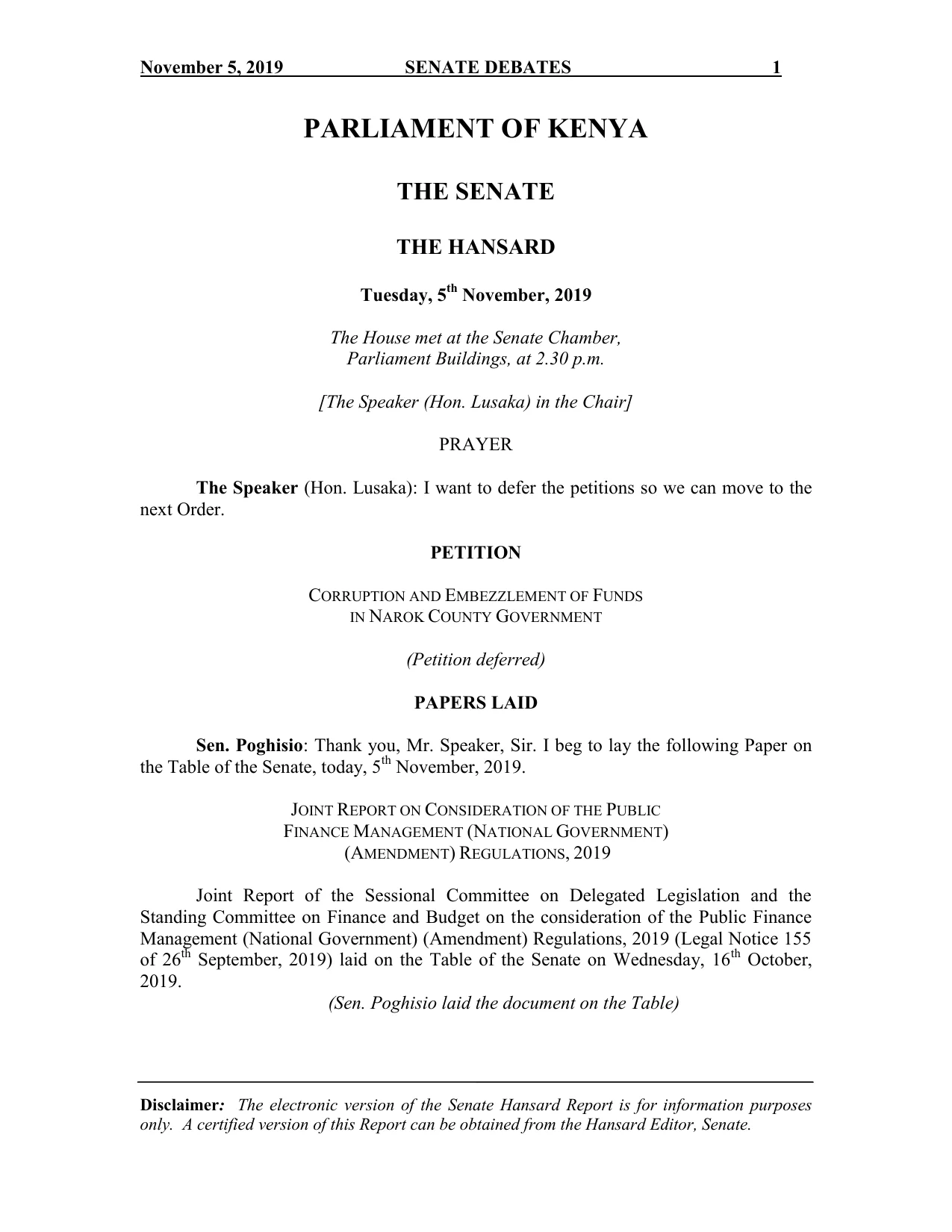
THE SENATE
THE HANSARD
PARLIAMENT OF KENYA
Tuesday, 5th November, 2019
I want to defer the petitions so we can move to the next Order.
CORRUPTION AND EMBEZZLEMENT OF FUNDS IN NAROK COUNTY GOVERNMENT
PAPERS LAID
Thank you, Mr. Speaker, Sir. I beg to lay the following Paper on the Table of the Senate, today, 5th November, 2019.
JOINT REPORT ON CONSIDERATION OF THE PUBLIC FINANCE MANAGEMENT (NATIONAL GOVERNMENT) (AMENDMENT) REGULATIONS, 2019
Next Order. Majority Leader, proceed.
Mr. Speaker Sir, I beg to lay the following Papers on the Table of the Senate, today, 5th November, 2019.
THE 2019 BUDGET REVIEW AND OUTLOOK PAPER FOR THE FY2020/2021 AND MEDIUM-TERM BUDGET
REPORTS ON THE FINANCIAL STATEMENTS OF VARIOUS COUNTY FUNDS/AGENCIES
Let us move on to the Next Order. Sen. (Dr.) Langat, proceed.
REPORT ON THE VISIT TO EAC ORGANS AND INSTITUTIONS
Thank you, Mr. Speaker Sir. I beg to lay the following papers on the Table of the Senate, today, 5thNovember, 2019.
Report of the Standing Committee on National Cohesion, Equal Opportunity and Regional Integration on the visit to the East African Community Organs and institutions from 18th to 30th August, 2019.
NOTICE OF MOTION
APPROVAL OF REVISED DEBT CEILING FOR THE NATIONAL GOVERNMENT
Mr. Speaker, Sir, I beg to give notice of the following Motion -
THAT, this House adopts the Joint Report of the Sessional Committee on Delegated Legislation and the Standing Committee on Finance and Budget on the consideration of the Public Finance Management (National Government) (Amendment) Regulations, 2019, laid on the Table of the Senate on Wednesday, 16th October, 2019, and pursuant to the provisions of Article 211(1)(a) of the Constitution of Kenya, Section 205(4) of the Public Finance Management Act and Section 18 of the Statutory Instruments Act, approves the amendments to the Public Finance Management (National Government) Regulations, 2015 (Principal Regulations) as effected through Legal Notice No.155 of 26th September, 2019.
STATEMENTS
RE-INTRODUCTION OF SPEED GOVERNORS FOR PSVS
Thank you, Mr. Speaker, Sir. I rise pursuant to Standing Order No.48 (1) , to seek a Statement from the Standing Committee on Roads and Transportation on the issue of re-introduction of new speed governors for public transport vehicles.
In the Statement, the Committee should-
Mr. Speaker, Sir, I wish to join the Senator for Nandi in the Statement that he has sought.
Two days ago, I saw an elderly woman from Nyeri on TV shedding tears because of the issue of speed governors. She said that every 18 or 24 months, they are forced to buy new speed governors at a cost of Kshs40,000. This is just about the profit they make from the matatus they run. She was asking and I quote her: “What is the lifespan of a speed governor once installed in your car? Does NTSA have a responsibility for routine
check to see if the speed governors are working? More importantly, why is the provision of speed governors a controlled business by certain cartels in the country?”
Mr. Speaker, this Statement is very important. If we want to create wealth and employment, we cannot allow cartels to milk dry the very informal sector that we are trying to help to boost the economy in the country. I would want to see that the Chairman of the Committee on Energy, Roads and Transportation brings a comprehensive Statement to see how to help our citizens in the informal sector; namely, the matatus.
Mr. Speaker, Sir, there is no evidence proven that the bulk of the accidents on our roads are because of high speed. It is because of recklessness, not caring, improper training and, above all, the police not doing their jobs in managing the road sector.
Thank you, Mr. Speaker, Sir, for giving me a chance to add my voice on this very important Statement. However, I wish the Chairperson of the Committee on Energy, Roads and Transportation is present today because there are several Statements sought by hon. Members concerning this Committee.
The Ministry has come up with several policies which are not---
Mr. Speaker, Sir, protect me.
Senator from Murang’a, you are causing a lot of disturbance.
Thank you, Mr. Speaker, Sir, for your protection. I am raising a very important issue here. Every day, the Ministry of Transport Infrastructure, Housing and Urban Development comes up with a new policy. It is a sad that road users cannot do their business without being harassed by police officers at the road blocks.
I wish the Committee could summon the Cabinet Secretary (CS) to come and explain to this House these policies that are being implemented by the NTSA. Even with these policies are in place, we have accidents on the roads.
It is the Ministry Interior and Coordination of National Government which is managing transport on our roads. The Ministry of Transport, Infrastructure, Housing and Urban Development is not doing much on our roads. We see NTSA officers harassing road users. Whenever there is an accident on Mombasa Road or on other roads, it become very difficult for other roads users and many Kenyans to make it to their places of work. This is because everybody is helpless. The Ministry insist to matatu owners to fit their vehicles with substandard seatbelts to enrich cartels in this sector.
I support this Statement. I wish the Chairman will bring a satisfactory response to this Statement.
Order, Members. Let us consult in low tones.
Thank you, Mr. Speaker, Sir.
You are off microphone, Sen. (Dr.) Musuruve.
Thank you, Mr. Speaker, Sir. I want to laud Sen. Cherargei for seeking this very important Statement. It should not be taken for granted. The NTSA is supposed to work for Kenyans and make our roads safe. There are quite a number of people who lose their lives on our roads. There is a reason as to why the Government requires speed governors to be fitted in matatus and other vehicles. We all know speed governors slow down running of an engine.
Order, Members! Can you take your seats please, hon. Members? Senator for Kericho, what is happening today? Let us consult in low tones.
Mr. Speaker, Sir, thank you for protecting me. When a vehicle is at a very high speed, it can be difficult to control it. As I said, speed governors slow down the running of an engine. High speed is one of the causes of accidents on our roads. However, there are other causes and we need to investigate them and make our roads safe. So, NTSA must serve Kenyans. It should not be a commercial entity to enrich a few cartels in the sector.
There is need to have a standard limit for the speed of vehicles on the roads. This speed should be predictable. The National Transport and Safety Authority (NTSA) should not say 80 kilometres per hour today and tomorrow, 120 kilometres per hour. The NTSA needs to be reliable because it is there to serve Kenyans and Kenyans are watching to see how NTSA will act on this.
There is need for the relevant Committee to work objectively on this Statement and ensure that it is effected to the latter for the purpose of Kenyans.
Thank you for giving me this opportunity.
Order, Members! Next Statement is by Sen. Omanga.
Thank you, Mr. Speaker, Sir. Pursuant to Standing Order No.48 (1) , I rise---
What is your point of order, Sen. Seneta?
On a point of order, Mr. Speaker, Sir. I have not heard your direction on this important Statement. Now that the Chairperson of the Committee on Roads and Transportation is here, we would wish to hear his commitment.
Sen. Wamatangi.
Mr. Speaker, Sir, we want to hear him and get the commitment of the Chairperson of the Committee on Roads and Transportation on this important Statement.
I requested for a Statement from the Committee, for which I have not got a satisfactory answer. We want to get his commitment on this Statement and also the way forward on this issue of the Ministry of Transport, Infrastructure, Housing and Urban Development on many other Statements that have been raised in this House.
I am not even sure whether the Chairperson got the question. However, according to the new Standing Orders, the Statement is committed to the Committee. So, he will come back with a response.
Mr. Speaker, Sir, with your indulgence, I want to undertake and assure, not only Sen. Seneta but all Members of this House that my Committee takes, with absolute seriousness, every Statement sought by Members here on various issues.
Notwithstanding that sometimes we also have to pick up fights with the Ministry of Transport, Infrastructure, Housing and Urban Development. As you know, it is not only with the Committee on Transport and Infrastructure Development, that Cabinet Secretaries (CSs) sometimes have this habit of reporting in a very skewed manner and sometimes very casually.
Last week when my Committee visited Mombasa County, we gave an order---
Order, Members! Sen. Farhiya, what is your point of intervention? Hon. Senators, let us consult in low tones.
On a point of order, Mr. Speaker, Sir. I beg to humbly disagree with the Chairperson of the Committee on Roads and Transportation. I also had a Statement on the status of Modogashe-Wajir Road, but up to now, I have not got a response and that was last year in 2018.
Sen. Halake, what is your intervention?
On a point of order, Mr. Speaker, Sir. I would also like to add my voice. My Statement to this Committee was mishandled so thoroughly, and I am dissatisfied with it. Up to now, many months down the road, we are still waiting.
That notwithstanding, many Statements that we ask from many committees are not handled well. They just disappear into thin air. I am wondering the value of bringing Statements to this House, going forward.
I think the Chairperson has heard.
Mr. Speaker, Sir, if you just allow me one minute, please?
Okay, one minute.
Mr. Speaker, Sir, allow me just a minute because the concerns raised by Members are important. One, let me assure the House that we take Statements very seriously like I said.
Second, the Statement that was sought by Sen. Seneta as she has put on record, she got the reply but she was not satisfied. My Committee undertook and went back to the relevant CS to ensure they give a satisfactory answer.
Mr. Speaker, Sir, I want to maybe beg your indulgence on some of these issues. For example, the Statement referred to by Sen. Halake was sought on the status of Isiolo Airport. My Committee undertook a visit to Isiolo Airport and handled the issues that were there in person.
What is your point of order, Sen. Wambua? Order, Members!
On a point of order, Mr. Speaker, Sir. I request the Chair to require that the Senator for Kiambu County be heard in silence. He is trying to put across a very important point but we cannot follow because Senators are consulting loudly.
Okay. I ask you to consult in low tones so that we are able to follow the proceedings.
Sen. Wamatangi, please, conclude. What is your point of order, Sen. Dullo?
On a point of order, Mr. Speaker, Sir. The Chairperson of the Committee on Roads and Transportation has just informed the House that they have been to Isiolo County to resolve the issue of the airport. I do not think that is the positon because I remember complaining about the Committee going on the ground without the Senators from the county. How do we make sure that those issues are resolved? It is important for us to give the correct position on the ground.
Thank you.
Sen. Shiyonga, what is your intervention? Let us conclude because we have very serious business ahead.
On a point of order, Mr. Speaker, Sir. The Chairperson cannot evade this because--- Let us get things right. What Members are saying is what we are thinking and what is happening. It is very good to convince us by telling us the truth.
You remember even when we were asking this, the CS admitted that he would follow up my Statement. There was a Statement on the safety of Mombasa Road which is a highway. People cross this highway and we do not have any safety measures. We are,
instead, endangering the lives of people and you are here convincing us that you have followed up. Surely, Chairperson, can you tell us the truth?
Sen. Wamatangi, you might be better off concluding.
Mr. Speaker, Sir, first, I confirm that I think the discussion on the Floor now confirms that probably---
Order, Senators! Senators, honestly, you are disrupting proceedings of this House. Please.
Mr. Speaker, Sir, I think the conversation on the Floor now confirms that we have a better dispensation if CSs are coming before this House. If I was a CS, I would have been answering those questions with follow-up action.
I want to state that, indeed, the Committee takes business seriously. The visit that this Committee undertook to Isiolo and other counties was intended to resolve the matters that were raised by Senators albeit, notwithstanding, sometimes CSs do not necessarily give comprehensive answers to the satisfaction of Members. We have no business trying to protect a CS. That is why we put them to test.
I am one of those who have stood very firm. We shall follow up every Statement to the satisfaction of every Member. On one issue---
What is your point of order, Sen. Seneta? Sen. Seneta: On a point of order Mr. Speaker, Sir. If the Chairman of the Committee seems to be helpless, this House needs to help him. We need to interact with the Cabinet Secretary of Transport, Infrastructure, Housing and Urban Development. Indeed, the Ministry is in problems. It is implementing nothing. The Ministry has given its work to the Ministry of Interior and Coordination of National Government. It is only the Administration Police (AP) who are helping the Ministry of Transport, Infrastructure, Housing and Urban Development. The Chairman has indicated here that he is helpless. Therefore, why not give directions so that this House can engage the CS? We have seen other committees interacting with the CSs, they have corrected one or two things and we are satisfied.
In my case, Mr. Speaker, Sir, the Chairman brought me a written theory in response to a Statement. I told him that I do not want a theory, but actual things.
Order, Sen. Seneta. What is your point of order? This is because you seem to be raising a new issue that was already dealt with by the Committee.
Chairman, can you conclude?
On a point of order Mr. Speaker, Sir. If the Chairman of the Committee seems to be helpless, this House needs to help him. We need to interact with the Cabinet Secretary of Transport, Infrastructure, Housing and Urban Development. Indeed, the Ministry is in problems. It is implementing nothing. The Ministry has given its work to the Ministry of Interior and Coordination of National Government. It is only the Administration Police (AP) who are helping the Ministry of Transport, Infrastructure, Housing and Urban Development. The Chairman has indicated here that he is helpless. Therefore, why not give directions so that this House can engage the CS? We have seen other committees interacting with the CSs, they have corrected one or two things and we are satisfied. In my case, Mr. Speaker, Sir, the Chairman brought me a written theory in response to a Statement. I told him that I do not want a theory, but actual things.
Order, Sen. Seneta. What is your point of order? This is because you seem to be raising a new issue that was already dealt with by the Committee.
Chairman, can you conclude?
Statement that was brought by Sen. Mutula Kilonzo Jr. Let him say that he is not satisfied with the way we prosecuted his Statement.
Lastly, Mr. Speaker, Sir, Members of the Senate also have to agree that if a committee is going to visit your county and you are not present, allow the committee to do its work. If we say that, as a policy, a committee cannot visit a county because the Senator is busy at that time, then we cannot get business done. However, we execute business in good faith on behalf of all Members. Our Committee is up to the task. We will ensure that the CS can be here at a convenient time. He has appeared before the Committee and if need be, we can ask him to come again to answer all the questions.
The Speaker (Hon. Lusaka): Okay. What is your intervention, Sen. Cherargei?
Order, Members! Order! You now get the feel of what you were also doing before you got to the Chair.
On a point of intervention, Mr. Speaker, Sir. I understand the frustration of the Chair, because I also Chair a Committee. What I was proposing, if it is acceptable by---
Okay; I think the matter has been well spoken to. Next Statement by Sen. Omanga.
Mr. Speaker, Sir, I wish that the House leadership would consult in low tones. I know that there is a serious matter that is coming up. But be it as it may, the intervention was that, as the Chair of a Committee, I understand what the Chairman of the Committee on Roads and Transportation is going through.
Mr. Speaker, Sir, I propose that in the future on serious issues of importance, for example, on the issue of matatu speed governors in the country, you would request that the Committee invites the Committee of the Whole of the Senate, the way the Committee on National Security, Defence and Foreign Relations used to do on the issue of Huduma Number. That way, the entire Senate can have an opportunity to debate the issue.
Mr. Speaker, Sir, I do not think that our committees are helpless. However, you have to understand that some of these CSs run away from the Chairmen. We have tried to engage them, but sometimes, they put obstacles in the way. I, therefore, request that if we have a serious issue of topical importance, we should do a Committee of the Whole, as the Senate.
Thank you, Mr. Speaker, Sir.
Okay; I think the matter has been well spoken to. Next Statement by Sen. Omanga.
STATE OF AFFAIRS AT THE NAIROBI CITY COUNTY GOVERNMENT
Thank you, Mr. Speaker Sir. I rise pursuant to Standing Order No.48 (1) to seek a Statement from the Standing Committee on Labor and Social Welfare regarding the status of sports activities funded by the Sports Fund. In the Statement, the Committee should -
Mr. Speaker, Sir, this is a very important issue that is being raised by Sen. Mutula Kilonzo Jr. This morning, the leadership of Football Kenya Federation (FKF) was before one of the Committtees of the National Assembly. I happened to be watching, and I realized the tribulations that many of our athletes are going through, especially Harambee Stars and Harambee Starlets. Many of these young people, just out of passion for this country and the desire to represent and carry our flag in great honor, they continue to participate in sports activities despite the fact that the Ministry of Sports and Social Services does not honour their promises to them. It will be important to know the justification of the Ministry funding some very elite sports that have got very little following in this country.
When we had the Kenya Golf Open, this kitty gave them Kshs200 million. When we had the National Safari Rally, they were given Kshs450 million, yet Harambee Stars - a team that when they play this country unites behind them and the 40 million plus citizens of this country cheer them on - cannot even get money to pay for hotel accommodation.
This issue is extremely urgent, and I want to request that you exercise your jurisdiction and order that the Committee on Labour and Social Welfare brings a response to this House within seven days and not the traditional 14 days.
Thank you, Mr. Speaker, Sir.
STATUS OF SPORTS ACTIVITIES FUNDED BY THE SPORTS FUND
Thank you, Mr. Speaker Sir. I rise pursuant to Standing Order No.48 (1) to seek a Statement from the Standing Committee on Labor and Social Welfare regarding the status of sports activities funded by the Sports Fund. In the Statement, the Committee should -
We need to establish who the signatories of this Fund are and how payments are made out of this Fund. With Kshs8.1 billion, how is it that we can have Kenyans representing us stranded at an airport and hotels because bills have not been paid, yet amounts have been approved or released?
Mr. Speaker, Sir, the other day, the Kenya Rugby Union, a sport I really love, was auctioned because of debts of Kshs10 million, yet more than Kshs70 million or Kshs80 million of theirs was approved in July, but never remitted to them. We will look at these issues.
We want to understand the procedure, the role the Commissioner of Sports plays, who is involved in determining what goes where and also how it is that sports, arts and development, if I heard Sen. Mutula Kilonzo Jr. right--- I think billions have been paid to The Kenyatta National Hospital. I think Kshs800 million was paid for mobile clinics. What part of sports or arts is found in mobile clinics? We are not sure.
Therefore, we will take this inquiry seriously. I would love to do, as the Senator---
What is your point of information, Sen. Cheruiyot?
We need to establish who the signatories of this Fund are and how payments are made out of this Fund. With Kshs8.1 billion, how is it that we can have Kenyans representing us stranded at an airport and hotels because bills have not been paid, yet amounts have been approved or released?
Mr. Speaker, Sir, the other day, the Kenya Rugby Union, a sport I really love, was auctioned because of debts of Kshs10 million, yet more than Kshs70 million or Kshs80 million of theirs was approved in July, but never remitted to them. We will look at these issues.
We want to understand the procedure, the role the Commissioner of Sports plays, who is involved in determining what goes where and also how it is that sports, arts and development, if I heard Sen. Mutula Kilonzo Jr. right--- I think billions have been paid to The Kenyatta National Hospital. I think Kshs800 million was paid for mobile clinics. What part of sports or arts is found in mobile clinics? We are not sure.
Therefore, we will take this inquiry seriously. I would love to do, as the Senator---
What is your point of information, Sen. Cheruiyot?
On a point of information, Mr. Speaker, Sir. I would like to inform the Chair for the Committee on Labour and Social Welfare that while that is a valid concern, the truth of the matter is that the Ministry was able to craft this during the regulation phase on how to administer this Fund. This is where they permitted that up to 60 per cent of this Fund can be used to fund universal healthcare. It is on that vote that actually those payments that Sen. Mutula Kilonzo Jr. was referring to were paid.
Thank you, Mr. Speaker, Sir.
I thank Sen. Cheruiyot for that information. If you look at Part 2 of the Fourth Schedule of the Constitution of the Republic of Kenya, on the functions of county Governments, No.4 talks about cultural activities, public entertainment and public amenities, including sports, cultural activities and facilities. How is it that regulations concerning a sports fund were passed by another House and did not come to the Senate? Those are part of the questions that we must get answers to because these sports are happening in the counties.
As you have heard, there are many issues, and that is why, Sen. Cheruiyot, I might not be able to bring a response in seven days. But trust me, we will do a thorough job on this, and in 14 days or so, have some action taken on this.
There is a point of intervention from Sen. Mutula Kilonzo Jr.
so that we do not lose the big picture. As we address the substantive issues, we will make sure that the Harambee Starlets and Harambee Stars are not stuck. I will be engaging just this afternoon with the Cabinet Secretary in charge of sports as well as the Principal Secretary, to make sure that the team is represented.
Thank you for the undertaking.
so that we do not lose the big picture. As we address the substantive issues, we will make sure that the Harambee Starlets and Harambee Stars are not stuck. I will be engaging just this afternoon with the Cabinet Secretary in charge of sports as well as the Principal Secretary, to make sure that the team is represented.
COMMUNICATION FROM THE CHAIR
INVITATION TO THE SENATE-KEPSA ROUNDTABLE CONFERENCE 2019
SPECIAL MOTION APPROVAL OF REVISED DEBT CEILING FOR THE NATIONAL GOVERNMENT
Is that the Chairman of KANU?
Mr. Speaker, Sir, the control of the consultation volume can help Members. It is the House that should be quiet, not me lowering my voice.
Mr. Speaker, Sir, by a Communication made on Wednesday, 16th October, 2019, the Speaker of the Senate referred the regulations to a joint Committee of the Sessional Committee on Delegated Legislation and the Standing Committee on Finance and Budget for consideration. The Speaker directed that the joint committee files the report within the next 15 sitting days.
The regulations seek to amend Regulation 26(1)(c) of the Public Finance Management (National Government) Regulations, 2015 (Legal Notice No.34 of 2015), to provide for a numerical limit to the total public debt of Kshs9 trillion in place of the current debt limit set at 50 per cent of GDP in net present value terms.
Pursuant to section 16 of the Statutory Instruments Act, 2013, the Committee invited the Regulation Making Authority to a consultative meeting on 23rd October, 2019, to consider the said statutory instrument. The CS, National Treasury submitted both oral and written submissions
The Joint Committee held its first meeting on Thursday, 17th October, 2019 to consider the Regulations. In considering the regulations, the Joint Committee, invited stakeholders including the Council of Governors (CoG), Commission on Revenue Allocation (CRA) and the Institute of Certified Accountants (ICPAK) to a stakeholders meeting held on Thursday, 23rd October, 2019.
Pursuant to Article 118(1) (b) of the Constitution and Senate Standing Orders, the Committee invited submissions from members of the public on the said regulations vide an advertisement on the Daily Nation Newspaper and the Standard on Saturday, 19th October, 2019.
Having scrutinized the Public Finance Management (National Government) (Amendment) Regulations, 2019 against the Constitution of Kenya, the Interpretations and General Provisions Act (Cap 2), Laws of Kenya, the Public Finance Management Act, 2012 and the Statutory Instruments Act, 2013, the Committee approved the regulations for reasons advanced in the Report.
The Members of the Joint Committee, who submitted an alternative view, submitted a minority report subject to the provisions of Standing Order---
Is that the Chairman of KANU?
Thank you, very much, Mr. Speaker, Sir.
Thank you, Mr. Speaker, Sir, for this opportunity to second this very important Motion. To start with, Senate is having a very unique opportunity to deal with a subject matter that we have grappled with in the last almost seven years through public debate about debt in this country.
Order, Members! The Senate Majority leader (Sen. Murkomen) : Mr. Speaker, Sir, I have had discussions with my colleagues in this House about loans and grants. Many of the people who have misgivings and a problem with the approval of these Regulations, their main problem is the management of debt. It is not the ceiling of the debt or the amount that is borrowed but the accountability of debt in the country. It is about how much is being borrowed into this country, who keeps the register, how is that money being distributed between the national and county Governments and also among the 47 counties.
If you listen to the colleagues in this House everybody is concerned about this debt that is being borrowed and is being paid by this country. I read in the newspapers
that every Kenyan owes a debt of Kshs130,000 or something of that sort. The question on everybody’s lips is: Is this debt is sustainable?
Is it a debt that can be said to have been borrowed with intergenerational equity in place? When my children and grandchildren come to a level where they can pay debt, can they say out-rightly, that they are paying a debt that was borrowed by their father and grandfather but it was used to construct a road, a viable railway or a dam that can still be seen?
The question that the people of Elgeyo-Marakwet want an answer to is whether Kimwarer and Aror dams were built to the standard that still provides water for irrigation in Kerio Valley and electricity to the Republic.
We cannot say that borrowing is just for the sake of it. In Mutula Kilonzo Jnr.’s county, Thwake Dam is being built at a cost of Kshs39 billion. This is money borrowed from the Chinese Government. The question we should be asking is: Is this distribution everywhere?
In Kitui County, for example, there is the Kibwezi-Kitui Road which is almost getting to Garissa. That road and the railway projects consist part of the loans that we are repaying. As a country, we are now thinking of developing a dual carriage from Mombasa to Busia so that it benefits future generations.
As a Senate, we are not saying that borrowing is wrong or a bad thing. However, two things are important: One, is the debt manageable? Secondly, is it being utilized to construct infrastructure or long-term projects that will benefit generations?
American President Roosevelt was one of the presidents whose actions were celebrated. After the 1930s depression, he borrowed money to construct what they call--- Sen. Kihika will help me here because she spent most of her time there studying and doing other things---
Thank you, very much, Mr. Speaker, Sir.
Thank you, Mr. Speaker, Sir, for this opportunity to second this very important Motion. To start with, Senate is having a very unique opportunity to deal with a subject matter that we have grappled with in the last almost seven years through public debate about debt in this country.
Order, Members! The Senate Majority leader (
Mr. Speaker, Sir, I have had discussions with my colleagues in this House about loans and grants. Many of the people who have misgivings and a problem with the approval of these Regulations, their main problem is the management of debt. It is not the ceiling of the debt or the amount that is borrowed but the accountability of debt in the country. It is about how much is being borrowed into this country, who keeps the register, how is that money being distributed between the national and county Governments and also among the 47 counties. If you listen to the colleagues in this House everybody is concerned about this debt that is being borrowed and is being paid by this country. I read in the newspapers
that every Kenyan owes a debt of Kshs130,000 or something of that sort. The question on everybody’s lips is: Is this debt is sustainable?
Is it a debt that can be said to have been borrowed with intergenerational equity in place? When my children and grandchildren come to a level where they can pay debt, can they say out-rightly, that they are paying a debt that was borrowed by their father and grandfather but it was used to construct a road, a viable railway or a dam that can still be seen?
The question that the people of Elgeyo-Marakwet want an answer to is whether Kimwarer and Aror dams were built to the standard that still provides water for irrigation in Kerio Valley and electricity to the Republic.
We cannot say that borrowing is just for the sake of it. In Mutula Kilonzo Jnr.’s county, Thwake Dam is being built at a cost of Kshs39 billion. This is money borrowed from the Chinese Government. The question we should be asking is: Is this distribution everywhere?
In Kitui County, for example, there is the Kibwezi-Kitui Road which is almost getting to Garissa. That road and the railway projects consist part of the loans that we are repaying. As a country, we are now thinking of developing a dual carriage from Mombasa to Busia so that it benefits future generations.
As a Senate, we are not saying that borrowing is wrong or a bad thing. However, two things are important: One, is the debt manageable? Secondly, is it being utilized to construct infrastructure or long-term projects that will benefit generations?
American President Roosevelt was one of the presidents whose actions were celebrated. After the 1930s depression, he borrowed money to construct what they call--- Sen. Kihika will help me here because she spent most of her time there studying and doing other things---
Yes, the interstate roads! You can see Sen. Olekina is helping me effortlessly because of his foreign experience!
Citizenship!
Not citizenship, I am sure he is not a foreign citizen.
Mr. Speaker, Sir, as a result of what President Roosevelt did, the American commerce increased. Business became possible and they raised enough money to sustain the money borrowed to do the infrastructure. As a House, that is not what we are complaining about. Our concern is: Can we have a fair distribution of debt? Can we have a public register of debt that is accountable? Can we have borrowing that is used and expended on projects that can be used for many years, which can be paid by future generations who will enjoy the benefits?
Mr. Speaker, Sir, I would like my colleagues to listen to me. When these regulations came to this House, I told myself: “Voila! This is the opportunity for us to sort out the issues that we have been raising about debt for the last seven years.” However, when I read the regulations, I saw the report of the Committee and consulted
Mr. Speaker, Sir, I can see the consultations have gone higher!
I am happy with the Senate for one thing; though we have our concerns with the Executive; most of us here have concerns about how this House has been treated, including allowing the national Government to borrow huge sums of money, give them to counties in form of loans and grants and then deny this House the resources to oversight this money. This is ridiculous.
As a House, we have been pushing that the oversight resources are not for personal gain. They are to ensure that the borrowed resources will benefit future generations. Therefore, I am asking my colleagues, that we continue in the path that we have shown as the Senate that we can rise above our other concerns we have with the Executive and the National Assembly and objectively work with the national Treasury to give them room to borrow a loan that comes down up to an interest rate of one per cent. That is really my request to my colleagues.
Mr. Speaker, Sir, even as we borrow these loans and raise these resources, we must resource the Senate to carry out its oversight responsibility. We will continue insisting. It is not about Sen. Murkomen or an individual Senator; it is about the office of the Senator and the Senate being able to oversight. You cannot pour large sums of money in the Universal Health Care (UHC) , including medical equipment, which Senators have no resource to investigate in their counties.
Mr. Speaker, Sir, we must also resource the Judiciary. I saw the Chief Justice yesterday in a lot of pain complaining. I know some people have reduced his complaints to the question of the car he was talking about, the sitting, et cetera. That is far from it. Although those are things that are also important, but what is more important is that for justice to be achieved and the thieves of our money to be arrested and put behind bars after trial, we must resource the Judiciary. We must not take the Judiciary or the complaints of the Chief Justice for granted.
I tweeted yesterday that the Chief Justice must also take things seriously. When the Senate and the Council of Governors (CoG) went to the Supreme Court to ask for accountability on how these resources would be distributed, the Judiciary showed us their back yet if they had worked with us on this process of accountability, we would be able to deal with these problems.
Finally, Mr. Speaker, Sir, the Judiciary has the ability to bite, hold us to account, ensure that the Constitution is being supported, and money is not being expended without the Judiciary Fund that was put in place. Let the judges and the Judiciary bite, take their stand and bring this country to order. If it is Parliament or the Executive that is misbehaving, let them bring them to order, because that is what it means to have accountability among the separate institutions under the separation of powers doctrine.
Mr. Speaker, Sir, I want to plead with my colleagues, with humility and utmost honour to pass these regulations so that we can save our country from the highest interest
rates we are paying at the moment. Doing so will help us to reduce it to a level that can be managed by this nation.
Mr. Speaker, Sir, with those many remarks, I beg to second.
Proceed, Sen. Mutula Kilonzo Jnr.; you were a Co- Chairperson.
Order, Members! Let us consult in low tones.
Dear Senators, this matter is here because Mr. Kihara Kariuki followed the law. That is because in 2014, the law was not followed. The National Assembly, in amendment of these regulations, have passed it without a comma. The majority opinion of the Senators is suggesting that we pass these regulations without a comma, full-stop, and without saying anything. We should just say ‘yes.’ Therefore, what was the purpose of these regulations coming here? No purpose!
In an English parable, they say, “When you find yourself in a hole, you stop digging.” Part of the schedule provided to us--- I want to correct Sen. Murkomen; we sat in the public hearing on your behalf, and we asked the question, “Where is the evidence of debt restructuring?” There is nothing!
An. Hon. Senator: Absolutely!
rates we are paying at the moment. Doing so will help us to reduce it to a level that can be managed by this nation.
Mr. Speaker, Sir, with those many remarks, I beg to second.
Proceed, Sen. Mutula Kilonzo Jnr.; you were a Co- Chairperson.
Dear Senators, this matter is here because Mr. Kihara Kariuki followed the law. That is because in 2014, the law was not followed. The National Assembly, in amendment of these regulations, have passed it without a comma. The majority opinion of the Senators is suggesting that we pass these regulations without a comma, full-stop, and without saying anything. We should just say ‘yes.’ Therefore, what was the purpose of these regulations coming here? No purpose!
In an English parable, they say, “When you find yourself in a hole, you stop digging.” Part of the schedule provided to us--- I want to correct Sen. Murkomen; we sat in the public hearing on your behalf, and we asked the question, “Where is the evidence of debt restructuring?” There is nothing!
An. Hon. Senator: Absolutely!
Where is the evidence that you want to restructure commercial loans that are now at 35 per cent? We have had more than 14 Cabinet Ministers for Finance since Independence. There must be a reason as to why we need to borrow another Kshs3 trillion on top of Kshs6.1 trillion.
Members of the Senate, what is your GDP today? Your GDP is at Kshs9.8 trillion, and we now we want to extend the ceiling to Kshs9 trillion.
An. Hon. Senator: That is 100 per cent!
Mr. Speaker Sir, I withdraw the word “lies” and replace it with “misinformation.”
In that debate, I argued that the Constitution as it is does not give the Senate the powers to deal with matters of boundaries of wards and constituencies. To demonstrate that, that was my true position, I came up with a constitutional amendment io this House that enables Parliament to participate in the delimitation of boundaries of wards and constituencies. This House, including Sen. Mutula Kilonzo Jnr., unanimously said that they do not want Parliament to be involved in matters of wards and boundaries.
Mr. Speaker Sir, is he in order to misinform this House?
The majority voted for an amendment to give the National Assembly an opportunity to deal with delimitation of wards and constituencies, which we objected to and I filed an amendment. I was talking about the majority, and at that time, Sen. Murkomen was not the Senate Majority Leader. However, let me finish.
My colleagues Senators, what is the problem with telling the national Treasury to amend this gazette notice to bring a different ceiling as proposed by the Parliamentary Budget Office, who are our advisors, and in that ceiling, we should put caveats for them to borrow here or there? This is because the principle is – and Sen. Wambua mentioned this somewhere in a different forum – that if you are unable to pay less, how will you be able to pay more? What is the justification? We have asked for the justification of the Kshs9 trillion, and it was not given.
We must look at the document that the National Treasury submitted. Sometimes, I think that there are people in this country who think that legislators are zombies; that we do not think and do not need information. The document submitted by the national Treasury looks like a PowerPoint presentation that you would submit in my daughter’s kindergarten class.
There is no justification as to why this country should increase its debt ceiling by 50 per cent from Kshs6 trillion to Kshs9 trillion. There is no calculation as to why that should happen. However, I have said that Sen. Murkomen and the Mover are supposed to
What is your point of order, Sen. Murkomen?
Mr. Speaker Sir, I have been waiting for this opportunity, because Sen. Mutula Kilonzo Jnr. has been peddling these lies continuously.
What is your point of information, Sen. Murkomen? Sen. Mutula Kilonzo Jnr., do you want to be informed?
It is okay.
Mr. Speaker, Sir, Sen. Mutula Kilonzo Jnr. said: “If you have an alternative view.” I do. I forgot to say in my seconding notes that these very regulations we are passing were passed by 47 governors sitting in the Intergovernmental Budget and Economic Council (IBEC) that approved these regulations. They are the people on the ground and went through it knowing how much money they are getting through this process for their counties.
satisfy this nation that now that we are in debt and a crisis, we are able to pay in the new ceiling.
Our largest external debt is to the Chinese on the Standard Gauge Railway (SGR). We were warned about this SGR, but we refused to listen. It is three times the cost, and if you doubt it, look for the article written by David Ndii. Look at what would have been a better option of rehabilitating the old railway lines or doing a different railway line. It would have cost us less.
Mr. Speaker Sir, will we be able to pay these debts in the manner suggested? The answer is no. However, this is the advice on our counties. The Parliamentary Budget Office has said in this report that if the Senators approve this ceiling, we must be prepared to vote less for the counties the following year than this year. If you have a different view, tell me. They have also suggested that---
On a point of information, Mr. Speaker, Sir.
The Senate Minority Leader (Sen. Orengo): Mr. Speaker Sir, it is important to cite a provision of the law in its entirety - not part of it - and even think about your own responsibility. Sen. Mutula Kilonzo Jnr. is talking about the responsibility of the Senate.
I am rising on a point of order because he is misleading the House. The information that I have is that this information is not given by the Cabinet Secretary on its own Motion. It says: “within seven days after either House of Parliament so requests.” This information is given on request.
Part of the problem that we have is that in the life of both Houses of Parliament, there has never been a request. Therefore, in the issue of management of debt, it is important to take our own responsibilities instead of throwing responsibilities elsewhere. Sen. Mutula Kilonzo jnr. should not mislead the Senate, and yet, he sits in that Committee.
It is okay.
question that Sen. Kibiru and Sen. Wamatangi have been asking in the County Public Accounts and Investments Committee (CPAIC).
Unless we flex our muscles, we are allowing the national Treasury to put us in a hole. We are allowing the national Treasury to continue borrowing without any condition offered by Parliament.
[The Deputy Speaker (Sen. (Prof.) Kindiki) in the Chair]
Order, Members.
Order, Members. Let us listen to Sen. Mutula Kilonzo Jnr.
Mr. Deputy Speaker, Sir, we will allow an opportunity and a window for the national Treasury to sit with Parliament before publication in the Kenya Gazette. That Parliament includes the Senate. I am talking about the Senate of the Republic of Kenya where I am seated and where I have sat for so long, waiting for this to come.
What the national Treasury is suggesting to do reminds me of a parable that I was reading with my daughter about Jesus being tempted to turn rocks into loaves of bread. The national Treasury is asking us to turn rocks to loaves of bread. They are also asking us to jump just like in the case of Jesus. They want us to jump because the angels will catch us. They are telling us that the Chinese loans are going to cushion us but that is a lie. The words of JF Kennedy---
On a point of order, Mr. Deputy Speaker, Sir.
“within seven days after either House of Parliament so requests.” This information is given on request.Part of the problem that we have is that in the life of both Houses of Parliament, there has never been a request. Therefore, in the issue of management of debt, it is important to take our own responsibilities instead of throwing responsibilities elsewhere. Sen. Mutula Kilonzo jnr. should not mislead the Senate, and yet, he sits in that Committee.
Mr. Deputy Speaker, Sir, this should probably have been a point of information but it can go for both. It is unparliamentary for Sen. Mutula Kilonzo Jnr. to keep on using the word lie.
question that Sen. Kibiru and Sen. Wamatangi have been asking in the County Public Accounts and Investments Committee (CPAIC).
Unless we flex our muscles, we are allowing the national Treasury to put us in a hole. We are allowing the national Treasury to continue borrowing without any condition offered by Parliament.
[The Deputy Speaker (Sen. (Prof.) Kindiki) in the Chair]
Order, Members.
By saying no to the national Treasury, Mr. Deputy Speaker, Sir, we will compel the national Treasury to negotiate---
Mr. Deputy Speaker, Sir, allow me to finish with the words of John Fitzgerald Kennedy.
Have you withdrawn the word lie?
Yes, Mr. Deputy Speaker, Sir. I have replaced it with the word false.
Is it false or untrue?
Both, Mr. Deputy Speaker, Sir.
Okay.
Mr. Deputy Speaker, Sir, allow me one extra minute.
No worries. I will give you two minutes.
Mr. Deputy Speaker, Sir, JF Kennedy had this to say, and I want to say this about the Senate of the Republic of Kenya.
‘When at some future date, the high court of history sits in judgment on each one of us, recording whether in our brief span of service we fulfilled our responsibilities to Kenya, our success or failure, in whatever office we may hold, will be measured by the answers to these four questions. Were we truly men and women of courage? Were we truly men and women of judgment? Were we truly men and women of integrity? Were we truly men and women of dedication?’
The responsibility that you have been given of protecting Kenyans includes the right to tell the Executive that, ‘you cannot continue this way, you cannot continue borrowing. You have to stop borrowing and that you have to borrow responsibly.’ It will not matter if it will only take one voice, that voice has to bring sense to this Republic that we love. This is the country of Eliud Kipchoge, the country of 1:59 and the country that is respected all over the world. We must change its course and that time is now. We are now the third largest borrower of Chinese loans in Africa.
However, we are not closing the door. We are just providing the formula of how we are going to get out of this. The formula is; do a better way, do a smaller ceiling, provide the debts, do not sign new contracts unless those contracts are truly necessary. I have a contract that is affected but allowing it to pass is being pennywise and pound- foolish.
I reject. Thank you.
It is unparliamentary and should not be used.
Mr. Deputy Speaker, Sir, allow me to finish with the words of John Fitzgerald Kennedy.
Have you withdrawn the word lie?
Thank you, Mr. Deputy Speaker, Sir. I rise to oppose this Motion. This is a sad day for Kenya. The National Assembly opened floodgates of local interest rates and the Senate wants to auction Kenyans to international loans sharks. Such situations will make many Kenyans to ask God the reason as to why they were born in Kenya when they get to Heaven. It is extremely difficult to see what is happening in our country. It is also difficult to see that we, the leaders who are supposed to save them, agree with the people who are causing their suffering.
We must not give up. Those of us who believe that we must always do right at all times despite enormous pressure and temptations must hold our fort this afternoon. I urge my colleagues to follow through the seven points that I want to lay before this House on the reason as to why no Senator should support these regulations in their present form.
First, we have the level of debt. A number of information has been put forth before this House on what our level of debt is as a country. According to the figures that were presented before our Committee as at 30th June, 2019, we were at Kshs5.8 trillion. We requested that we be issued with a debt register. We calculated and tallied the list of loans that had been presented before our Committee. Sen. Farhiya was seated next to me. She is the one who did the tallying with me on her calculator. We found out that those loans were totaling more than Kshs7.5 trillion. Therefore, it is not true in the first instance that we are at Kshs5.8 trillion.
Mr. Deputy Speaker, Sir, the second piece of evidence is that Central Bank publishes its weekly review of how the economy is performing and one of the indicators they put forth is the level of debt in this country. This is their report for this week. One of
Both, Mr. Deputy Speaker, Sir.
Mr. Deputy Speaker, Sir, allow me one extra minute.
No worries. I will give you two minutes.
Mr. Deputy Speaker, Sir, JF Kennedy had this to say, and I want to say this about the Senate of the Republic of Kenya.
‘When at some future date, the high court of history sits in judgment on each one of us, recording whether in our brief span of service we fulfilled our responsibilities to Kenya, our success or failure, in whatever office we may hold, will be measured by the answers to these four questions. Were we truly men and women of courage? Were we truly men and women of judgment? Were we truly men and women of integrity? Were we truly men and women of dedication?’
The responsibility that you have been given of protecting Kenyans includes the right to tell the Executive that, ‘you cannot continue this way, you cannot continue borrowing. You have to stop borrowing and that you have to borrow responsibly.’ It will not matter if it will only take one voice, that voice has to bring sense to this Republic that we love. This is the country of Eliud Kipchoge, the country of 1:59 and the country that is respected all over the world. We must change its course and that time is now. We are now the third largest borrower of Chinese loans in Africa.
However, we are not closing the door. We are just providing the formula of how we are going to get out of this. The formula is; do a better way, do a smaller ceiling, provide the debts, do not sign new contracts unless those contracts are truly necessary. I have a contract that is affected but allowing it to pass is being pennywise and pound- foolish.
I reject. Thank you.
Thank you, Mr. Deputy Speaker, Sir. I was making a very important point and, perhaps that is why I was being interrupted so that it gets drowned.
In the budget review outlook paper that the Cabinet Secretary (CS) placed before our Committee and the Houses of Parliament the level of debt they want to achieve on each financial year from 2019/2020 to 2020/2021. On their target, it points out that at the end of the Financial Year 2019/2020, they project that our debt level will be at Kshs6.4 trillion. However, the document I had tabled previously shows that by August of 2019, the debt is already at Kshs6 trillion. It will only take a fool to believe that they intend to follow the documents they are presenting before this House. Tell us that the Kshs9 trillion will not be used all the way up to 2024 is a lie.
Mr. Deputy Speaker, Sir, I want to assure the Senators who are here in this House, who want to support this Regulation that if you grant National Treasury the chance they are looking for, by December of this year, I will not be shocked if they will be at Kshs9 trillion. That is how difficult these things are.
Thirdly, is the issue of underperformance of revenue; it is a very critical and important point of this debate. We have been told that budget deficit is a problem and it is caused by the difference between our expenditure and what we are collecting. However, as it is today, for every Kshs100 that Kenyans are being taxed, half of that amount is going to service debt. If that does not throw you into a chill mode as a Senator and ask you to first summon the Acting Cabinet Secretary and the whole of Treasury before this House, so that they expose and talk to us about the future of this country, I do not know what will.
COMMUNICATION FROM THE CHAIR
VISITING DELEGATION FROM LITTLE SISTERS OF FRANCIS OF ASISI, NAKURU COUNTY
I would like to acknowledge the visiting students and teachers from the Little Sisters of Francis of Asisi in Nakuru County. Karibuni sana.
Mr. Deputy Speaker, Sir, “whipped” is the word that I wanted to use.
the things they pointed out is that as at 30th August, this year, our debt was already at Kshs6.1 trillion.
If is whipping, they can be whipped by any means possible, but not something else.
I want to whip them back to agree. We need to have a proper conversation---
Mr. Deputy Speaker, Sir, protect me from the Senate Majority Leader. He is heckling me because---
It is a contradiction, Sen. Cheruiyot.
Which one?
Order! Sen. (Dr.) Kabaka, you are out of order! You cannot call a colleague a voting machine; that is not something we will entertain. However, having said so, I see a lot of movement and excitement on the Majority side. Hon. Senators, please, observe the rules of the debate. Chief Whip sit down. If you have not whipped this is not the place to do so. This is a place for debate. You should have whipped before or you can de-whip later, if need be. Senate Majority Leader and all the Senators, let us give our House the dignity it deserves. Proceed, Sen. Cheruiyot.
Thank you, Mr. Deputy Speaker, Sir. I was making a very important point and, perhaps that is why I was being interrupted so that it gets drowned.
In the budget review outlook paper that the Cabinet Secretary (CS) placed before our Committee and the Houses of Parliament the level of debt they want to achieve on each financial year from 2019/2020 to 2020/2021. On their target, it points out that at the end of the Financial Year 2019/2020, they project that our debt level will be at Kshs6.4 trillion. However, the document I had tabled previously shows that by August of 2019, the debt is already at Kshs6 trillion. It will only take a fool to believe that they intend to follow the documents they are presenting before this House. Tell us that the Kshs9 trillion will not be used all the way up to 2024 is a lie.
Mr. Deputy Speaker, Sir, I want to assure the Senators who are here in this House, who want to support this Regulation that if you grant National Treasury the chance they are looking for, by December of this year, I will not be shocked if they will be at Kshs9 trillion. That is how difficult these things are.
Thirdly, is the issue of underperformance of revenue; it is a very critical and important point of this debate. We have been told that budget deficit is a problem and it is caused by the difference between our expenditure and what we are collecting. However, as it is today, for every Kshs100 that Kenyans are being taxed, half of that amount is going to service debt. If that does not throw you into a chill mode as a Senator and ask you to first summon the Acting Cabinet Secretary and the whole of Treasury before this House, so that they expose and talk to us about the future of this country, I do not know what will.
How will we survive if we get to a point where for every revenue that we will be collecting, close to Kshs60 or Kshs70 out of Kshs100 we will be servicing our debt? Therefore, I want to persuade my colleagues who may have been lobbied or whatever means that may have been used to convince them otherwise---
Order, Sen. Cheruiyot!
Mr. Deputy Speaker, Sir, “whipped” is the word that I wanted to use.
Were you introduced here by Sen. Gideon Moi?
Sen. Cheruiyot, you have been accused of not being respectful to your elders.
On a point of order, Mr. Deputy Speaker, Sir.
What is it, Sen. Omanga?
Mr. Deputy Speaker, Sir, protect me from the Senate Majority Leader. He is heckling me because---
It is a contradiction, Sen. Cheruiyot.
Which one?
You have talked about the Senate Majority Leader and heckling. Those two cannot go together.
Sen. Murkomen and I were neighbours at KICC and, subsequently, we have been neighbours. When the Senator for Kericho was elected, I heard Sen. Murkomen telling him, “just watch me and follow me.”
On a point of order, Mr. Speaker, Sir. The Deputy Speaker (
What is it, Senate Majority Leader?
Mr. Deputy Speaker, Sir, when Sen. Cheruiyot came to this House, you remember I am the one who brought him here for introduction to this Chamber. Therefore, I would least expect him to use unparliamentary language and say that I am “heckling”. If it was Sen. Gideon Moi, I would understand!
On a point of order, Mr. Deputy Speaker, Sir.
Okay, but let us not prolong this.
What is it, Sen. Omanga?
Mr. Deputy Speaker, Sir, I think the Senate Majority Leader is trying to intimidate Sen. Cheruiyot the way he has been intimidating us from this side because of this Bill.
Order! Where is the intimidation, Sen. Omanga? He stated what he considered a fact that he introduced Sen. Cheruiyot when he was being sworn in. I do not see any intimidation there.
unfortunate that despite the fact that we are signed on to keeping our borrowing at 50 per cent of net present value, already even as it stands today, we have passed that ceiling. The reason why the EAC has never successfully integrated is because of our behaviour as Kenyans. Each time we go to Arusha, we set up beautiful meetings where EAC Heads of States sign protocols, but we come back to Kenya and believe that somehow we can only follow those rules in so far as it favours us, as a country. However, at a particular time, when we feel that we want to do things otherwise, we disregard them. Tanzania, Rwanda and all these other countries will never respect us if, we, as a country, do not respect the rules that we are setting.
Mr. Deputy Speaker, Sir, based on the evidence that is being placed before us today, I agree with the Ugandans, Tanzanians and the Rwandese who have been saying that the biggest stumbling block to the integration of the EAC is Kenya. I finally have come to agree with them based on the evidence that is being tabled here.
On a point of information, Mr. Deputy Speaker, Sir.
Order Senators! Let us listen to
That is okay.
Mr. Deputy Speaker, Sir. Indeed, I confirm that I have been following the Senate Majority Leader studiously as a student, until last Friday when he changed his mind.
Mr. Deputy Speaker, Sir, you know very well that in matters to do with law, you either comply fully or you do not comply. You cannot appear before a judge and argue that: “Because I have followed all the other nine laws, permit me to break this particular law.”
If Kenya is serious and if, indeed, we are the big brother as Sen. Pareno has said, then it is incumbent upon us to respect each and every EAC Treaty that we have entered into and signed as a country. This is one serious one. If we violate it, we shall be sending a very bad signal.
Finally, Mr. Deputy Speaker, Sir, on this very important issue about debt restructuring, because it is one of the high points that the Acting Cabinet Secretary keeps on hinting in the media, I have also seen the same being repeated on the Floor of this House that we are using this particular debt to retire commercial loans so that we can use concessional loans.
We, as a Committee, requested the Acting Cabinet Secretary to present us with evidence of any institution that is willing to do so. This is because, as we know, this is the problem with Kenyans. Sometimes when a Kenyan priest finds himself in a mosque, he still wants to pretend as if he is an authority in matters to do with a particular religion. People who do not understand economics want to lecture us on things that they know
Yes! The Deputy Speaker (
Order, Sen. Kang’ata! I gave you a chance to contribute and you were not here. Now you are here and causing havoc.
On a point of order, Mr. Deputy Speaker, Sir.
Okay, but let us not prolong this.
Mr. Deputy Speaker, Sir, if you heard Sen. Orengo right, I just told him, “follow me”; whether it was Friday this way and Monday this other way, nothing changed.
No, Mr. Deputy Speaker, Sir. I would wish to hear from the teacher who misled Sen. Murkomen.
Thank you, Mr. Deputy Speaker, Sir. My fourth point is on the issue of equitable share. One of the things that we did is that we sent away the representative of the Commission on Revenue Allocation (CRA) because in one way or the other, they tried to mislead the Committee that this borrowing does not have a direct bearing on the equitable share that is sent to each and every county that we represent in this House. Mr. Deputy Speaker, Sir, if you keenly follow the calculation, in terms of sharable revenue that is brought before this House, the truth of the matter is that even in this current financial year, while at the previous years, it was anywhere close to between 20 and 22 per cent, this year it is at 17 per cent. That tells you that it is already decreasing even as things are. So, if you push this ceiling to Kshs9 trillion, chances are that we might even barely make it to 15 per cent. That is important for our colleagues to note. On the issue of county borrowing, because we are being enticed and being told that one of the avenues or the room that is being opened in terms of this borrowing is so that our counties can borrow. However, the truth of the matter is that for the last six years since the advent of devolution in this country, the national Government has guaranteed zero shilling in terms of debts to our county governments. So, if they have not done it in the last six years, why do you want to believe that at this particular time they will do it? I will be more prone to support regulations that specify that of this amount that we want to borrow, “X” amount is purely set for counties. If that is put on pen and paper, then I can support such regulations. The reason I want to do that is that all the 47 counties in this country are taxpaying.
“Of the Kshs9 trillion that you are borrowing, how much will go to Bungoma County in terms of projects?” He was shown a project of Kshs100 million. It is a shame! How do you expect that I, in my rightful mind, as a representative of the people of Kericho County, to vote to increase such a debt ceiling when I cannot see even a single shilling in terms of projects going to my county? We are all Kenyans. Therefore, this business of the whole country borrowing, guaranteeing the 47 million of us, but projects going only to specific counties, some of us can never support this.
Thank you, Mr. Deputy Speaker, Sir, for disowning your student.
The point that I was making in concluding is that, the thing that multilateral lenders would do is to fund specific projects. This is something which, we, as a Committee, pondered about and said we would be so happy about.
Mr. Deputy Speaker, Sir, just allow me a minute to wrap up my thoughts.
You have one minute to conclude.
Mr. Deputy Speaker, Sir, we would be so happy if the Acting Cabinet Secretary had presented before us specific projects with specific funding requests up to the point of the mid-term budget framework that they had presented to us that ends up in 2022. We would be so okay about that particular one. However, the one that he is telling us that for long term and longevity about it up to Kshs9 trillion, I reject.
In concluding, I want to remind my colleagues, the words of the third President of the United States, President Thomas Jefferson who said-
“In matters of style, swim with the current; in matters of principle, stand like a rock” In matters of politics, I will stand with my party, but in matters of economy, I will stand with the people of Kenya.
I reject these regulations.
Very well. Sen. Cheruiyot, when you finish contributing, you resume your seat. You do not go into a frenzy of greeting people. You look like an athlete who is taking a victory lap to congratulate yourself.
Proceed, Sen. Pareno.
Mr. Deputy Speaker, Sir, you know very well that in matters to do with law, you either comply fully or you do not comply. You cannot appear before a judge and argue that: “Because I have followed all the other nine laws, permit me to break this particular law.”
If Kenya is serious and if, indeed, we are the big brother as Sen. Pareno has said, then it is incumbent upon us to respect each and every EAC Treaty that we have entered into and signed as a country. This is one serious one. If we violate it, we shall be sending a very bad signal.
Finally, Mr. Deputy Speaker, Sir, on this very important issue about debt restructuring, because it is one of the high points that the Acting Cabinet Secretary keeps on hinting in the media, I have also seen the same being repeated on the Floor of this House that we are using this particular debt to retire commercial loans so that we can use concessional loans.
We, as a Committee, requested the Acting Cabinet Secretary to present us with evidence of any institution that is willing to do so. This is because, as we know, this is the problem with Kenyans. Sometimes when a Kenyan priest finds himself in a mosque, he still wants to pretend as if he is an authority in matters to do with a particular religion. People who do not understand economics want to lecture us on things that they know
Order, Sen. Moi and Sen. Kihika!
Mr. Deputy Speaker, Sir, she made a very simple point that the simplest criteria in borrowing lies in the ability to repay. When you borrow money, you must have the capacity and ability to repay.
Order, Senators! I expect a lot of concentration because this matter is extremely important for the country.
Mr. Deputy Speaker, Sir, the whole country is watching on what this Senate is going to do.
On a point of order, Mr. Deputy Speaker, Sir. Sen. Cheruiyot is talking about people who know nothing about what they are talking about. Is he in order to mislead the House that the responsibility of the International Monetary Fund (IMF) and the World Bank (WB) is not to restructure debt? Mr. Deputy Speaker, Sir, you taught me, and you know very well that, that is one of the main responsibilities of those two multilateral agencies. Even in the past, I have participated in debt restructuring in this country.
On a point of order, Mr. Deputy Speaker, Sir. It cannot be true that you taught Sen. Murkomen that the principal engagement of the IMF and the World Bank is to restructure debt. That is not what they were set up to do. If you did that, it is most unfortunate.
You should have waited until I respond. Why are you pre-empting my response? Can I hear from Sen. Cheruiyot first?
No, Mr. Deputy Speaker, Sir. I would wish to hear from the teacher who misled Sen. Murkomen.
He had absolutely none!
Proceed, Sen. Cheruiyot.
Thank you, Mr. Deputy Speaker, Sir, for disowning your student.
The point that I was making in concluding is that, the thing that multilateral lenders would do is to fund specific projects. This is something which, we, as a Committee, pondered about and said we would be so happy about.
Mr. Deputy Speaker, Sir, just allow me a minute to wrap up my thoughts.
concessional funding, China – with its largest economy today on the globe – has given us only Kshs1 billion.
Mr. Deputy Speaker, Sir, if you see what countries like the Federal Republic of Germany has given us in terms of concessional loans – Kshs29 billion – and we have no commercial loans from Germany. Therefore, between China and Germany, who is our friend? We want to open up, go and borrow more from China; extend the railway line to somewhere; and extend I do not know what to somewhere. This is killing our country. We must face the facts. We are not opposing anybody; I want this country to move forward.
Mr. Deputy Speaker, Sir, Sen. Nyamunga spoke passionately, but the anticlimax came when she said ‘yes.’ She asked the Acting Cabinet Secretary: “Can you explain how projects in this country are costed?” This is a very pertinent question.
Sen. Orengo and I sat in the former President Kibaki Cabinet. The road from Jomo Kenyatta International Airport to Westlands was approved by President Kibaki’s Cabinet at a cost of Kshs23 billion. Sen. Mugo was this us. Even if there was super inflation in Kenya, which there is not, I saw the other day---
The Senate Minority Leader (Sen. Orengo): On a point of order, Mr. Deputy Speaker, Sir.
What is it, Sen. Orengo? The Senate Minority Leader (Sen. Orengo) : Mr. Deputy Speaker, Sir, is the distinguished Senator for Bungoma correct in giving a very positive portrayal of that Grand Coalition Government when the road to China was opened under it? Probably, this Government would never have gone to China had we not taken the country to China.
Mr. Deputy Speaker, Sir, the only reason Sen. Orengo stood on a point of order is because he heard me mention his name. He did not get the point.
Be kind, Sen. Wetangula.
On a point of information, Mr. Deputy Speaker, Sir.
I am sufficiently informed; it is me to allow.
Mr. Deputy Speaker, Sir, she made a very simple point that the simplest criteria in borrowing lies in the ability to repay. When you borrow money, you must have the capacity and ability to repay.
Mr. Deputy Speaker, Sir, since the distinguished Senator for Bungoma did not want this information, let me put it as a point of order.
He has eventually accepted.
Mr. Deputy Speaker, Sir, let me ask if he is in order then to misinform the House that the road project was launched at a cost of Kshs63 billion when, indeed, it was launched at a cost of Kshs59 billion. He will need to have his figures correct.
Sen. Wetangula, it is Kshs59 million and not Kshs63 Billion.
He was saying things that, at a private session with the CS – because the CS appeared before us – he did not say them. We asked the CS, “Can you show us your schedule of debt restructuring;” and he had absolutely none.
if your GDP is Kshs9.8 trillion and you have borrowed Kshs9 trillion, how will the country run? We are told that 52 per cent of our revenues are paying public salaries. How are we going to pay those salaries? We have launched public projects everywhere.
When I saw the President launching the road at City Cabanas, I tweeted on the eve of Mashujaa Day and said: “Mr. President, I salute you on Mashujaa Day, but encourage you that, please, as your legacy, finish all the stalled and incomplete projects in the country, instead of launching new projects.” You cannot continue launching new projects when you have no money. I want to encourage---
He had absolutely none!
I want to finish by encouraging everybody here, whether it is Sen. Murkomen who was crying the other day here about Arror and Kimwarer dams, that even in this list of those priority projects those dams are not there.
Mr. Deputy Speaker, Sir, she understands. She is not protesting. Article 2 (6) of the Constitution, Kenya has signed to the East African Protocol. Article 2 (6) of the Constitution says that:-
“Any treaty or convention ratified by Kenya shall form part of the law of Kenya under this Constitution.” The East African Protocol says that our debt to Gross Domestic Product (GDP) ratio should never exceed 50 per cent. However, we are now about to take our debt to GDP ratio to 100 per cent. That is because I asked the CS what our GDP is and even if he did not answer. We know it because it is in the public domain. Our GDP is Kshs9.8 trillion. We want to open the debt ceiling to Kshs9 trillion, which means that our GDP and debt weight will be equal. Which country does that? I do not know of any.
Mr. Deputy Speaker, Sir, I urge Senators here that voting against this Motion is not going against the President, the Government or the national Treasury. We are saying, as a responsible House of Parliament, that we should defeat this Motion and follow what the budget officers advised. They advised that we should bring in a new set of regulations capping our debt ceiling to Kshs7.5 trillion, and then let us see how you behave with it.
Nothing stops the CS, in another two or three months, from coming to Parliament again to justify what you have given him. He could come here and say, “I have used this money responsibly; now give me an extra opening on the ceiling.” That is not asking for too much. We have already shown, as a Government, that we have an extremely avaricious and uncontrollable appetite for borrowing. We have borrowed everywhere.
Mr. Deputy Speaker, Sir, I thank the current CS because this is the first time that our Committee – where I have sat with Sen. Mutula Kilonzo Jnr. for the last seven years – we have seen a debt register of the Republic of Kenya. We have never seen it before. This debt register tells you even the mind games and the economic games that a country like China plays on Kenya. If you look at the debt register, the commercial debt from China is Kshs660 billion. The bilateral debt, or what we call concessional debt from China, is only Kshs1 billion. Do you see how China is playing on us? They are luring us into borrowing huge sums of money at commercial levels. However, when it comes to
What is it, Sen. Murkomen?
Mr. Deputy Speaker, Sir, is it in order for Sen. Wetangula to reduce petitions and the defence we make here on behalf of our counties to crying? If I was crying for Arror and Kimwarer dams, which I did and confess that in the list he is holding at least Arror Dam is there--- So, my only petition is on the Kimwarer Dam.
Mr. Deputy Speaker, Sir, most importantly, is Sen. Wetangula in order to tell the House that the President should complete projects and on the other hand say that we should deny him from borrowing. How will he complete the projects without the money being borrowed?
Mr. Deputy Speaker, Sir, we never told the Cabinet Secretary that we cannot allow him to open the ceiling. We only told him that we cannot open it to Kshs9 trillion, because it will be taking us to the equality of GDP and debt. In fact, the Committee of the National Assembly had approved Kshs7.5 trillion, but when they went to the Floor, as you said, every means necessary was applied.
On a point of order, Mr. Deputy Speaker, Sir.
They quickly transformed from Saul to Paul; lightning struck them and they changed their minds.
I want to encourage the Senator for Baringo whom I am very impressed has sat in the Chamber the whole afternoon.
Mr. Deputy Speaker, Sir, is the distinguished Senator for Bungoma correct in giving a very positive portrayal of that Grand Coalition Government when the road to China was opened under it? Probably, this Government would never have gone to China had we not taken the country to China.
Mr. Deputy Speaker, Sir, the only reason Sen. Orengo stood on a point of order is because he heard me mention his name. He did not get the point.
Mr. Deputy Speaker, Sir, he normally does, but he does not have that extreme patience.
Mr. Deputy Speaker, Sir, even asked him to let me finish the point. If it is unkind, I withdraw it. What I said was that Sen. Orengo, Sen. Mugo and I sitting in Cabinet, approved a road from the Jomo Kenyatta International Airport to Westlands for Kshs23 billion.
The other day, I saw the President launching the same road, from City Cabanas to Westlands at Kshs63 billion. If you live in this country you saw it. It was in public domain. It is not the mistake of the President. Who is costing our projects? Even during that time when the Minister was Hon. Franklin Bett, it was an elevated road from the Jomo Kenyatta International Airport to Westlands, ending up at James Gichuru Junction. Let me go to another point.
On a point of information, Mr. Deputy Speaker, Sir.
We need them to use innovations and technology to help us in our agricultural sector. Agriculture contributes 25 per cent of the GDP yet it is the least funded of all the factors of production. Therefore, while we are accepting that we have a problem and that we need to do ‘X.’ However, we have to see what will be sustainable going into the future. We must change the economic policies concerning land and encourage entrepreneurship. We must give people access to cheap capital. Those are the things we must do.
Mr. Deputy Speaker, Sir, we cannot run away or dodge the fact that we have got an elephant in the room. We have to pay for it. Whether the decision which was taken is right or wrong, it has found itself on our table.
I am urging and pleading with my colleagues, let us do the right thing. I know when they said you look at the list, not everybody is there. However, the people who are there are Kenyans too. Let them benefit too. Next year I know in the next policy they are saying that we will have our cake and eat it. Mine is just to ask and plead with my colleagues, let us be prudent and let us do the right thing and support these regulations.
Sen. Wetangula, you are on a warpath today. Anyway, it is you discretion. Unless it is very critical, we should not be discourteous to each other. I am sure that Sen. Wamatangi does not want to---
Mr. Deputy Speaker, Sir, since the distinguished Senator for Bungoma did not want this information, let me put it as a point of order.
of houses. We then have to figure out and ask ourselves whether we can continue borrowing or whether we have to change the entire policy.
It is high time that this House sends a very strong message to the National Treasury and the Executive that the Big Four Agenda may not succeed. If we will allow the National Treasury to continue borrowing, then by all means we have to be willing to say no to certain projects such the housing being done in this country. I have seen in the list of the projects that are supposed to be paid by the borrowing, housing is number one. Why not leave that to the private sector?
Mr. Deputy Speaker, Sir, the problem we are putting ourselves in is that we are not scrutinising every single document which is being provided to us by the National Treasury. There is no problem in borrowing. We are in a country where we want to live beyond our means so we have to continue borrowing. My point is that if we will support this, which I am inclined to support, I think we have to come up with proper regulations on what the Government can undertake and what it cannot. There is no way I will support this if we will allow the Government to continue saying they want to support the Big Four Agenda, build houses, have Universal Health Care (UHC) and everything yet when you go to the manufacturing sector, monopoly still thrives.
If you go to Mombasa next to the Port, there are companies that want to build their own industries, but are not being allowed because of monopoly. As we vote for this we have to be prepared and tell Kenyans that the cost of borrowing even locally will be higher. The interest rates locally will be higher. There is no way we will allow the Government to borrow more and then expect the interest rates to go down. We have to be realistic and tell Kenyans that even this interest cap we are talking about will have to go away because next year the largest part of the Kenyan budget will be to repay the loans.
Mr. Deputy Speaker, Sir, it is sad, but it is a reality that we are part of that generation which will burden the future generations. Although I support I do so with a very heavy heart because there is nothing I can do. I have to support this because one of the things I have learnt in this Parliament is that although it is shameful ---
Order! Sen. Omanga. Order!
Mr. Deputy Speaker, Sir, it is a reality that we are living in an economy that is slowing down and people are suffering. I have never in my life got to a point where when you try to buy someone a drink, you expect them to buy you another drink and they tell you: “Boss, I have not been paid for the last one or two weeks.” This economy is slowing down.
We have to bite the bullet, but allow the National Treasury to raise the debt ceiling. We have to encourage them to leave the private sector to help build this economy.
Mr. Deputy Speaker, Sir, I rest my case.
Do you rest your case or support?
if your GDP is Kshs9.8 trillion and you have borrowed Kshs9 trillion, how will the country run? We are told that 52 per cent of our revenues are paying public salaries. How are we going to pay those salaries? We have launched public projects everywhere.
When I saw the President launching the road at City Cabanas, I tweeted on the eve of Mashujaa Day and said: “Mr. President, I salute you on Mashujaa Day, but encourage you that, please, as your legacy, finish all the stalled and incomplete projects in the country, instead of launching new projects.” You cannot continue launching new projects when you have no money. I want to encourage---
Order, Members.
On a point of order, Mr. Deputy Speaker, Sir.
What is it, Sen. Murkomen?
Mr. Deputy Speaker, Sir, is it in order for Sen. Wetangula to reduce petitions and the defence we make here on behalf of our counties to crying? If I was crying for Arror and Kimwarer dams, which I did and confess that in the list he is holding at least Arror Dam is there--- So, my only petition is on the Kimwarer Dam.
Mr. Deputy Speaker, Sir, most importantly, is Sen. Wetangula in order to tell the House that the President should complete projects and on the other hand say that we should deny him from borrowing. How will he complete the projects without the money being borrowed?
Mr. Deputy Speaker, Sir, we never told the Cabinet Secretary that we cannot allow him to open the ceiling. We only told him that we cannot open it to Kshs9 trillion, because it will be taking us to the equality of GDP and debt. In fact, the Committee of the National Assembly had approved Kshs7.5 trillion, but when they went to the Floor, as you said, every means necessary was applied.
They were whipped.
They quickly transformed from Saul to Paul; lightning struck them and they changed their minds.
I want to encourage the Senator for Baringo whom I am very impressed has sat in the Chamber the whole afternoon.
Order, Sen. Wetangula! Do you not expect Sen. Moi to sit through the afternoon?
Mr. Deputy Speaker, Sir, he normally does, but he does not have that extreme patience.
What is it, Sen. Madzayo?
We need them to use innovations and technology to help us in our agricultural sector. Agriculture contributes 25 per cent of the GDP yet it is the least funded of all the factors of production. Therefore, while we are accepting that we have a problem and that we need to do ‘X.’ However, we have to see what will be sustainable going into the future. We must change the economic policies concerning land and encourage entrepreneurship. We must give people access to cheap capital. Those are the things we must do.
Mr. Deputy Speaker, Sir, we cannot run away or dodge the fact that we have got an elephant in the room. We have to pay for it. Whether the decision which was taken is right or wrong, it has found itself on our table.
I am urging and pleading with my colleagues, let us do the right thing. I know when they said you look at the list, not everybody is there. However, the people who are there are Kenyans too. Let them benefit too. Next year I know in the next policy they are saying that we will have our cake and eat it. Mine is just to ask and plead with my colleagues, let us be prudent and let us do the right thing and support these regulations.
Very well, Sen. Olekina.
Thank you, Mr. Deputy Speaker, Sir. I rise to make my contribution on this very important Motion. I am very happy that it has come at a time when this House has come out as the House of reason.
Today as I rise to contribute to this Motion, I am worried about the future generation. I am worried about the burden which we, in the current generation, are continuing to heap on the future generation. We are told choices have consequences.
Mr. Deputy Speaker, when you think about the cost of borrowing in this country think about this Motion today and the actions of our voting today, either ‘yes’ or ‘no’, tomorrow the cost of borrowing in this country will skyrocket. Our economy will continue to stagnate. We have got to look at the whole issue of the economy in a much broader spectrum. We need to ask ourselves: If we allow Treasury to raise the ceiling of borrowing debt in this country, how will we oversight them to ensure that we do not continue getting deeper down in the hole?
My biggest worry is that currently, the Government is trying to carry out every single project in this country. Private sector is not being given an opportunity to be able to help the economy grow. Monopoly is something which is being encouraged with the heavy borrowing that we are doing.
I was reading this Report which has been tabled here. The interest rates that the Government is currently paying from commercial banks worries me.
Mr. Deputy Speaker, Sir, this is the point where I agree with Sen. Moi that we must retire these commercial loans. When you borrow in foreign currency and the interest rates are as high as 7.5 per cent from Citigroup Global Market Europe, all the way down to --- at about six per cent, it worries me.
We have to figure out how we will control our debt and manage it. We have put ourselves in this situation where we want to support the Big Four Agenda, yet, where we are allowing the Government to get into what the private sector does such as construction
Order, Members!
On a point of order, Mr. Deputy Speaker, Sir.
What is it, Sen. Kabaka? Sen. Madzayo is on a point of order; so he has to rest his point first.
Asante. Sen. Kabaka ni wakili, lakini kwa sababu ni mara yake ya kwanza kuwa hapa, ni sawa kumkosoa kidogo.
Order, Sen. Madzayo!
You have to end by either supporting or opposing. You cannot just rest your case, whether you heart is heavy or light; it does not matter. You either support or oppose.
Order, Sen. Cheruiyot! You are the one almost doing what you were accusing the Senate Majority Leader of doing.
Proceed, Sen. Omanga.
Asante Bw. Naibu Spika. Nitakuchangia Hoja hii kwa kutumia lugha ya Kiswahili ili wale wananchi ambao wananisikiliza waelewe jambo ambalo tunalizungumzia juu yake.
Napinga Hoja hii vile nilivyoipinga kwenye Kamati. Sijabadili msimamo bado nasimama na “Wanjiku, Nyaboke na Akinyi’. Katika ripoti ya Kamati mimi ni mmoja waliyolipinga jambo hili la mkopo zaidi kwa wananchi.
Je, ni nidhamu kwa Seneta wa Kilifi kuzungumza na kutumia maneno na sentensi ambayo inaweza kutoa taharuki kwenye fikra za watu, kwa kusema kwamba hataki kuingia katikati ya mama Millicent Omanga?
Nakisia kuwa Kshs7.5 trillioni. Sasa wanahitaji Kshs9 trillioni. Kwa nini hawatupi ratiba pesa hii yoyote ni nini inafaa kufanyia? Tunajua Kenya hii uporaji wa pesa unatoka kwenye bajeti. Ni kwa sababu hiyo unaona katika bajeti nyingi, kwa mfano, National Youth Sevice (NYS) tulipoteza mabilioni ya pesa. Watu hao wa NYS hadi sasa hawajashikwa na kuchukuliwa hatua yoyote.
Tuna ona Serikali ikikimbizana na wachache tunaoambiwa ni wa Kshs20 milioni kama vile Gov. Sonko. Anakimbizwa kwa sababu eti Kshs20 milioni iliwekwa kwenye akaunti yake lakini tuna mabilioni ambayo yalipotea wakifanya bajeti kwenye NYS. Hadi sasa wale ambao waliokuwa kwenye vyeo na kuidhinisha hiyo pesa, hawajashikwa.
Bw. Naibu Spika, niko upande wa wengi katika Bunge hili. Tumekuwa tukipigiwa simu na kulazimishwa na Kiongozi wa Walio Wengi Sen. Murkomen kwamba lazima tuunge mkono Hoja hii.
Order, Sen. Omanga! You are out of order! If you want to discuss the Senate Majority Leader, you must bring a substantive Motion.
Order! This is not a place to do party politics. Do your party politics in the rallies.
Bw. Naibu Spika, nimesikia.
You cannot say that the Mover does not believe in his Motion. That is a very serious allegation to make.
Nimesikia, Bw. Naibu Spika. Ni kwa sababu tulipokuwa kwenye Kamati hiyo pamoja na Waziri, idara yake ya wataalamu wa maswala ya kifedha, sote tuliukataa msimamo wake. Lakini tulipotoka kule na kuenda kuandika ripoti kesho yake, wengine walibadili mawazo yao. Sikuelewa walibadili mawazo yao vipi kutoka wakati tulipokuwa nao tukielezwa, na keshoye wakati wa kuandika ripoti.
Haiwezekani kuwa Serikali inakopa ili kulipa madeni mengine. Hii ni kumaanisha kuwa tunachimba shimo ambalo halina mwisho. Kusema ukweli, hii itakuwa na madhara hata kwa watoto wetu na watoto wa watoto wetu watakaokuja baadaye.
Bw. Naibu Spika, napinga Hoja hii.
Sen. (Dr.) Kabaka, kindly approach the Chair.
Jambo la nidhamu, Bw. Naibu Spika,
What is it, Sen. Orengo? The Senate Minority Leader (
Bw. Naibu Spika, umeelewa vile Sen. Omanga, aliyekuwa akiongea amesema ya kwamba wanashurutishwa. Pengine hakutumia neno hilo lakini yale aliyoyasema, inamaanisha kwamba wanashurutishwa kupiga kura na kuzungumza. Hili ni jambo ambalo lazima lirekebishwe kwa sababu Katiba inasema kwamba kuna uhuru wa kuzungumza na kupiga kura ndani ya Seneti. Kwa hivyo, inaweza ikaeleweka huko nje kwamba kuna watu wengine hapa ambao wanashurutishwa. Sijasikia mtu yeyote ambaye amesema kwamba yaliyotoka katika mdomo wake ni mambo ya kushurutishwa. Ni lazima Sen. Omanga aeleze iwapo yale maneno anayoyasema ameshurutishwa na Kiongozi wa Wengi katika Seneti ama ni maoni yake.
Sen. Omanga, please, wait. Sen. Orengo, I heard Sen. Omanga explaining what has transpired between her and her colleagues on their side of the House with their Leader of Majority. I told her that if she has any information suggesting that the Senate Majority Leader is breaking the Standing Orders or the Constitution, she should bring a substantive Motion.
I will not allow her to use the time provided to debate this very important issue to perpetuate political party politics. What happens among political parties out there is not our business. However, if anything has been done that is contrary to Standing Orders or the Constitution, the procedure is to bring a substantive Motion to discuss the Senate Majority Leader.
Sen. Omanga, I hope that, that is not the direction that you are going. Otherwise, you can go and do party politics out there. That is where you are whipped and de- whipped. Parties are allowed by law to whip and de-whip their members outside, but not here.
Conclude your remarks, Sen. Omanga.
Bw. Naibu Spika, nina huzuni sana kwamba mwezi uliyopita tumekuwa kwenye vuta nikuvute na Bunge la Kitaifa kwa sababu ya mgao wa pesa unaoenda kwenye kaunti. Tukikubalia Serikali uwezekano wa kuchukua madeni zaidi, mwaka unaokuja, tutapata pesa chache katika kaunti. Mwaka mwingine na mtondoo na mtondogoo pesa chache muno zitapelekwa mashinani.
Bw. Naibu Spika, iwapo tutapitisha Hoja hii itamaanisha kwamba sisi hatutakuwa tunapigania ugatuzi na pesa nyingi ziende kwa kaunti zetu.
sector. Are we going to increase debt that will limit further funding to counties? We cannot allow that to happen. If we do that as Senate, we will be going against our mandate which is to protect devolution, counties and their governments.
Mr. Deputy Speaker, Sir, when you take too much money from shylocks, they come and auction you. I can foresee a situation whereby we will be auctioned, especially by external creditors. Auctioning the country is a sad state, the same way if you would be auctioned as an individual.
We have companies like Kenya Airways which run the risk of being the first to go because I have seen that it is being managed by foreigners. It will be the first thing that will be taken by these foreigners who have given us money. The Kenya Ports Authority (KPA) has always been under threat from people we owe money.
Mr. Deputy Speaker, Sir, for the protection of this country and its dignity, I oppose this Motion.
Asante, Bw. Naibu Spika. Singependelea kabisa kuingilia kati dada yangu katika heshima---
Kuingilia?
Nimesema yeye ni dadangu---
Order, Members!
The Motion before us is a very important Motion for this country. I want to use very elementary language to demonstrate the reason as to why it is important to borrow money. We borrow money to increase our working capital for us to do business. We borrow money or restructure debts for us to create capital by expanding the period by which we are supposed to retire those debts for us to meet the immediate business needs so as to have a healthy environment to do business.
This Motion is coming at a time when everyone in this country is crying. Everybody can feel the economic pain that we are going through. Lack of money is evident. Those of us who have had the benefit of walking into a bank to borrow some money know that bankers ask few questions when you want to get some finance, but the most critical one is your ability to finance the repayment of that particular debt. They also ask for the things that you are going to do with the money that you are asking for.
Mr. Deputy Speaker, Sir, in my view, if we are borrowing money to do projects for the good of the country and with returns, putting in money that will stimulate the economy to the extent that we will be able to raise more revenue to support the repayment of the debt, that kind of debt would be prudent in such circumstances.
I have heard many Members say that when the National Treasury appeared before the Committee, they did not satisfy the Committee in terms of what the money was supposed to do and how it would be repaid. In the absence of such information, it would be completely wrong for us, as the people’s watchdog--- It would be an act of irresponsibility on our part---
What is your point of order Sen. Murkomen?
Mr. Speaker, Sir, I apologize to Sen. Linturi, but because of interest of time, permit me to move a Procedural Motion for extension of time like you have already permitted me.
Proceed!
Bw. Naibu Spika, dada yetu, Sen. Omanga, amesema “mtondo na mtondogoo.” Hiyo ni lugha ambayo hatuwezi kuifafanua kisawasawa. Sijui kama ni sawa angelisema “kesho, kesho kutwa, kisha afike mtondogoo.
Asante, Bw. Naibu Spika.
Mr. Deputy Speaker, Sir, I beg to move:
THAT, pursuant to Standing Order No.31 (3) (a) , the Senate resolves to extend its sittings until conclusion of debate on the Motion in Order No.8 on today’s Order Paper. I request Sen. Kihika to second the Procedural Motion.
Mr. Deputy Speaker, Sir, I second.
Je, ni nidhamu kwa Seneta wa Kilifi kuzungumza na kutumia maneno na sentensi ambayo inaweza kutoa taharuki kwenye fikra za watu, kwa kusema kwamba hataki kuingia katikati ya mama Millicent Omanga?
Order! Order, Members!
Order! You are imputing improper motives.
Sen. Omanga, just say your points in support or in opposition. Stop hurting other people and colleagues; it is not advisable.
Nimekuelewa, Bw. Naibu Spika.
You cannot say that the Mover does not believe in his Motion. That is a very serious allegation to make.
Mr. Deputy Speaker, Sir, time has come for us to stand up to be counted. We must resist by all means possible the count of undue influence and threats that we receive every day.
Mr. Deputy Speaker, Sir, Sen. Orengo will tell you---
Sen. Orengo?
Yes, Mr. Deputy Speaker, Sir. He is a living testimony. If in their time they did not rise to say ‘no’ to the bad rule of the Kenya African National Union (KANU) and President Moi, Kenya would not be a multi-party State. If we cannot stand up today to say ‘no’ to this reckless borrowing, we will get this country into deeper debt. We will be auctioned. Every Kenyan here, whenever you get home, you will be dealing with miserable people because of the kind of situation that we have participated in putting them in.
With that, I oppose this Motion. In the event that I will not be in the House tomorrow, I will vote by proxy and my vote must be checked. It must be “No,” if I will not be here.
Order! You are not supposed to disclose what you will do tomorrow. Voting is your right, whichever way.
Senate Minority Leader, proceed. The Senate Minority Leader (Sen. Orengo) : Thank you, Mr. Deputy Speaker, Sir, for giving this opportunity. I have listened very keenly to what has been said this afternoon. Everything that has been said about what is happening about Kenya’s economy is correct.
It is also true that when the Cabinet Secretary approached both Houses of Parliament on this issue of the debt ceiling, he pleaded guilty in the sense that he did not mince words by saying that we are approaching not only a debt crisis or that we had a debt crisis, but we are having a financial crisis.
Mr. Deputy Speaker, Sir, this is something that has been with us not today. The issue of the levels of debt in this country is not a new matter. This is a matter that even during the very first Government under KANU and subsequently, the issue of debt has always been a question that has troubled the minds of the people of Kenya and its leaders. If anybody goes to the records in the HANSARD, what I have said about debt and borrowing has been consistent with many of the things that I have been saying today.
What I fear about what people have been saying today, and the only person that I commend for trying to approach a solution---. It is not good as leaders, for us to say that we cannot allow the levels of debt to go up without offering a comprehensive solution. What is it that we are coming up with as a Senate? The tools are not with the national Government, but with Parliament.
Mr. Deputy Speaker, Sir, if you look at the Constitution, the levels of borrowing are things that are legislated by Parliament. It is not lost to me that the ceiling on debt applies only to external debt. For the internal debt, there is no ceiling as it were. That is why you will see in this Report all the intended debt or the sources of these loans are all intended external debts.
To that extent, you will find that as we speak today, nearly 90 per cent of local borrowing in the Republic of Kenya is being done by the Government of Kenya.
If you look at what the Government pays in terms of interest and penalties on this internal debt, the situation is even worse. In fact, the ceiling is about external debt but a bigger problem is that internal debt has got consequences that you cannot imagine. It means that money is scarce to business. When money is scarce to business you find that people cannot undertake business in the private sector.
Mr. Deputy Speaker, Sir, I want us, as legislators not just to talk about the problem. I would be happy if we are talking about the solution. Kenya is approaching the situation that was there in Greece. The Greek were experiencing a debt problem. That is what caused the financial crisis in Greece. The solution that they offered initially was to increase tax. Increasing tax is an option.
I remember when the National Assembly was debating on the increase of Value Added Tax (VAT) even in this Senate, nobody came up with a Motion to try and say---
What is it Sen. Linturi? Are you on a point of Order?
sector. Are we going to increase debt that will limit further funding to counties? We cannot allow that to happen. If we do that as Senate, we will be going against our mandate which is to protect devolution, counties and their governments.
Mr. Deputy Speaker, Sir, when you take too much money from shylocks, they come and auction you. I can foresee a situation whereby we will be auctioned, especially by external creditors. Auctioning the country is a sad state, the same way if you would be auctioned as an individual.
We have companies like Kenya Airways which run the risk of being the first to go because I have seen that it is being managed by foreigners. It will be the first thing that will be taken by these foreigners who have given us money. The Kenya Ports Authority (KPA) has always been under threat from people we owe money.
Mr. Deputy Speaker, Sir, for the protection of this country and its dignity, I oppose this Motion.
Thank you, Mr. Deputy Speaker, Sir, for giving me this chance to also contribute to the ongoing Motion.
From the onset, let me say that I support. I will give my reasons for supporting. I agree with the cry in the House and in the country that things are difficult at the moment. I also want to agree that quite a lot of the projects which have been build in the country have been overpriced because of the corruption that we all know has existed in the country. However, at the same time, the Government has taken action on corruption which we all support. Most of the people involved have been taken to court or are in the process of being taken to court. We do hope that they will be held accountable by the courts and pay back to the State.
Mr. Deputy Speaker, Sir, most of the development projects that have been undertaken in Kenya are mainly projects on infrastructure. We all know that no country can develop without sound infrastructure. It is a fact that any country can never be able to develop enough infrastructure without borrowing.
What has been borrowed has been mostly used to build infrastructure. It has not been used to pay salaries and neither has it been used on recurrent expenditure. If we want to grow to the next stage and move from being called under developed or developing world, then we have to put a lot of focus on infrastructure and that is what this Government has done.
After the Second World War, President Franklin Delano Roosevelt built most of the infrastructure in the United States of America (USA) . The masses complained because there was a lot of poverty at that time. Those who have watched the film on President Roosevelt know that people walked on the railway because they could not afford to pay for transport. He built Hoover Dam. There were a lot of complications and complains yet it is the one that opened up the central states of the United States of America. The infrastructure projects that he did are the ones that propelled America to where it is today.
This Government’s vision has been building of infrastructure with the intention of propelling our country to higher heights. However, some people, as always, decided to
take money that was meant for development, but we cannot say that development was bad just because some people stole.
We should support the request being made by the National Treasury because we cannot let our country come to a standstill. The Acting Cabinet Secretary has said that we need this to move forward or to use it to pay the expensive loans and borrow cheaper loans and that does make sense. What is the alternative? Those who are objecting should give us the alternative.
It is true that people are suffering, we do not have enough jobs, but the infrastructure that is being built today is what will open up for the jobs tomorrow. I believe that our future generations will be happy with the development that is being done and they will pay the loans that we will not have finished paying because they will have the means.
We cannot ask to stop where we are and go backwards because we are afraid of taking more loans. All countries, including those in Europe and even the USA take loans. USA has actually taken loans from China. What is wrong with a developing country taking loans from China? If we are to take the loan from Europe, we will be taking it second hand because Europe also takes loans from China. We do have a right to shop at the right place. Why does USA, a big country, take loans from countries such as China? If China called American loans today, they will be in a big problem. Let us not be intimidated.
Let us not stop developing our country and getting it to the middle income bracket or even better because of fear of taking loans. No country can develop with taxes. There is always a hue and cry when the Government increases taxes. I do empathise and sympathise with the situation today, but I believe that what is being done today will give Kenya a better future than choosing to remain a developing country. We should aspire to be a developed country. The countries that are developed today went through the same route and that includes Germany which was completely demolished during the Second World War yet it is now the leading country in Europe. We are the leading country if not one of the leading countries in Africa.
With those remarks, I support this Motion and ask my colleagues to give Kenya a chance to develop. Let us explain to our people the reason as to why we are where we are and we should support our Government.
Thank you, Sen. Mugo.
Thank you, Mr. Deputy Speaker, Sir, for giving me the opportunity to contribute to this important Motion.
I want to remind the Members of this House that some time back, in the year 2017, Kenyans woke up very early to elect us, as their representatives. The power of the people is only demonstrated or exercised once every five years when they have an opportunity to elect leaders and we are supposed to be accountable to them and that is why they rescinded their authority or their power to us. When this happens, it is my considered opinion that we are supposed to exercise the authority of the people for their good and for the good of this country.
On a point of information, Mr. Deputy Speaker, Sir.
Would you like to be informed? The Senate Minority Leader (Sen. Orengo) : Yes, Mr. Deputy Speaker, Sir.
Mr. Deputy Speaker, Sir, Sen. Cheruiyot being a Member of the Committee, understands that when you are dealing with regulations, you cannot amend the report. It is either you pass it or you do not pass it. Therefore, these amendments that are being suggested are not an option as a solution.
I just want to inform him that it is very clear that you have to continue offering solutions. The proposal to amend is not a solution.
The Senate Minority Leader (Sen. Orengo) : Mr. Deputy Speaker, Sir, in saying all this, I want to confess that the Government has not behaved well in this regard; how they have borrowed and how they have used the money. Sometimes you go into projects like I want the SGR to go everywhere including Kisumu, but the way it has been implemented is a total disaster.
There are many other projects which one can mention without end. I think the solution this time round is to look at the law because the Constitution has provided a framework where Parliament is the one to set the limits. That is why we have this Gazette Notice because it cannot happen without the approval of Parliament. This is the legislative framework.
Proceed!
PROCEDURAL MOTION
EXTENSION OF SITTING
Mr. Deputy Speaker, Sir, I second.
At the end of the day, some people make more money when the country is in a lot of problems. When there is a war, there are war mongers. When the economy is not doing well, the black economy and the underworld do much better. Let us do things in a regular way. However, I plead with the Government of President Uhuru Kenyatta not to make decisions without giving the leadership some public participation. Even if we are not recognised, as Senators, we should be recognised as part of the public, so that people get to understand why we have to increase the levels of debt. This is because if many people knew why we want to increase that ceiling, they would probably support that position, but if I go to the market in Siaya County and ask them if we should have more debt, they will say, ‘no’, but if there are no drugs in hospitals, the same people will say that they want drugs in the hospitals.
Let me not belabour the point. I think this is one time that we can come together-- -
Order, Sen. Cheruiyot; you are behaving like a cheering squad in a marathon race.
Order, Sen. Cheruiyot! You are completely out of order!
Conclude Sen. Orengo, I would advise that you conclude along the lines of your debate.
The Senate Minority Leader (Sen. Orengo) : Mr. Deputy Speaker, Sir, you gave very good advice that when we come to this Chamber, there are other laws that operate. Out there, we may call each other names but when we are here, we treat each other with absolute respect.
That is why I think he is still not following the man who introduced him to this House.
Mr. Deputy Speaker, Sir, time has come for us to stand up to be counted. We must resist by all means possible the count of undue influence and threats that we receive every day.
Mr. Deputy Speaker, Sir, Sen. Orengo will tell you---
Sen. Orengo?
It has taken a crisis to bring this report before Senate. Before that period of time, Senate never figured anywhere in the final resolution of this report, particularly on money matters. Let me say it without any contradiction that the public debt, after the Grand Coalition stood at Kshs 1.8 trillion. Today, according to the Central Bank Survey, it is at Kshs 6.2 trillion. Therefore, public debt as a ratio to GDP is over 50 per cent.
Mr. Deputy Speaker, Sir, one of the fundamental issues we should be asking is that the majority side has had an opportunity as a Government to interrogate and to be able to give us an internal critique on how the Government finances must move and go. They normally do that through the expression or proposals such as budget proposals to the National Assembly and we only have a chance to debate it when it comes to Division of Revenue and also on the County Allocation Revenue Act (CARA).
What has happened is that we have seen a “do not care” attitude where money has been borrowed and has been spent recklessly on projects that actually border on phantom lines. Most of the major projects have excluded the counties that we come from. I do not see any project for instance, in both Kisii and Nyamira counties that you can say, this is a flagship project that we can carry home. If I was to speak politics, that would be the reality of the matter from this side. I will be agitating for a position. It has come to a time when this must fall.
Let me remind my dear Senator colleagues that through experience, a country goes through a social crisis. We have had very many social crises in this country. Sometimes, the social crises ends up in a revolution. I am not advocating for one. Countries go through political crises, and we have had such crisis during the multi-party era.
In 1992, it took Kenyans to come together to solve the crisis of Section 2A of the Constitution. We had a crisis in 2007. Again, it took Kenyans to come together to find a solution to this problem. We had another crisis in 2017. It took a handshake to resolve this matter. Otherwise, this country would have burnt and would have been be on its death bed.
However, because of the interest of a nation, the Republic of Kenya, one has to decide how to handle such crises that come before this House. One such crisis is the economic crisis. That is the third element that I wanted to bring out. When there was a meltdown in the United States of America (USA), it took both the Houses and the Executive to come together and revolve the meltdown issues.
We obviously have a crisis in this country. The rate of unemployment has gone beyond levels we have never anticipated. The per capita income is in a sordid state when you look at it. When you look at the small scale industries in the informal sector--- I had the opportunity to ginger up the informal sector when I was the Minister for Technical Training and Applied Technology and the respectable name today of the Jua Kali sector. I vividly recall when the Bretton Woods institutions like the International Monetary Fund (IMF) and the World Bank (WB) took a clamp down on any further borrowing by the Kenyan Government.
We were unable to borrow from these institutions and any other institution internationally, because the Bretton Woods institutions had already put a clamp on
Order! You are not supposed to disclose what you will do tomorrow. Voting is your right, whichever way. Senate Minority Leader, proceed. The Senate Minority Leader (
Thank you, Mr. Deputy Speaker, Sir, for giving this opportunity. I have listened very keenly to what has been said this afternoon. Everything that has been said about what is happening about Kenya’s economy is correct. It is also true that when the Cabinet Secretary approached both Houses of Parliament on this issue of the debt ceiling, he pleaded guilty in the sense that he did not mince words by saying that we are approaching not only a debt crisis or that we had a debt crisis, but we are having a financial crisis. Mr. Deputy Speaker, Sir, this is something that has been with us not today. The issue of the levels of debt in this country is not a new matter. This is a matter that even during the very first Government under KANU and subsequently, the issue of debt has always been a question that has troubled the minds of the people of Kenya and its leaders. If anybody goes to the records in the HANSARD, what I have said about debt and borrowing has been consistent with many of the things that I have been saying today. What I fear about what people have been saying today, and the only person that I commend for trying to approach a solution---. It is not good as leaders, for us to say that we cannot allow the levels of debt to go up without offering a comprehensive solution. What is it that we are coming up with as a Senate? The tools are not with the national Government, but with Parliament. Mr. Deputy Speaker, Sir, if you look at the Constitution, the levels of borrowing are things that are legislated by Parliament. It is not lost to me that the ceiling on debt applies only to external debt. For the internal debt, there is no ceiling as it were. That is why you will see in this Report all the intended debt or the sources of these loans are all intended external debts.
To that extent, you will find that as we speak today, nearly 90 per cent of local borrowing in the Republic of Kenya is being done by the Government of Kenya.
If you look at what the Government pays in terms of interest and penalties on this internal debt, the situation is even worse. In fact, the ceiling is about external debt but a bigger problem is that internal debt has got consequences that you cannot imagine. It means that money is scarce to business. When money is scarce to business you find that people cannot undertake business in the private sector.
Mr. Deputy Speaker, Sir, I want us, as legislators not just to talk about the problem. I would be happy if we are talking about the solution. Kenya is approaching the situation that was there in Greece. The Greek were experiencing a debt problem. That is what caused the financial crisis in Greece. The solution that they offered initially was to increase tax. Increasing tax is an option.
I remember when the National Assembly was debating on the increase of Value Added Tax (VAT) even in this Senate, nobody came up with a Motion to try and say---
What is it Sen. Linturi? Are you on a point of Order?
No, Mr. Deputy Speaker, Sir.
Proceed,
Financial Year 2019/2020 is over Kshs3 trillion. If we can save Kshs1 trillion every year that is lost through corruption, we can actually offset our principal debt in the next six years.
Mr. Deputy Speaker, Sir, why are people not looking at that opportunity? That is what I do not understand. We have an opportunity. Sen. Orengo has said nobody is providing a solution but I am providing a solution that will clear our debt. Kenyans are hardworking people. If we save Kshs1 trillion in a year, we will clear the current debt within the next six years. Hopefully, because of the gains that we will have realised from the development of the infrastructure that we will use our loans on, we can start reaping the benefits of that loan.
The animal in the room is this debt which will not only make our economy unsustainable, lead to increase in poverty, decrease employment; but in the end all services will shut down if we do not tame this animal called corruption.
Mr. Deputy Speaker, Sir, the National Treasury told us that we have to be accountable to the common mwananchi and they need absolute figures. This is because when we say “a percentage of the GDP” it is only the experts who can understand. If you tell the layman that it is Kshs9 trillion and you surpass that, then they know you have reached. Sometimes these parameters keep on changing.
Last time we had a meeting with the National Treasury, one of the questions I asked is why the revenue was not growing in tandem with the GDP since they had said the GDP is growing. The GDP is supposed to grow in tandem with the revenue but it is not. What is happening? Either somebody is messing around with the economic parameters or the money is not reaching the ground. So, there is a mishap that needed to be cured. If this is curing that, so be it.
Mr. Deputy Speaker, Sir, I do not recommend an absolute figure. I recommend - I am giving part of the solution – that we use the GDP because it determines your ability to pay. At the same time, we need to have an absolute figure that is informed by the GDP that exists. That cures both issues. You have an absolute figure but it must be informed by the growth of the economy because your ability to pay is determined by that.
I also wanted to mention about the EAC Treaty, but since it has been dealt with, I will not engage in it.
Mr. Deputy Speaker, Sir, part of the reason why we go into debt and our economy is not doing well, is that we do not tap the resources that we have properly. For example, we have a lot of opportunity for clean energy in this country, including sand. Like where I come from, God has given sand in abundance and that is a safe energy that is so cheap but we have failed to tap.
Part of the reason why the manufacturing industry is not growing in this country is because electricity is expensive and, therefore, the overhead cost for manufacturers is higher. As a result of that, we are not expanding our ability to manufacture.
For three quarters of the year, we have sand in Wajir County. Can you imagine where we would be if we tapped all that sand and included it in the grid of this country? Our electricity would be so cheap, not only because of free energy but also because of
our ability later to use less fuel. You are also compensated some money for using green energy in terms of world pollution and all that. We would have also tapped that.
The other issue is that the National Assembly passed a Budget with Kshs635 billion deficit. By passing that, they have actually authorised the CS for National Treasury to borrow. If you have a hole---. I asked the National Treasury this question, but unfortunately we do not have the opportunity to check the numbers in this House. This would have come out at the time of the Budget debate.
For this reason, this House should discuss the budget so that some of these issues are unpacked and Kenyans see that there was already a hole by the time the budget for the Financial Year 2019/2020 was being passed.
At that time, the net present value to the Gross Domestic Product (GDP) was 50.7 per cent, instead of 50 per cent. That was almost 1 per cent above. Someone should have asked those questions at that time.
Mr. Deputy Speaker, Sir, if we do not want to pass these Regulations, there is the risk of projects that have already started not being completed. That means that we will sink this country deeper into problems. If you do not complete a project, then the rate of return of that project is lower. This means you lose anyway. For that reason, I support these regulations.
The other reason I support these regulations is because Kenya has been independent for the last 56 years. We are supposed to be becoming a middle income country. For 56 years, every time it rains, Wajir and Mandera counties are cut off from the rest of the country. Those are the only two counties that are not linked to the headquarters of this country. They have a perennial problem where food shortage and businesses are cut off. As you are aware, everything depends on the road network. Since part of the projects being proposed in this Budget include the road from Modogashe to Wajir, I support these Regulations.
Mr. Deputy Speaker, Sir, we have a unique opportunity to crush this economy or restructure our debt and support these Regulations so that we give this country a lease of life. I support Sen. Orengo, in that, we will be very unpatriotic if we allow one of the most vibrant economies in this region to crash as we watch.
I support.
Thank you, Mr. Deputy Speaker, Sir, for allowing me to make my contribution. I sat as the Member of the Committee on Delegated Legislation to consider this matter. If I heard the Acting Cabinet Secretary for the National Treasury and Planning and his team well, the message from Hon. Ukur Yatani to the Committee was so clear.
He found financial problems within the National Treasury. If I got him right, he actually was pleading with the Committee to understand the situation of finances and the economy in this country. His message was that the economy of this country was on its knees. The message that I got from him was that we are closing shop and rejection of this ceiling would be almost an economic shutdown in this country.
To me, this is a tricky situation that we need to carefully consider, as Senators. That is because the situation, as presented to us by the CS and his team, is that we are
Mr. Deputy Speaker, Sir, my apologies for interrupting the Senate Leader of Minority but I do not think he is in order to suggest that he has not heard any proposed solutions from those who are opposed to the increase of this ceiling, yet the report that is before this House, attached to it, is a report from those of us who dissented at Kshs9 trillion. We have specified what we think is our proposal, starting with the figure of Kshs7.5trillion and how it can be achieved and broken down yearly. I think that is a fair point. The Senate Minority Leader (
Very well, mover. Vice-Chairperson, Sen. Farhiya it is time to reply. Order, Senate Majority Leader.
On a point of information, Mr. Deputy Speaker, Sir.
Would you like to be informed? The Senate Minority Leader (
Very well. Proceed, Sen. Poghisio.
Mr. Deputy Speaker, Sir, I beg to reply. This has been a good moment for Members of this Senate to speak up and ventilate on the issue of national debt. The Motion seeks to amend Regulation 26 (1) (c) of the Public Finance Management (National Government) Regulations, 2015 vide a Legal Notice.
Mr. Deputy Speaker, Sir, we have agreed as a Committee that Members of the Senate support and pass the Regulation. We have requested Members to vote in support. However, Members have had a chance to contribute in order for some of them to show their dissatisfaction on the issue of debt.
I wish to note that when settled with this matter, the Senate should take its rightful place and make sure that future debt is in accordance with certain laws and conditionalities. I hope we will move in that direction together, to make sure that this country does not continue to grow its appetite for debt, but that debt can be used to develop the country.
Mr. Deputy Speaker, Sir, with those few remarks, I thank every Member who has contributed. I hope that Members will agree with the Committee.
I beg to move and pursuant to Standing Order 61 (3) , ask the Chair to defer the putting of the question to a later date.
Order! Have you applied for deferral?
Sen. Poghisio: Yes, Mr. Deputy Speaker, Sir.
Mr. Deputy Speaker, Sir, in saying all this, I want to confess that the Government has not behaved well in this regard; how they have borrowed and how they have used the money. Sometimes you go into projects like I want the SGR to go everywhere including Kisumu, but the way it has been implemented is a total disaster. There are many other projects which one can mention without end. I think the solution this time round is to look at the law because the Constitution has provided a framework where Parliament is the one to set the limits. That is why we have this Gazette Notice because it cannot happen without the approval of Parliament. This is the legislative framework.
However, we need a law in place that measures up to what the Constitution desires. This is because Article 211(1) of the Constitution says:
“Parliament may, by legislation-
Therefore, I beg this Senate to rise up to the occasion. It may sometimes appear unpopular, and if you want populist politics, they are there. There are so many populist politicians in Europe to the left and to the right, but populism for the sake of it has never helped. You can stand in a rally and be the watchman for the people. The late hon. Shikuku used to say that he was the peoples’ watchman, but he lost an election despite the name he had.
At the end of the day, some people make more money when the country is in a lot of problems. When there is a war, there are war mongers. When the economy is not doing well, the black economy and the underworld do much better. Let us do things in a regular way. However, I plead with the Government of President Uhuru Kenyatta not to make decisions without giving the leadership some public participation. Even if we are not recognised, as Senators, we should be recognised as part of the public, so that people get to understand why we have to increase the levels of debt. This is because if many people knew why we want to increase that ceiling, they would probably support that position, but if I go to the market in Siaya County and ask them if we should have more debt, they will say, ‘no’, but if there are no drugs in hospitals, the same people will say that they want drugs in the hospitals.
Let me not belabour the point. I think this is one time that we can come together-- -
What is it Sen. Cheruiyot?
Mr. Deputy Speaker, Sir, the Senate Minority Leader has spoken so well and is about to conclude. There are two words I would wish that he concludes his speech with so that he wraps it and gives it the very spirit of what he was saying. The two words are: Tuko Pamoja.
Order, Sen. Cheruiyot! You are completely out of order! Conclude Sen. Orengo, I would advise that you conclude along the lines of your debate. The Senate Minority Leader (
Mr. Deputy Speaker, Sir, you gave very good advice that when we come to this Chamber, there are other laws that operate. Out there, we may call each other names but when we are here, we treat each other with absolute respect. That is why I think he is still not following the man who introduced him to this House.
Very well. Sen. (Prof.) Ongeri, kindly proceed.
Thank you, Mr. Deputy Speaker, Sir, for allowing me to weigh in on a very important Motion before this House. I have listened very carefully to the proposals that have been put before this House from both sides of the divide.
It has taken a crisis to bring this report before Senate. Before that period of time, Senate never figured anywhere in the final resolution of this report, particularly on money matters. Let me say it without any contradiction that the public debt, after the Grand Coalition stood at Kshs 1.8 trillion. Today, according to the Central Bank Survey, it is at Kshs 6.2 trillion. Therefore, public debt as a ratio to GDP is over 50 per cent.
Mr. Deputy Speaker, Sir, one of the fundamental issues we should be asking is that the majority side has had an opportunity as a Government to interrogate and to be able to give us an internal critique on how the Government finances must move and go. They normally do that through the expression or proposals such as budget proposals to the National Assembly and we only have a chance to debate it when it comes to Division of Revenue and also on the County Allocation Revenue Act (CARA).
What has happened is that we have seen a “do not care” attitude where money has been borrowed and has been spent recklessly on projects that actually border on phantom lines. Most of the major projects have excluded the counties that we come from. I do not see any project for instance, in both Kisii and Nyamira counties that you can say, this is a flagship project that we can carry home. If I was to speak politics, that would be the reality of the matter from this side. I will be agitating for a position. It has come to a time when this must fall.
Let me remind my dear Senator colleagues that through experience, a country goes through a social crisis. We have had very many social crises in this country. Sometimes, the social crises ends up in a revolution. I am not advocating for one. Countries go through political crises, and we have had such crisis during the multi-party era.
In 1992, it took Kenyans to come together to solve the crisis of Section 2A of the Constitution. We had a crisis in 2007. Again, it took Kenyans to come together to find a solution to this problem. We had another crisis in 2017. It took a handshake to resolve this matter. Otherwise, this country would have burnt and would have been be on its death bed.
However, because of the interest of a nation, the Republic of Kenya, one has to decide how to handle such crises that come before this House. One such crisis is the economic crisis. That is the third element that I wanted to bring out. When there was a meltdown in the United States of America (USA), it took both the Houses and the Executive to come together and revolve the meltdown issues.
We obviously have a crisis in this country. The rate of unemployment has gone beyond levels we have never anticipated. The per capita income is in a sordid state when you look at it. When you look at the small scale industries in the informal sector--- I had the opportunity to ginger up the informal sector when I was the Minister for Technical Training and Applied Technology and the respectable name today of the Jua Kali sector. I vividly recall when the Bretton Woods institutions like the International Monetary Fund (IMF) and the World Bank (WB) took a clamp down on any further borrowing by the Kenyan Government.
We were unable to borrow from these institutions and any other institution internationally, because the Bretton Woods institutions had already put a clamp on
Kenya. Therefore, we almost became a banana state. What kept the economy moving is the informal sector, the so-called Jua Kali sector. It happened at the time that I was the Minister for Technical Training and Applied Technology. This is what gave birth to vocational and technical training institutes.
If you do an economic survey, 40 per cent of the jobs were being created by small scale industries in the informal sector. Therefore, the unemployment crisis did not come out at that time. Of course, the bank rates went up because the people who were managing the banks were capitalists. The small scale investor, therefore, had no access to credit. What do we have today? It is the banks that are borrowing from the Government. They have crowed out the small scale enterprises and they are not in business.
Consequently, the job opportunities that would have been buttressed by these informal sectors; the Jua Kali sector, will not be possible. That is why there is rise in unemployment to a point where it is almost becoming a social crisis that will only end in things that are unfathomed at this stage. Therefore, we must recognise, as a nation, that if we continue like this, we will be moving towards a social crisis and we must also recognise that this nation is moving towards a total shutdown.
I do not want to go to the merits and demerits and I do not want to talk of who is right and who is wrong. I could have easily taken political capital out of this crisis but good sense of citizenry tells me that doing so will be a cowardly approach. What happens when you are faced with a gigantic element of issues that involve the survival of your own nation?
What happens if we, as Senate, vote ‘no’ to this Motion? It will be status quo and what is the status quo? Unemployment will continue soaring, debt crisis will continue rising and those that we have borrowed money from will come for their money. When they do so, the revenue streams and taxation measures will also be curbed down because people will not have money to pay. The economy will collapse and we will become a failed state or a banana state and it will take another 100 years to reengineer this country to normalcy.
I have heard people say that devolution will suffer yet devolution has already suffered and will only continue suffering if no remedial actions are taken. Devolution has suffered because we took almost three or four weeks arguing about the Division of Revenue Act (DORA) and we only got a nominal increase from Kshs310 billion to Kshs316 billion.
As Senators, we can heroically stand here and please our constituents by saying ‘no’ to this Motion, but we have to remember that we are only driving this nation to the bottomless pit. Mistakes have been made and we must accept when the Government comes with bended knees and says: ‘We made mistakes and we want to make amends’. This is what they have done. The explanation by the National Treasury must be acceptable. We cannot brush it away because of our politics.
I have seen another trend here which is not comfortable, and it makes me worry; that when it comes to issues of national nature, we reduce them to party issues. These are not party issues; we are talking about the nation of Kenya and its survival. We are talking
about the characteristics of this nation, just like we talk vehemently about the borders of this nation.
When there is migration from outside, we feel threatened and we talk with one voice in unison. Similarly, we now feel economically threatened as a nation, and the only way we can redeem ourselves is to accept the proposal before this House. Initially, if I were to go on a party line, I would have taken a very strong stand in opposing this Motion.
However, considering the interest of this nation and what it stands to lose and considering what we have invested in this nation; in the people, infrastructure, education and agriculture, and I do not see any chance of revival of all these important sectors unless we recollect and find out how we can heal this debacle that has beset before us today in this House of the Senate.
Mr. Deputy Speaker, Sir, the only suggestion I was going to make is that even when we say ‘yes’ to this Motion, the National Treasury should come before this House - now that they know that as Senate we matter on issues of public debt; they should not always depend on the National Assembly to pass the money Bills and be satisfied, because they are running into a crisis - once we have given this okay, and tell us how the schedules of borrowing will benefit this whole country, rather than one segment of the country. That is the cry of those who are opposing it. Their worry is where their county has been factored in, with this additional borrowing.
In addition to that, it makes sense that when you have expensive commercial loans, the only sensible way of doing business is to restructure those loans. Even those of us who have bank loans, when we run into difficulties of repayments, we go back for restructuring.
I heard somebody saying earlier on that the International Monetary Fund (IMF) and the World Bank (WB) are not involved in restructuring. Of course, they are involved in restructuring. In fact, the first thing that the WB and the IMF do, when they go to a country to assess its economic viability, they would say: “Would you like to have your loans restructured in a manner which is sustainable?” That is why we have sustainability conferences of the United Nations (UN).
Sustainable development is all about restructuring of our economies so that they are sustainably fit for human use and consumption. We cannot run away from restructuring because it is part of the story of the world economy.
Mr. Deputy Speaker, Sir, I want to plead, because I was going to vote ‘no’, however, in the interest of this nation, knowing that it has the capacity and the capability in the new dispensation that we have seen today, of reawakening its economy to a much higher level than what we are seeing today, we then give them yet another chance.
We shall have another occasion to debate on this public debt; this is not the first and the last. We will come back again to give a score card on how this money has been utilized. We will then be able to assess, through the programs and projects that have been carried out through this borrowed money, how they have benefited the people and the society. If they would not have benefited them, we should then take a decisive action on which way to go.
Mr. Deputy Speaker, Sir, for now, I want to plead with those protagonists who are saying ‘no’ to come with me, in the interest of this nation, and say ‘yes.’ I say ‘yes’ to this Motion, and I beg to support.
Thank you. Proceed, Sen. Farhiya.
Thank you, Mr. Deputy Speaker, Sir. From the outset, I want to state that I support the amendment of these Regulations with the following reasons: We are in a catch 22 situation where I am damned if I do, and damned if I do not. So, we are already in a hole.
This House has two options; to allow the country to sink into a hole now or pass these Regulations, extend the ceiling and let us have some money to restructure the expensive debt and stop internal borrowing.
The issue of internal borrowing has been touched by many Senators while contributing, but I want to shed more light from the impact that it has. You have noticed that when the interest rates were capped, the banks stopped lending to small-scale entrepreneurs. However, that did not stop the banks from reporting very high profits, quarter in, quarter out. Do you know why? It is because they were busy lending to the Government, while the small entrepreneur, who would have created jobs and profits, from where the Government would have gotten its taxes from and grown the economy, were denied cash flow because the Government was borrowing from the economy.
Mr. Deputy Speaker, Sir, if the new Cabinet Secretary finds himself in a catch 22 situation, where he found a problem--- In my native language, we say that the warlords kill the people whom they found in the village. They never look for those who left. We have a Cabinet Secretary who found a mess, but now that he is there, what can he do about it? If he is suggesting that we clear the expensive loan and get concessional loans that are cheaper for this country, I support him. Let us allow people to think beyond the box and ensure that we get money to fix the problem that they have.
Let me give an example. If you borrowed money and cleared an old debt, leaving you with a concessional loan, literally, your loan has not increased. You have just taken one loan, and at the end of the day, your costs are lower.
Mr. Deputy Speaker, Sir, I sit in the Committee on Finance and Budget and I am sure that most of my colleagues are wondering, given my stand on issues, why I am supporting this amendment to the Regulations. It is because, for our economy to grow, we need businesses to flow to the local entrepreneur. Unless the Government stops borrowing from the local market---
If we do not pass this amendment to the Regulations, the Government will continue borrowing from the local market, which means that the small investors will be denied cash.
We are already in a hole and we need to get out of it. What is the best way to do so? The core problem of this country is in a dragon and animal called corruption. Let me give an example of the impact of corruption. We are being told that we have Kshs6 trillion debt. This is not confirmed, but there is also discussion that every year this country loses a third of its budget through corruption. The current Budget for the
Financial Year 2019/2020 is over Kshs3 trillion. If we can save Kshs1 trillion every year that is lost through corruption, we can actually offset our principal debt in the next six years.
Mr. Deputy Speaker, Sir, why are people not looking at that opportunity? That is what I do not understand. We have an opportunity. Sen. Orengo has said nobody is providing a solution but I am providing a solution that will clear our debt. Kenyans are hardworking people. If we save Kshs1 trillion in a year, we will clear the current debt within the next six years. Hopefully, because of the gains that we will have realised from the development of the infrastructure that we will use our loans on, we can start reaping the benefits of that loan.
The animal in the room is this debt which will not only make our economy unsustainable, lead to increase in poverty, decrease employment; but in the end all services will shut down if we do not tame this animal called corruption.
Mr. Deputy Speaker, Sir, the National Treasury told us that we have to be accountable to the common mwananchi and they need absolute figures. This is because when we say “a percentage of the GDP” it is only the experts who can understand. If you tell the layman that it is Kshs9 trillion and you surpass that, then they know you have reached. Sometimes these parameters keep on changing.
Last time we had a meeting with the National Treasury, one of the questions I asked is why the revenue was not growing in tandem with the GDP since they had said the GDP is growing. The GDP is supposed to grow in tandem with the revenue but it is not. What is happening? Either somebody is messing around with the economic parameters or the money is not reaching the ground. So, there is a mishap that needed to be cured. If this is curing that, so be it.
Mr. Deputy Speaker, Sir, I do not recommend an absolute figure. I recommend - I am giving part of the solution – that we use the GDP because it determines your ability to pay. At the same time, we need to have an absolute figure that is informed by the GDP that exists. That cures both issues. You have an absolute figure but it must be informed by the growth of the economy because your ability to pay is determined by that.
I also wanted to mention about the EAC Treaty, but since it has been dealt with, I will not engage in it.
Mr. Deputy Speaker, Sir, part of the reason why we go into debt and our economy is not doing well, is that we do not tap the resources that we have properly. For example, we have a lot of opportunity for clean energy in this country, including sand. Like where I come from, God has given sand in abundance and that is a safe energy that is so cheap but we have failed to tap.
Part of the reason why the manufacturing industry is not growing in this country is because electricity is expensive and, therefore, the overhead cost for manufacturers is higher. As a result of that, we are not expanding our ability to manufacture.
For three quarters of the year, we have sand in Wajir County. Can you imagine where we would be if we tapped all that sand and included it in the grid of this country? Our electricity would be so cheap, not only because of free energy but also because of
our ability later to use less fuel. You are also compensated some money for using green energy in terms of world pollution and all that. We would have also tapped that.
The other issue is that the National Assembly passed a Budget with Kshs635 billion deficit. By passing that, they have actually authorised the CS for National Treasury to borrow. If you have a hole---. I asked the National Treasury this question, but unfortunately we do not have the opportunity to check the numbers in this House. This would have come out at the time of the Budget debate.
For this reason, this House should discuss the budget so that some of these issues are unpacked and Kenyans see that there was already a hole by the time the budget for the Financial Year 2019/2020 was being passed.
At that time, the net present value to the Gross Domestic Product (GDP) was 50.7 per cent, instead of 50 per cent. That was almost 1 per cent above. Someone should have asked those questions at that time.
Mr. Deputy Speaker, Sir, if we do not want to pass these Regulations, there is the risk of projects that have already started not being completed. That means that we will sink this country deeper into problems. If you do not complete a project, then the rate of return of that project is lower. This means you lose anyway. For that reason, I support these regulations.
The other reason I support these regulations is because Kenya has been independent for the last 56 years. We are supposed to be becoming a middle income country. For 56 years, every time it rains, Wajir and Mandera counties are cut off from the rest of the country. Those are the only two counties that are not linked to the headquarters of this country. They have a perennial problem where food shortage and businesses are cut off. As you are aware, everything depends on the road network. Since part of the projects being proposed in this Budget include the road from Modogashe to Wajir, I support these Regulations.
Mr. Deputy Speaker, Sir, we have a unique opportunity to crush this economy or restructure our debt and support these Regulations so that we give this country a lease of life. I support Sen. Orengo, in that, we will be very unpatriotic if we allow one of the most vibrant economies in this region to crash as we watch.
I support.
Thank you, Mr. Deputy Speaker, Sir, for allowing me to make my contribution. I sat as the Member of the Committee on Delegated Legislation to consider this matter. If I heard the Acting Cabinet Secretary for the National Treasury and Planning and his team well, the message from Hon. Ukur Yatani to the Committee was so clear.
He found financial problems within the National Treasury. If I got him right, he actually was pleading with the Committee to understand the situation of finances and the economy in this country. His message was that the economy of this country was on its knees. The message that I got from him was that we are closing shop and rejection of this ceiling would be almost an economic shutdown in this country.
To me, this is a tricky situation that we need to carefully consider, as Senators. That is because the situation, as presented to us by the CS and his team, is that we are
doomed if we do not, and we are doomed if we do. Therefore, I looked at it this way; which is the lesser evil, or which is the less doom for us? Is it not to raise the ceiling, and then we might have some economic crisis in this country or is it to raise the ceiling and give a lease of life for them to be able to reinvent and look at the systems?
Mr. Deputy Speaker, Sir, the great concern for me, then, was that we could allow them to borrow more, and then we get the money misused, as usual. In fact, the concern now is for us to crosscheck that whatever money that is borrowed is going to be used in a prudent manner, and that we check on the corruption that is in this country.
It is a shame that we are in this situation; that we are borrowing day in, day out, not because this country is lacking in resources. We are not borrowing because this country is so bad that we cannot have a sound economic system. However, we are crying day in, day out and we are borrowing day in, day out, just because of the corruption that we have in this country.
Mr. Deputy Speaker, Sir, if I heard the CS well, they, in fact, presented to the Committee and said that: “We are working on cleaning the systems; we are working to ensure that we use the money prudently to ensure that we have a sound economic system.” Therefore, when I considered the options, I personally decided to support and to choose the lesser evil. Both are evils, because we are in trouble; but the lesser evil is for us to allow this ceiling to go to what the Treasury thinks is going to help us, as a country.
They also presented to the Committee a list of projects which have been referred to severally by hon. Members, as they were contributing. These include ongoing projects and fresh projects that will stall, if these ceilings are not raised. These projects are partner-funded, but the partners will not give more because we have already bypassed the ceiling that is allowed.
Mr. Deputy Speaker, Sir, for these reasons, I felt that we needed to consider saving this country. We should not say that because we are in trouble, let us get into further trouble by allowing the CS, hon. Ukur Yatani, and his team, to take us through their promise; that they are going to ensure that things are right within the Treasury.
What has eaten into this country is nothing but corruption. If only we can deal with corruption, then all the rest of the things will follow suit. Therefore, I support that we raise this ceiling, not because of wanting to let them eat more into the economy, but giving them a chance to prove that we can do things right this time.
Mr. Deputy Speaker, Sir, it is also worth noting that the Institute of Certified Public Accountants of Kenya (ICPAK) was represented, and they actually said that to them, having analysed all that has been presented, they did not object to this ceiling being raised. Therefore, we are many that think that this country needs to be rescued. If this is what will cost us, or if this is what is called for, for us to be able to have a sound system, then so be it.
I beg to support.
Very well, mover. Vice-Chairperson, Sen. Farhiya it is time to reply. Order, Senate Majority Leader.
Order! You are not on record.
Mr. Deputy Speaker, Sir, I notice that my Chairman is here. So, I will let him reply.
Very well. Proceed, Sen. Poghisio.
Mr. Deputy Speaker, Sir, I beg to reply. This has been a good moment for Members of this Senate to speak up and ventilate on the issue of national debt. The Motion seeks to amend Regulation 26 (1) (c) of the Public Finance Management (National Government) Regulations, 2015 vide a Legal Notice.
Mr. Deputy Speaker, Sir, we have agreed as a Committee that Members of the Senate support and pass the Regulation. We have requested Members to vote in support. However, Members have had a chance to contribute in order for some of them to show their dissatisfaction on the issue of debt.
I wish to note that when settled with this matter, the Senate should take its rightful place and make sure that future debt is in accordance with certain laws and conditionalities. I hope we will move in that direction together, to make sure that this country does not continue to grow its appetite for debt, but that debt can be used to develop the country.
Mr. Deputy Speaker, Sir, with those few remarks, I thank every Member who has contributed. I hope that Members will agree with the Committee.
I beg to move and pursuant to Standing Order 61 (3) , ask the Chair to defer the putting of the question to a later date.
Order! Have you applied for deferral?
Yes, Mr. Deputy Speaker, Sir.
I direct that Division be conducted tomorrow, at 2.30p.m. This is a matter that requires voting by county delegations.
ADJOURNMENT
Having concluded debate on Order No.8, as earlier resolved, it is now time to adjourn the House. The Senate, therefore, stands adjourned until tomorrow, Wednesday, 6th November, 2019, at 2.30 p.m.
The Senate rose at 7.10 p.m.