Hansard Summary
Senators raised concerns over the performance of the Office of the Controller of Budget and the need for regular reporting on county and national expenditures, urging parliamentary oversight. They also criticised unilateral government actions such as the extension of the logging moratorium and highlighted security issues involving excessive force by law enforcement, while navigating procedural confusion during the session. Senators laid several committee reports, including county public accounts, labour welfare, and roads and transport, and discussed the application for Nakuru’s city status. A motion was moved to adopt the county accounts report, while members sharply criticised the delayed and unpaid compensation for workers involved in the Huduma Namba registration, calling it a shameful mismanagement. The debate combined routine procedural items with pointed criticism of government execution of key programmes. Sen. Sakaja highlighted that Nairobi City County had not spent any of its FY 2018/19 development budget, pointing to failures in health, water, roads and planning services, and warned that the suspended planning department has halted construction approvals. Other senators, including Murkomen and Ochillo‑Ayacko, echoed concerns about corruption, cartels and the hostile environment faced by MCAs, urging investigations and urging the county to meet devolution standards.Sentimental Analysis
MixedTHE PARLIAMENT OF KENYA
THE SENATE
THE HANSARD
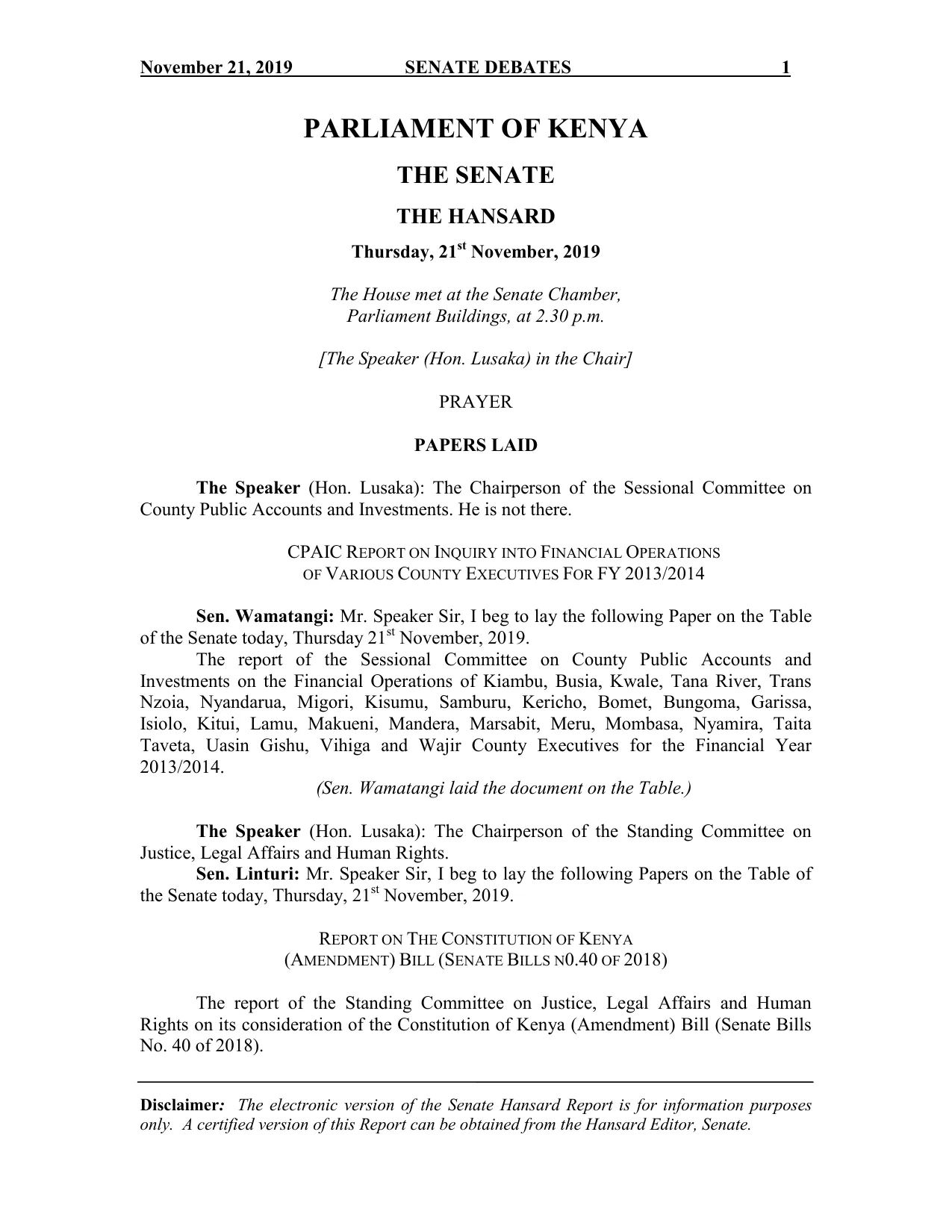
PARLIAMENT OF KENYA
Thursday, 21st November, 2019
PAPERS LAID
The Chairperson of the Sessional Committee on County Public Accounts and Investments. He is not there.
CPAIC REPORT ON INQUIRY INTO FINANCIAL OPERATIONS OF VARIOUS COUNTY EXECUTIVES FOR FY 2013/2014
Mr. Speaker Sir, I beg to lay the following Paper on the Table of the Senate today, Thursday 21st November, 2019.
The report of the Sessional Committee on County Public Accounts and Investments on the Financial Operations of Kiambu, Busia, Kwale, Tana River, Trans Nzoia, Nyandarua, Migori, Kisumu, Samburu, Kericho, Bomet, Bungoma, Garissa, Isiolo, Kitui, Lamu, Makueni, Mandera, Marsabit, Meru, Mombasa, Nyamira, Taita Taveta, Uasin Gishu, Vihiga and Wajir County Executives for the Financial Year 2013/2014.
The Chairperson of the Standing Committee on Justice, Legal Affairs and Human Rights.
Mr. Speaker Sir, I beg to lay the following Papers on the Table of the Senate today, Thursday, 21st November, 2019.
REPORT ON THE CONSTITUTION OF KENYA (AMENDMENT) BILL (SENATE BILLS N0.40 OF 2018)
REPORT ON THE CONSTITUTION OF KENYA (AMENDMENT) BILL (SENATE BILLS NO. 2 OF 2019)
REPORT ON THE CONSTITUTION OF KENYA (AMENDMENT) BILL (SENATE BILLS NO.16 OF 2019)
REPORT ON THE INDEPENDENT ELECTORAL AND BOUNDARIES COMMISSION (AMENDMENT) (NO. 3) BILL (NATIONAL ASSEMBLY BILLS NO.35 OF 2019)
REPORT ON THE STATUTE LAW (MISCELLANEOUS AMENDMENT) (NO. 2) BILLS (NATIONAL ASSEMBLY BILLS NO.13 OF 2018)
The Chairperson of the Standing Committee on Labour and Social Welfare.
REPORT ON THE CARE AND PROTECTION OF CHILD PARENTS BILL (SENATE BILLS NO. 11OF 2019)
Mr. Speaker, Sir, I beg to lay the following Paper on the Table of the Senate today, Thursday 21st November, 2019.
The report of the Standing Committee on Labour and Social Welfare on its consideration of the Care and Protection of Child Parents Bill (Senate Bills No. 11 of 2019) .
The Chairperson of the Committee on Roads and Transport.
REPORT ON PROJECTS UNDERTAKEN BY KENYA MARITIME AUTHORITY, KENYA FERRY SERVICES AND NATIONAL SOCIAL SECURITY FUND
Mr. Speaker Sir, I beg to lay the following Paper on the Table of the Senate today, Thursday, 21st November, 2019.
The report of the Standing Committee on Roads and Transportation on its initiated inquiries on projects undertaken by Kenya Maritime Authority, Kenya Ferry Services and National Social Security Fund.
If I seek your indulgence, you had given a directive that the report by this Committee be tabled yesterday. I want to report that we endeavoured to have the report tabled, but because of some of the clearances which are required to be done within the processes of laying the report, that was not possible yesterday. But it was ready and it is hereby tabled.
It is an opportune time - if you allow me - I would like to expound on some of the issues on this. The issue of the ferries is a very sensitive matter and one that is of great importance to Senators. I would seek your indulgence on the way forward on that.
I think we can have notice later, not right now. The Report of the ad hoc Committee of the Nakuru County Executive on the application for conferment of city status to Nakuru Municipality.
Thank you, Mr. Speaker Sir. I beg to lay the following Paper on the Table of the Senate, today, Thursday, 21st November, 2019.
REPORT OF THE AD HOC COMMITTEE ON THE APPLICATION FOR CONFERMENT OF CITY STATUS TO NAKURU MUNICIPALITY
Order! Members. Hon. Senators, I have a Communication to make.
COMMUNICATION FROM CHAIR APPLICATION FOR CONFERMENT OF CITY STATUS TO NAKURU MUNICIPALITY
Assembly that adopted the Report of the ad hoc Committee of the Nakuru County Executive on the application for conferment of city status to Nakuru Municipality.
Hon. Senators, I will briefly explain the requirement and process for such application.
Section 5 of the Urban Areas and Cities Act provides that for an area to be classified as a city, it must:
NOTICE OF MOTION
ADOPTION OF CPAIC REPORT ON INQUIRY INTO FINANCIAL OPERATIONS OF VARIOUS COUNTY EXECUTIVES FOR FY 2013/2014
Mr. Speaker, Sir, I beg to give notice of the following Motion - THAT, the Senate adopts the Report of the Sessional Committee on County Public Accounts and Investments on the inquiry into the financial operations of Kiambu, Busia, Kwale, Tana River, Trans Nzoia, Nyandarua, Migori, Kisumu, Samburu, Kericho, Bomet, Bungoma, Garissa, Isiolo, Kitui, Lamu, Makueni, Mandera, Marsabit, Meru, Mombasa, Nyamira, Taita Taveta, Uasin Gishu, Vihiga and Wajir County Executives for the FY 2013/2014
laid on the Table of the Senate, today, Thursday, 21st November, 2019.
STATEMENTS
DELAY IN PAYMENT TO OFFICERS WHO CONDUCTED NIIMS REGISTRATION EXERCISE
Mr. Speaker, Sir. I rise, pursuant to Standing Order No. 48 (1) , to seek a Statement from the Standing Committee on National Security, Defence and Foreign Relations on the delayed payment to officers who carried out the National Integrated Identity Management System (NIIMS) , commonly referred to as Huduma Namba registration exercise.
In the Statement, the Committee should-
Mr. Speaker, Sir, the concern I have, although I agree with the Statement---. In fact, the question should be after Kshs7 billion and the urgency of the Huduma Namba, where exactly is the position of the numbers we were supposed to
be given and why have the numbers not been given? Why was it so urgent? Although we face the same challenges in Makueni, the more important question is, where is the Huduma Namba?
Thank you, Mr. Speaker, Sir. You remember very well the way we were pushed around when it came to the Huduma Namba. People were being told: “You cannot sleep, eat, and you have to join lines day-in, day-out.” People were running up and down. We even pleaded with the Government to give us extra time and up to-date, there is nothing.
I am carrying that paper in my wallet; it has no job. At that time, we were told that this one will be the most important number in this country and it will solve all our problems. About Kshs8 billion was used and still, those young men and women who toiled going to people’s houses and sitting in the cold have not been paid. This is shameful.
Every time, we are talking of pending bills and workers not being paid. Are we going to put these things to the pending bills as well? I think this country should do better than this.
Thank you, Mr. Speaker, Sir. I join the rest of my colleagues in giving the necessary attention to the statement which has been requested by Sen. Prengei.
You will recall that, earlier before this exercise was undertaken, I brought a question to this House that led to the invitation of the Cabinet Secretary for Interior and Coordination of National Government together with his Permanent Secretary and the rest of the team that was to undertake this exercise.
Though half-heartedly, the House gave them the greenlight and stamp of approval because many of the things that we questioned were not brought to the fore. However, here we are today and Sen. Prengei has captured the mood of the country. On many occasions when you are seated in gatherings, people ask you: “As a Member of Parliament, what are you doing about some of these things that completely do not make sense in this country?”
However, after being pushed and shoved around, almost four to five months down the line, there is absolutely no communication on how many people were captured in the data, when they intend to release it, and what will be the way forward after this, especially in light of the money that was spent.
Mr. Speaker, Sir, Parliament is not impotent. In fact, a good reading of our Constitution equates representation, which is the work of Parliament, to sovereignty. Kenyans exercise their sovereignty through us, their representatives. Therefore, we cannot turn this House into a House of lamentation each time Kenyans look up to us for leadership.
I want to request that the Chair do furnishes - it is good because Sen. Prengei was very specific - by way of a report before this House on the issues of expenditure and the little matter of the young people who participated in this exercise having not been paid. However, most importantly, on justification for this exercise and what the Government has achieved this far. This is an important issue that Kenyans need to know the truth.
Thank you, Mr. Speaker, Sir, for this opportunity to contribute to the Statement by Sen. Prengei.
I was in the process of seeking a similar Statement but I was advised by the secretariat that Sen. Prengei had already requested the same Statement.
There are few issues that come to the fore on this matter of Huduma Namba: One, is the manner in which this project was launched. There was so much pushing to get everybody in this country to participate and to register for Huduma Namba. In fact, the Government was so serious on this matter that I remember all parliamentary party leaders took turns and went to different parts of this country to launch this project.
I saw the leader of ODM in Mombasa launching this project. My party leader was in Murang’a accompanied by our colleague, Sen. Wetangula, launching that project.
Thank you, Mr. Speaker, Sir, for this opportunity. I want to congratulate Sen. Prengei for bringing the plight of non-payment of NIIMS agents and the clerks that participated.
I do not understand the rationale of the Government. I think the Chair of National Security, Defence and Foreign Relations, which the Statement is likely to be directed to, should tell us why it is that every time when any Kenyan works for the Government, they are not paid. The other day, we had the census clerks and it took a lot of pulling and noise. They are now in the process of being paid.
We finished Huduma Namba long time ago and the NIIMS agents have not been paid. Most of these workers are youths who do not have any other source of income. They want this money so that they can live one day at a time. Therefore, I think it deserves urgency.
The Cabinet Secretary in charge of National Treasury and Planning has issued a circular against counties; that if they do not clear pending bills, then they will not be
allowed to access the funds from national Treasury. We want to request the Cabinet Secretary, Ministry of Planning and National Treasury again through the relevant Committee of National Security, Defence and Foreign Relations to order the Ministry of Interior and Coordination of National Government to pay those clerks who participated in NIIMS.
I have listened to my friend, Sen. Wambua, and I think there was somebody who wanted to embarrass these national leaders. Why would you parade national leaders to launch something that was a wild goose chase? I have seen some news flash that the Ministry of Interior and Coordination of National Government has requested Kshs1 billion to print more cards. I do not know how authentic that information is but we want these cards to be delivered because they did it through a lot of force, violence, threats and coercion; that if you do not register for Huduma Namba, you will not be able to sleep in your bed.
Therefore, we need the same urgency and pressure to be put in place so that we can get Huduma Namba cards. Even as we close on that, in this report - I agree with Sen. Cheruiyot - the Ministry through the Committee should table a report on how far this exercise went.
Secondly, they should also tell us what they have done in the diaspora because there are many Kenyans who are living in diaspora who wanted access to the Huduma card just like the new generation of identification number that we have in this country. Therefore, in that report, they must include the aspect of Kenyans who are living in the diaspora in terms of accessing the Huduma Namba card and they should be given to Kenyans to enable them access services in this country.
Mr. Speaker, Sir, I hope the relevant Committee will respond in the next few days and ensure that Kenyans can sleep peacefully and have their Huduma Namba cards.
Thank you.
allowed to access the funds from national Treasury. We want to request the Cabinet Secretary, Ministry of Planning and National Treasury again through the relevant Committee of National Security, Defence and Foreign Relations to order the Ministry of Interior and Coordination of National Government to pay those clerks who participated in NIIMS.
I have listened to my friend, Sen. Wambua, and I think there was somebody who wanted to embarrass these national leaders. Why would you parade national leaders to launch something that was a wild goose chase? I have seen some news flash that the Ministry of Interior and Coordination of National Government has requested Kshs1 billion to print more cards. I do not know how authentic that information is but we want these cards to be delivered because they did it through a lot of force, violence, threats and coercion; that if you do not register for Huduma Namba, you will not be able to sleep in your bed.
Therefore, we need the same urgency and pressure to be put in place so that we can get Huduma Namba cards. Even as we close on that, in this report - I agree with Sen. Cheruiyot - the Ministry through the Committee should table a report on how far this exercise went.
Secondly, they should also tell us what they have done in the diaspora because there are many Kenyans who are living in diaspora who wanted access to the Huduma card just like the new generation of identification number that we have in this country. Therefore, in that report, they must include the aspect of Kenyans who are living in the diaspora in terms of accessing the Huduma Namba card and they should be given to Kenyans to enable them access services in this country.
Mr. Speaker, Sir, I hope the relevant Committee will respond in the next few days and ensure that Kenyans can sleep peacefully and have their Huduma Namba cards.
Thank you.
Mr. Speaker, Sir, I beg to add my voice to those who are supporting this Statement.
Since it was decreed that it was urgent, we plead with you to urgently direct the Ministry to give us answers. If you can give them as a short as one week, that would be hallelujah to us because they also gave us a very short time to act in this matter. There was a rumour out there that this number had some devils in it. There were people who were intending to bewitch Kenyans.
You have heard what Members are saying. It appears that where Sen. Wetangula and I come from, we know witches are there, perhaps this number is being used by witches.
On a point of order, Mr. Speaker, Sir.
What is your point of order, Sen. Wario?
Mr. Speaker, Sir. Hallelujah is the language you use to cast away evil spirits.
Mr. Speaker, Sir, you are so powerful that if you said ‘Hallelujah’, those people would bring the answer here as quickly as possible.
There is anxiety from where we come from. We know that in a civilized society, and we belong to one of them, the value for money is very important. We have spent a lot of money. There is no value for the last six months. It is in good order and test that we get value for our money.
Mr. Speaker, Sir, you are so powerful that if you said ‘Hallelujah’, those people would bring the answer here as quickly as possible.
There is anxiety from where we come from. We know that in a civilized society, and we belong to one of them, the value for money is very important. We have spent a lot of money. There is no value for the last six months. It is in good order and test that we get value for our money.
Thank you, Mr. Speaker, Sir, for giving me this opportunity to also air my view with regard to the Statement by Sen. Prengei.
Having listened to my colleagues contribute, I need to also get from the relevant Committee the following details or concerns. We know we gave out our own individual data; I would like to know how safe it is.
Mr. Speaker, Sir, do we really know whether our data is safe and that it cannot be interfered with? I would also like to know the total cost of the project because it keeps on varying. Sometime you hear it is a Kshs1 billion. Other times, they say it Kshs2 billion. We do not know the exact amount which this project gobbled.
We would like to know whether the Government has paid all the participants in this project. I have the list of participants from Machakos County who have not being paid. I will table it to the relevant Committee. I have it in writing. I will present the information to them.
Mr. Speaker, Sir, recently, we had census exercise which was carried out in this Republic. Many of our people were wondering how different it was from the Huduma project. Is there any distinction between the two projects? If there is no distinction, why was it necessary to undertake a similar exercise whereas the Government has information within its own reach?
I support.
Thank you, Mr. Speaker, Sir, for giving me this opportunity to also air my view with regard to the Statement by Sen. Prengei.
Having listened to my colleagues contribute, I need to also get from the relevant Committee the following details or concerns. We know we gave out our own individual data; I would like to know how safe it is.
Mr. Speaker, Sir, do we really know whether our data is safe and that it cannot be interfered with? I would also like to know the total cost of the project because it keeps on varying. Sometime you hear it is a Kshs1 billion. Other times, they say it Kshs2 billion. We do not know the exact amount which this project gobbled.
We would like to know whether the Government has paid all the participants in this project. I have the list of participants from Machakos County who have not being paid. I will table it to the relevant Committee. I have it in writing. I will present the information to them.
Mr. Speaker, Sir, recently, we had census exercise which was carried out in this Republic. Many of our people were wondering how different it was from the Huduma project. Is there any distinction between the two projects? If there is no distinction, why was it necessary to undertake a similar exercise whereas the Government has information within its own reach?
I support.
Nikimalizia, ningependa kusema kwamba ile Kamati husika itatupatia jawabu mufti ni kwa nini waliofanya kazi ya kupeana Huduma Namba hawajalipwa, Huduma Namba itatoka lini na wanahitaji Kshs1 bilioni ya nini ili kutuletea Huduma Namba? Ninaomba Kamati ifanye bidii ili tupate jawabu hilo.
Asante, Bw. Spika.
Nikimalizia, ningependa kusema kwamba ile Kamati husika itatupatia jawabu mufti ni kwa nini waliofanya kazi ya kupeana Huduma Namba hawajalipwa, Huduma Namba itatoka lini na wanahitaji Kshs1 bilioni ya nini ili kutuletea Huduma Namba? Ninaomba Kamati ifanye bidii ili tupate jawabu hilo.
Asante, Bw. Spika.
Thank you, Mr. Speaker, Sir. I rise to seek a Statement from the Standing Committee on National Security, Defence and Foreign Relations on the failure by the Government to offer assistance to the beneficiaries of the deceased persons on the Solai Dam tragedy.
In the Statement:
FAILURE BY THE GOVERNMENT TO OFFER ASSISTANCE TO BENEFICIARIES OF THE DECEASED PERSONS ON THE SOLAI DAM TRAGEDY
Thank you, Mr. Speaker, Sir. I rise to seek a Statement from the Standing Committee on National Security, Defence and Foreign Relations on the failure by the Government to offer assistance to the beneficiaries of the deceased persons on the Solai Dam tragedy.
In the Statement:
Thank you, Mr. Speaker, Sir. I rise to seek a Statement pursuant to Standing Order No.47 (1) on a matter of national and, in fact, international concern because this is about Nairobi City County. It is on the current state of Nairobi City County.
THE STATE OF NAIROBI CITY COUNTY
Currently, we are facing a tragedy of untold proportions. As I speak, our Nairobi City County that we all love, is mortally ill with one foot in the grave. It is suffering a triple calamity of a Governor with no substantive deputy, a non-functional executive and an Assembly in shambles. Nairobi City County continues to sink further into an abyss of mismanagement and impunity. As anarchy and disorder reigns supreme at the City Hall, services to Nairobi City County citizens have practically ground to a halt.
On matters of service provision, the citizens and the people of Nairobi City County are grappling with a myriad of inconveniences, frustrations and general lack of basic services and amenities. Instead, the people are being treated to all manner of shadowboxing and dramatization. Recently, we saw chaos in the Assembly and a lot of drama in the City County by the people who are supposed to offer services to Nairobians.
It has to be said that the Constitution envisages a very clear distinction and sharing of roles between the national Government and county governments. The national Government has done its part in the city through its ministries and agencies. Members of Parliament (MPs) have also done their part in representation, legislation and development through the National Government-Constituencies Development Fund (NG-CDF). As this is going on, the most important services that touch the common Nairobian are still devolved and domiciled at City Hall and, thus, the need for attention on those services.
Mr. Speaker, Sir, as the Senator, I thank the Senate and my colleagues because we have together dutifully conducted our constitutional duty of allocating monies to Nairobi City County and all counties through the Division of Revenue Bill. This is why the people of Nairobi City County are demanding accountability for the billions of shillings allocated to the Nairobi City County annually. The highest chunk that this House passes goes to Nairobi City County.
In the last two years, Nairobi City County has received in excess of Kshs52 billion. This is from equitable share, own source revenue and grants. An amount of Kshs52 billion in two years, yet taps remain dry, garbage remains uncollected; sewerage is flowing freely; estate and feeder roads are in deplorable conditions; and residents are seeking health services in private establishments or elsewhere because county dispensaries and those at the lower level are unable to provide the services. Other critical services remain unrendered.
The breakdown of what I have said is that in 2017/2018 Financial Year, we gave Nairobi City County Kshs15.4 billion. As the Senator, I am glad that I pushed for my county to get that amount. Own source revenue was Kshs10 billion and conditional grant was Kshs817 million. That is Kshs26 billion for one year.
In the 2018/2019 Financial Year, I made sure as the Senator of Nairobi City County, and I thank my colleagues, that we gave Nairobi City County Kshs 15.8 billion. Own source revenue was Kshs10 billion and conditional grants was Kshs179 million. The total available funds were Kshs26 billion in Nairobi City County.
Mr. Speaker, Sir, if we were to academically divide that amount - of course, we know that there is the recurrent - that translates to around Kshs3 billion per constituency amongst the 17 constituencies of Nairobi City County. That means that Nairobians should feel a development impact, of course, not of Kshs3 billion but every part of this county should feel the impact of this Kshs52 billion.
Last week, I received a report from the Controller of Budget (CoB), that as of October, 2019 Nairobi City County had not used a single shilling of the development budget of the Financial Year 2018/2019. The amounts that have been used are those of recurrent expenditure. So, the citizens are demanding to known what the billions that this House dutifully allocates to Nairobi City County – and other counties as well – are doing to better the plight of our residents.
Mr. Speaker, Sir, the county government has failed in delivering critical services enumerated as county functions. As I had listed earlier, they are health, water, sewage and sanitation, estate and feeder roads, physical planning, Early Childhood Education (ECD) among others.
Currently – and Sen. Kasanga will tell you – the construction industry in Kenya is at a standstill because the sector does not only provide employment to thousands of Nairobians, but also creates a lot of movement on our Gross Domestic Product (GDP). The Planning Department in the Nairobi City County has been shut down owing to suspensions. This has led to inordinate delays in building approvals. When will these officers be replaced if they are guilty? If they are not, when will they come back? Our concern is not the individuals because Nairobi City County cannot be held hostage by individuals, but all departments need to work as they should for the benefit of this county.
Mr. Speaker, Sir, Members of the County Assembly (MCAs), who ideally form the first line of defence and oversight, are operating in a hostile environment. A non- functional executive, nepotism, bullying, intimidation, physical assault, destruction of property and violence, as we have seen, has left MCAs with their hands behind their backs, limited on service delivery to their electorate. In fact, even now, a section of them are doing a press conference to counter the one we did earlier, yet if you go to their wards, they cannot point to the actual development that is being done, yet they should play an oversight role.
Among the questions that we will be seeking this House to look into through a Statements from the relevant Committee at the right time, and also through the Auditor- General are:-
Last week, I received a report from the Controller of Budget (CoB), that as of October, 2019 Nairobi City County had not used a single shilling of the development budget of the Financial Year 2018/2019. The amounts that have been used are those of recurrent expenditure. So, the citizens are demanding to known what the billions that this House dutifully allocates to Nairobi City County – and other counties as well – are doing to better the plight of our residents.
Mr. Speaker, Sir, the county government has failed in delivering critical services enumerated as county functions. As I had listed earlier, they are health, water, sewage and sanitation, estate and feeder roads, physical planning, Early Childhood Education (ECD) among others.
Currently – and Sen. Kasanga will tell you – the construction industry in Kenya is at a standstill because the sector does not only provide employment to thousands of Nairobians, but also creates a lot of movement on our Gross Domestic Product (GDP). The Planning Department in the Nairobi City County has been shut down owing to suspensions. This has led to inordinate delays in building approvals. When will these officers be replaced if they are guilty? If they are not, when will they come back? Our concern is not the individuals because Nairobi City County cannot be held hostage by individuals, but all departments need to work as they should for the benefit of this county.
Mr. Speaker, Sir, Members of the County Assembly (MCAs), who ideally form the first line of defence and oversight, are operating in a hostile environment. A non- functional executive, nepotism, bullying, intimidation, physical assault, destruction of property and violence, as we have seen, has left MCAs with their hands behind their backs, limited on service delivery to their electorate. In fact, even now, a section of them are doing a press conference to counter the one we did earlier, yet if you go to their wards, they cannot point to the actual development that is being done, yet they should play an oversight role.
Among the questions that we will be seeking this House to look into through a Statements from the relevant Committee at the right time, and also through the Auditor- General are:-
Proceed, Senate Majority Leader.
to deal with corruption? I agree with Sen. Sakaja that there is a problem with the buildings department. Some of us are also practicing law, if you want to do matters property in this Nairobi, it is difficulty because that department has nobody.
to deal with corruption? I agree with Sen. Sakaja that there is a problem with the buildings department. Some of us are also practicing law, if you want to do matters property in this Nairobi, it is difficulty because that department has nobody.
Everyone has been suspended.
Members of County Assembly (MCAs) and agree to put aside all other differences to sort out the mess of Nairobi particularly the problem of cartels.
Thank you, Mr. Speaker, Sir.
Members of County Assembly (MCAs) and agree to put aside all other differences to sort out the mess of Nairobi particularly the problem of cartels.
Thank you, Mr. Speaker, Sir.
Thank you, Mr. Speaker, Sir. The failure of Nairobi City County is a national failure. It is something that we all cannot run away from. We are intertwined with Nairobi. When we talk about devolution; if Nairobi fails, then there is no need to talk about devolution in Mandera, Mombasa, Migori or anywhere else because Nairobi should be the shining example of success of devolution.
I have heard the Senate Majority Leader propose that you invite the Governor of Nairobi City County. I am reluctant to endorse that, because that invitation will just lead to a baraza. Since the Speaker used to be in provincial administration, he knows that barazas are not very good. Hecklers will come and try to heckle what you are doing.
My proposal would be---
On a point of order, Mr. Speaker, Sir.
What is your point of order?
Mr. Speaker, Sir, is Sen. Ochillo-Ayacko in order to call a Sitting of this House, the Senate of the Republic of Kenya a baraza? Is he insinuating that you are presiding over a baraza? Is it in order for him to leave a baraza in Migori where he was and come to this House to look for another baraza?
Leader of Majority, I think he did not say that. You missed his point. I got what he said unless he wants to clarify.
assign it a room and all the powers and privileges that it should have so that in the fullness of time, it can present to us an actionable report.
assign it a room and all the powers and privileges that it should have so that in the fullness of time, it can present to us an actionable report.
Thank you, Mr. Speaker, Sir. Nairobi is the capital city of this country. It is also said to be generating about 60 per cent of the Gross Domestic Product (GDP) . Therefore, it is important for the county government to provide an enabling environment for that kind of production. Unfortunately, we have an Executive which has suspended departments and a county government which has a lot of infighting and where the Speaker could not run the county assembly for a whole year. We have problems that we need to think through.
I agree with what Sen. Ochillo-Ayacko has said. This is because the Committee of the Whole will not have all the time to sit and hear the matters. However, if we get a dedicated special committee, it can have time to go through the problems and present the report to the House.
Thank you, Mr. Speaker, Sir. It is a sad story to hear a Statement coming from the Senator of Nairobi City County concerning the governance structure of Nairobi City County.
This is not unique to Nairobi as a county. Indeed, when it was Nairobi City Council, I had the privilege of one time dissolving it and I appointed a commission to look at the raft of measures that ranged from political, social and economic factors.
I agree that the bulk of more than 45per cent of our GDP is generated within Nairobi City County. When you look at the haphazard manner in which issues are handled at the moment, it leaves no doubt whatsoever that the resources that are pumped into Nairobi City County cannot be utilised optimally because of the tug of war from one institution to another.
The only way forward, in the spirit of helping Nairobi City County to stand tall among the other counties, not only of this country but the greatest counties like the great Borough City of London, is to go the direction that has been suggested of a select Committee. It will have time and opportunity to basically examine who the cartels are and whether they have political, economic or social interest and vice versa. Until we reach that level and distil the elements that are bedeviling the Nairobi City County, we will not achieve much in the Committee of the Whole. This is because it will be a onetime appearance and the management, interrogation and processing of information will be skimpy. Therefore, we need to consolidate the thinking along the lines.
In that case, I suggest that the Senator for Nairobi City County provides a template of issues that are critical so that we can look at them in a critical manner and provide solutions at the select Committee which will then present its report to plenary for further action.
Yesterday, we were told how two Committees of this House walked into Kitui Prison, and after that visit alone, more than 500 prisoners were let free. This is because they were incarcerated but they did not deserve to be in prison. They were let go just by a simple act of this House walking into those prison walls. That is how powerful the Senate of the Republic of Kenya is.
Any time we speak, we should not appear as if we lack solutions. Anytime a person appears before this House either by way of Committee or plenary, they know its potential. When we handle issues, we take them to their logical conclusion. Therefore, I have heard a good number of my colleagues suggest that we go the select Committee way. There is a history. Perhaps, those of us who have been in this House longer enough know the history that led this House to move away from the select committees especially where governors are involved and opted for the Committee of the Whole. Sen. Mutula Kilonzo Jnr. knows what I am referring to.
Mr. Speaker, Sir, it is my thinking that we stick to the particular wisdom of having a Committee of the Whole as opposed to a select Committee. We have been told that we are handling powerful and moneyed cartels that have a way of folding the hands of Members of County Assembly (MCAs). So, if we go the Committee of the Whole of way, I am not sure that the team that you might pick will have the wherewithal to withstand whatever will be brought before them. We have been more successful especially when issues of great importance to specific counties have come before this House. From experience, having served in a select Committee and sat through a plenary of the Committee of the Whole---
Yesterday, we were told how two Committees of this House walked into Kitui Prison, and after that visit alone, more than 500 prisoners were let free. This is because they were incarcerated but they did not deserve to be in prison. They were let go just by a simple act of this House walking into those prison walls. That is how powerful the Senate of the Republic of Kenya is.
Any time we speak, we should not appear as if we lack solutions. Anytime a person appears before this House either by way of Committee or plenary, they know its potential. When we handle issues, we take them to their logical conclusion. Therefore, I have heard a good number of my colleagues suggest that we go the select Committee way. There is a history. Perhaps, those of us who have been in this House longer enough know the history that led this House to move away from the select committees especially where governors are involved and opted for the Committee of the Whole. Sen. Mutula Kilonzo Jnr. knows what I am referring to.
Mr. Speaker, Sir, it is my thinking that we stick to the particular wisdom of having a Committee of the Whole as opposed to a select Committee. We have been told that we are handling powerful and moneyed cartels that have a way of folding the hands of Members of County Assembly (MCAs). So, if we go the Committee of the Whole of way, I am not sure that the team that you might pick will have the wherewithal to withstand whatever will be brought before them. We have been more successful especially when issues of great importance to specific counties have come before this House. From experience, having served in a select Committee and sat through a plenary of the Committee of the Whole---
On a point of order, Mr. Speaker, Sir.
Sen. Ochillo-Ayacko, what is your point of intervention?
Mr. Speaker, Sir, I have listened to my good friend, Sen. Aaron Cheruiyot. I have heard him doubt the integrity of Members in their individual capacity and applaud their integrity in their corporate capacity. Would I be in order to ask him to exclude me from the list of individuals whose integrity is wanting? If others do not raise this, it will go on record that one of us has evidence that we are people who can be armtwisted and mislead into discarding or abdicating our public responsibility.
Sen. Cheruiyot meant that we are human beings so we cannot rule out the fact that one or two people could be compromised. He is not talking about the whole House. If you want him to exclude you, that is his discretion.
context of my argument. I am not casting aspersions on the conduct of any individual in this House.
Mr. Speaker, Sir, I propose that we should listen to the concerns that have been raised by our colleagues, Sen. Sakaja---
context of my argument. I am not casting aspersions on the conduct of any individual in this House.
Mr. Speaker, Sir, I propose that we should listen to the concerns that have been raised by our colleagues, Sen. Sakaja---
What is your point of intervention, Sen. Mutula Kilonzo Jnr.?
On a point of order, Mr. Speaker, Sir. I am extremely concerned that Sen. Cheruiyot is suggesting that the decision made by the Select Committee that considered the impeachment proceedings of Gov. Samboja received phone calls or that their decision was influenced by people other than the Members of that Committee. Sen. Cheruiyot has suggested that the Members of that Select Committee were coerced, cajoled, persuaded or otherwise caused them to make a decision other than a decision that would lead to a proper judgement.
Mr. Speaker, Sir, Sen. Mutula Kilonzo Jnr. needs to listen to the entire logic of my argument. I argued that whatever you can do to a select committee, it is harder to do it to a plenary. That is my whole point of argument. If we were use the example of the phone calls---
Order Sen. Cheruiyot. Sen. Mutula Kilonzo Jnr. meant that by the statement you made, you raised issues about the report that was tabled before this House. You have said that Members were called. Did the phone calls have a bearing on the final product that found its way to this House?
Mr. Speaker, Sir, I can neither confirm nor deny that the phone calls had a bearing on the final product.
What is your point of intervention, Sen. Ochillo- Ayacko?
On a point of order, Mr. Speaker, Sir. The issue you have raised is the point I was trying to make. It is possible to use the privilege of this platform to defend people. Sen. Cheruiyot should confirm whether he received a phone call because people have individual phones. We all made our decision individually on the basis of what we considered merit.
I had said earlier that it is not good to condemn wholesale issue of select committee or talk about collective integrity of the House thus casting aspersions on the conduct of individual Members. Sen. Cheruiyot should tread carefully in that area lest he brings down through improper perspective or insinuation as to the image and the conduct of the Members of this House.
What is your point of intervention, Sen. Poghisio?
On a point of order, Mr. Speaker, Sir. It is out of order to impute improper motive on the Members of this House. I ask the Chair to guide that Sen. Cheruiyot withdraws the claims that people received phone calls to influence the decision of a Committee. The claim should be withdrawn and expunged. That claim imputes improper motive and casts aspersions on Members.
young people who have been planting flowers and grass around the city have issues on how they are contracted and are paid. Those are young people that we support. The planning department of Nairobi City County has currently shut down.
I do not think that the Committee of the Whole can meet every day. However, as Sen. (Prof.) Ongeri stated, there is need to look at the top five key issues as we seek to help the Nairobi City County.
young people who have been planting flowers and grass around the city have issues on how they are contracted and are paid. Those are young people that we support. The planning department of Nairobi City County has currently shut down.
I do not think that the Committee of the Whole can meet every day. However, as Sen. (Prof.) Ongeri stated, there is need to look at the top five key issues as we seek to help the Nairobi City County.
Sen. Sakaja, you are suggesting the way forward yet we are still on a point of order. A very serious issue has been raised about what Sen. Cheruiyot said.
Standing Order 96 (4) states that:- ‘No Senator shall impute improper motive to any other Senator or to a Member of the National Assembly except upon a specific substantive Motion of which at least three days’ notice has been given, calling in question the conduct of that Senator or Member of the Assembly.’ Sen. Cheruiyot, you indicated that phone calls were made and that is on record. You need to substantiate or withdraw your claim for us to expunge it from our records.
Mr. Speaker, Sir, if there is a person who improper motive on their conduct has been imputed, it is me. In the course of making my remarks, I mentioned that phone calls were made. There is no reference that those phone calls were to an individual Senator. Secondly, I never stated that it is on the basis of the phone calls that people made the decision. That is why I urged Sen. Mutula Kilonzo Jnr. to listen to the entire context of my argument. I said that whatever can be done to a select committee would be harder to do it to a sitting of the entire House. That is plain a simple. It can be to the point of trying to convince them otherwise.
I do not understand where Sen. Ochillo-Ayacko gets the impression that the phone calls I mentioned informed the decision of the Select Committee.
On a point of order, Mr. Speaker, Sir. I do not understand the belligerence of Sen. Cheruiyot on the matter. He has continued to further claim that we should not go the way of a Select Committee because they can be compromised. That concept alone is imputing improper motive on a House and that should not be. It does not take much for him to apologize and withdraw for us to make progress.
On a point of order, Mr. Speaker, Sir. We are aware that this House operates through sessional or standing committees. I believe that Sen. Cheruiyot’s usage of the standing committees implies committees that are not of the whole. Is Sen. Cheruiyot right to claim that this House abandon working through smaller committee and work through the Committee of the Whole because smaller committees are susceptible to being arm-twisted, influenced, cajoled or coerced so that the output is adulterated?
Mr. Speaker, Sir, Sen. Poghisio was on phone when I began making my argument. That is why he does not seem to understand the whole context of my argument. However, since I do not want to waste the time of the House---
What is your point of intervention, Sen. Poghisio?
phone? I cannot be on phone in this House when the Speaker is sitting. The Chair would have noticed it.
phone? I cannot be on phone in this House when the Speaker is sitting. The Chair would have noticed it.
Sen. Cheruiyot, kindly, conclude that matter for us to make progress.
Mr. Speaker, Sir, if Sen. Poghisio was to allow me, I would conclude my matter.
The point I was trying to raise is that if Sen. Poghisio had concentrated enough to listen to my argument from the beginning, he would have realized my point. If in trying to push my point on the difference between a select committee and a Committee of the Whole, if there is any inkling towards making it appear as if a select committee is more susceptible to being unduly influenced, I withdraw that perception. However, it is unclear to me how I can withdraw a perception in someone’s mind. I withdraw that kind of insinuation of on the part of anyone.
Mr. Speaker, Sir, can I proceed?
Kindly conclude.
Thank you, Mr. Speaker, Sir. Since we began this debate, Sen. Sakaja, who is the originator of this Statement, has brought a twist to this issue. Perhaps the best way to handle it is to pick on five areas that are more critical to Nairobi City County, and have a committee look into them.
Having made such submissions, I abandon my earlier thought on why it is important---
I thought that the matter is going to be ruled on by the Speaker?
Which one?
The same matter that has been brought by Sen. Sakaja.
I am abandoning my persuasion on whether to proceed. Earlier on I thought that a Committee of the Whole will be better. However, I pray that we stay long enough until Members get to see the difference between what I was trying to argue, then we will have the discussion later. In no way do I imply that anyone is of a lesser character or conduct in this House.
Okay, Sen. Cheruiyot. Since Sen. Cherargei is not here to comment on this matter, we will finally listen to Sen. Olekina.
this country. If we do not rise up to the occasion, the situation in Nairobi will worsen. There are allegations of cartels left, right and centre. If you talk to Gov. Sonko, he will tell you that the cartels are out to destroy him. The Statement by Sen. Sakaja also points out to cartels.
Hypothetically, if the cartels succeeded in removing the current Governor of Nairobi, who is going to take over? The current Speaker of Nairobi County Assembly should do so, but there are still issues regarding her. Therefore, there will be no one to take over. It is time that we took this matter seriously.
If that piece of legislation was enacted into law, a substantive deputy governor would have been appointed. If the Ethics and Anti-Corruption Commission (EACC) or a court order bars the governor from accessing the office, the people of Nairobi should not continue suffering. Nairobi is the Capital City of Kenya and, I dare say, of East Africa.
Mr. Speaker, Sir, as of two days ago, which is 18th November, 2019, the current eligible pending Bills of Nairobi, were Kshs21 billion. These are pending bills that were re-audited by the Auditor-General. I hope that we will come up with a substantive Motion next week to direct the national Treasury not to release more money to the counties until those pending bills are paid. It should be on a first-in, first-out basis.
When you move around Nairobi, you will be surprised by the level of operational misappropriation of funds in this county. I would like every Member of this House to be observant. Every week, grass is uprooted at the roundabouts, and new grass is planted. What kind of operations are we running?
In our County Public Accounts and Investments Committee (CPAIC), we have raised concerns regarding JamboPay in Nairobi. I remember that we sat for long hours to see where that money goes. We know that the contract for JamboPay was terminated, but another company has been appointed to collect revenue on behalf of Nairobi. We need to think seriously about the way forward.
Mr. Speaker, Sir, I will summarise by saying the following. I believe that this is not a matter of setting up a select committee. All the 47 county governors will have to sit with us here, including the nominated Senators, so that we discuss this issue for the interest of the people of Nairobi. We should be objective about the future of Nairobi as a county government or part of the national Government, whichever way it will go.
Thank you, Mr. Speaker, Sir.
this country. If we do not rise up to the occasion, the situation in Nairobi will worsen. There are allegations of cartels left, right and centre. If you talk to Gov. Sonko, he will tell you that the cartels are out to destroy him. The Statement by Sen. Sakaja also points out to cartels.
Hypothetically, if the cartels succeeded in removing the current Governor of Nairobi, who is going to take over? The current Speaker of Nairobi County Assembly should do so, but there are still issues regarding her. Therefore, there will be no one to take over. It is time that we took this matter seriously.
If that piece of legislation was enacted into law, a substantive deputy governor would have been appointed. If the Ethics and Anti-Corruption Commission (EACC) or a court order bars the governor from accessing the office, the people of Nairobi should not continue suffering. Nairobi is the Capital City of Kenya and, I dare say, of East Africa.
Mr. Speaker, Sir, as of two days ago, which is 18th November, 2019, the current eligible pending Bills of Nairobi, were Kshs21 billion. These are pending bills that were re-audited by the Auditor-General. I hope that we will come up with a substantive Motion next week to direct the national Treasury not to release more money to the counties until those pending bills are paid. It should be on a first-in, first-out basis.
When you move around Nairobi, you will be surprised by the level of operational misappropriation of funds in this county. I would like every Member of this House to be observant. Every week, grass is uprooted at the roundabouts, and new grass is planted. What kind of operations are we running?
In our County Public Accounts and Investments Committee (CPAIC), we have raised concerns regarding JamboPay in Nairobi. I remember that we sat for long hours to see where that money goes. We know that the contract for JamboPay was terminated, but another company has been appointed to collect revenue on behalf of Nairobi. We need to think seriously about the way forward.
Mr. Speaker, Sir, I will summarise by saying the following. I believe that this is not a matter of setting up a select committee. All the 47 county governors will have to sit with us here, including the nominated Senators, so that we discuss this issue for the interest of the people of Nairobi. We should be objective about the future of Nairobi as a county government or part of the national Government, whichever way it will go.
Thank you, Mr. Speaker, Sir.
Hon. Senators, I think the matter has been well spoken to. This is a weighty matter that has been raised by the Senator for Nairobi. I know that it is not supposed to go to any Committee, but because of the weight of the matter, I will use my discretion under Standing Order 47 (3) , to direct it to the Committee on Devolution and Intergovernmental Relations. They should look at the issues and advice---
An hon. Senator: On a point of order, Mr. Speaker, Sir.
Committees sit on behalf of the Senate. If one Committee is embarrassed or belittled, like the other time when the Governor allegedly lectured Senators, it is the whole Senate that is in disrepute. We must, therefore, be careful and come up with practical solutions that will not embarrass this House. That is why the Committee on Devolution and Intergovernmental Relations must put its foot down and come up with a way forward, which should be reported to this House.
Let us listen to Sen. Mutula Kilonzo Jnr.
Committees sit on behalf of the Senate. If one Committee is embarrassed or belittled, like the other time when the Governor allegedly lectured Senators, it is the whole Senate that is in disrepute. We must, therefore, be careful and come up with practical solutions that will not embarrass this House. That is why the Committee on Devolution and Intergovernmental Relations must put its foot down and come up with a way forward, which should be reported to this House.
Let us listen to Sen. Mutula Kilonzo Jnr.
POINT OF ORDER
PENDING BILLS IN COUNTIES
Mr. Speaker, Sir, I rise on a point of order to seek your direction on something that Sen. Olekina has alluded to. As the leader of this House, and as a matter of national concern, this is a matter that needs your communication.
Amb. Ukur Yatani, who is the Acting Cabinet Secretary (CS) for the national Treasury, has issued a direction that he will not release funds to 15 counties if they do not pay pending bills. Section 97 (2) of the Public Finance Management (PFM) Act on procedures for stoppage of funds states as follows:-
“Not later than seven days after the date of the decision to stop the transfer of funds, the Cabinet Secretary shall seek approval from Parliament.” The suggestion alluded to by Sen. Olekina is that there appears to be a discretion by the Acting CS to stop the release of funds without the approval of Parliament. Therefore, next time we have a sitting, I would like you to issue a proper communication so that it is clear to the country. The process of stoppage of funds should be followed according to this law.
Thank you, Mr. Speaker, Sir.
An. Hon. Senator: What?
There is no money out there. Mr. Speaker, Sir, we have to treat this matter as sui generis; something which is unique. What is happening out there? I know that the CS issued a premature circular that might not meet all the thresholds of law. It is time we took this matter seriously. This Senate is supposed to be defending devolution. Why are we sending money to county governments, yet they are not paying pending bills? As of today, there was a directive that those eligible pending bills amount to over Kshs63 billion be settled. If it is paid and circulated, the situation on the ground will be different. As you give a communication, it is important that we really think about this.
Mr. Speaker, Sir, I am thinking of bringing a Motion here so that we find a way of wriggling out of this situation. People need money. There are people who are killing
An. Hon. Senator: What?
themselves because they are unable to pay their bills and service their loans. We must care about them.
The Speaker (Hon. Lusaka): I will give a chance to the Chairman of the Committee on Finance and Budget and, as I do so, I think that what Sen. Mutula Kilonzo Jnr. has raised is very important. That we, as a House, must be careful not to cede our ground, because that is why we are in court. We know certain processes had not been followed, and that this House had been bypassed. As much as we agree, we must also know that we, as a House, have a role to play, and that it cannot be side stepped.
Proceed, Sen. (Eng.) Mahamud.
themselves because they are unable to pay their bills and service their loans. We must care about them.
I will give a chance to the Chairman of the Committee on Finance and Budget and, as I do so, I think that what Sen. Mutula Kilonzo Jnr. has raised is very important. That we, as a House, must be careful not to cede our ground, because that is why we are in court. We know certain processes had not been followed, and that this House had been bypassed. As much as we agree, we must also know that we, as a House, have a role to play, and that it cannot be side stepped.Proceed, Sen. (Eng.) Mahamud.
Thank you, Mr. Speaker, Sir. I agree with Sen. Mutula Kilonzo Jnr.; that whereas pending bills are a big issue in this country, counties must pay them to the suppliers and the contactors. We must also, in the process, respect the law. The Constitution must be adhered to and respected by all.
Last week, the national Treasury issued a lot of circulars, which shows that there is a big crisis, even in the way we do things. We would like the pending bills to be paid and, as a matter of fact, this Senate has been discussing them. We would like the national Treasury to share it with us so that we know when the approval is given; so that when counties get those releases, they pay, because everybody is suffering. The suppliers who have not been paid must be paid. Salaries must be paid. There will be a bit of confusion.
Mr. Speaker, Sir, give us proper direction, because Article 97 of the Constitution must be followed to the letter.
I beg to support.
Mr. Speaker, Sir, I would like to join my colleagues in saying that it is very important for us to adhere to the rule of law. At the same time, we need to remind ourselves that Article 96 of our Constitution gave us the mandate to oversight and represent our people. Article 1 of the Constitution gave us the sovereign power to represent them. It is very important to note that the suppliers who have done business with counties are our people. Therefore, it is our core mandate to protect them.
I want to join my colleague, Sen. Olekina of Narok, who suggests that counties which are unable to pay pending bills should not receive any money from the central Government. We are not saying that those counties will not operate, moving forward. We are saying that the monies that will be released to them should be conditional. Let them pay all pending bills.
It is very sad, indeed, because there are people who took loans from banks, and they are unable to pay because they did business with counties. Most of the county governors prioritize paying people who are giving back commissions to them.
An. Hon. Senator: That is true.
Is that why you have reduced weight?
Order, Sen. Malalah! You are out of order, because I already made a ruling on that matter. I hope you are not challenging my ruling.
Sen. Malalah: No, I am not challenging it, Mr. Speaker, Sir.
Do not proceed along those lines, because I have already made a ruling. It will be up to the Committee to make recommendations on how we proceed.
Sen. Malalah: Mr. Speaker, Sir, I would encourage Members of this House to attend that Committee session and to contribute. We must take part in the decision making on Nairobi.
Mr. Speaker, Sir, many of us have now seen how Nairobi has deteriorated. When you walk into the streets, there is a lot lawlessness and hawkers are selling everywhere. We even do not have enough supply of water. We cannot leave this to the Senator of Nairobi only. We want to join Sen. Sakaja in the fight to restore sanity in Nairobi. I want to donate to that cause. I will walk with you, Sen. Sakaja, to ensure that we protect our Capital City. Otherwise, I want to encourage Sen. Sakaja to continue with the same spirit of oversighting Nairobi without fear. Nobody can intimidate him.
Mr. Speaker, Sir, I have seen goons walking around town, saying that if you talk about a certain governor, you will humiliated. Sen. Sakaja, I want to ask you to put on a brave face. Handle your issues as they are provided for in the Constitution of Kenya. Nobody – be it a governor, Speaker, or an MCA – will stop Sen. Sakaja form executing his mandate.
The Speaker (Hon. Lusaka) : I know that in your other life, you were a thespian; but well put.
Proceed, Sen. Cheruiyot.
Thank you, Mr. Speaker, Sir. I was wondering whether Sen. Malalah meant that Sen. Sakaja should put on a brave face or be brave. I think that he meant the latter rather than the former.
Mr. Speaker, Sir, this is a very important issue. I want to point at where the problem is. If you were to ask me about where the challenge, in terms of pending bills in
counties, comes from, it is from Article 228 of our Constitution. The Office of the Controller of Budget has failed this country.
Mr. Speaker, Sir, you have been a governor and you understand how public finance in counties is managed. We cannot expense public funds unless you have a budget for that particular budget line item. How it is that county governments are able to requisition money, say to pay for a particular road, but thereafter, because of the meanderings therein, they end up paying a particular supplier, as it has been pointed out by Sen. Malalah, because that supplier is a friend to the governor?
Mr. Speaker, Sir, this is a very important issue. I request that the Committee on Finance and Budget be quickly seized of this matter. Article 228(6) of the Constitution clearly states that for every four months, the Office of the Controller of Budget shall submit to each House of Parliament a report on the implementation of budgets of national and county governments.
Sen. Olekina, the Controller of Budget needs to give you, every four months, a report showing the people what Gov. Samuel Tunai has paid in the last four months. This is the only way you can keep a track of all the people who have been paid. If you notice a particular supplier or entity that is paid repeatedly, yet you know that the young people in your county who are supplying goods and services to the county government are not paid because they do not have the high connections; then you must begin raising questions from that particular point. Those are the provisions and intention of Article 228(6).
Therefore, having a new Controller of Budget in office now, and she is about to be vetted by our colleagues in the National Assembly--- I suggest that when she takes on the reigns of the Office of the Controller of Budget, she should be brought before this House.
Mr. Speaker Sir, you recall that at the beginning of this 12th Parliament, we brought Ms. Agnes Odhiambo here, and we raised the issue of pending bills. Unfortunately, she has left office without having sufficiently addressed this issue. The audit that was carried out by the Office of the Auditor-General unraveled things that many of us did not know---
Do not proceed along those lines, because I have already made a ruling. It will be up to the Committee to make recommendations on how we proceed.
I am Sorry, Mr. Speaker Sir. I got lost along the way. We were dealing with Sen. Sakaja’s issue and then, suddenly, we are discussing pending bills. I do not know where we are, because I want to contribute. I really want to know where we are. Is it a Statement or a Motion? Where are we?
I think it was a point of order. There were two issues. I already made a ruling on the issue raised by Sen. Sakaja. After that, Sen. Mutula Kilonzo Jnr. raised the issue of pending bills. That is what I am concluding now, because I want to give direction.
I know that in your other life, you were a thespian; but well put. Proceed, Sen. Cheruiyot.
Thank you, Mr. Speaker, Sir. I was wondering whether Sen. Malalah meant that Sen. Sakaja should put on a brave face or be brave. I think that he meant the latter rather than the former.
Mr. Speaker, Sir, this is a very important issue. I want to point at where the problem is. If you were to ask me about where the challenge, in terms of pending bills in
counties, comes from, it is from Article 228 of our Constitution. The Office of the Controller of Budget has failed this country.
Mr. Speaker, Sir, you have been a governor and you understand how public finance in counties is managed. We cannot expense public funds unless you have a budget for that particular budget line item. How it is that county governments are able to requisition money, say to pay for a particular road, but thereafter, because of the meanderings therein, they end up paying a particular supplier, as it has been pointed out by Sen. Malalah, because that supplier is a friend to the governor?
Mr. Speaker, Sir, this is a very important issue. I request that the Committee on Finance and Budget be quickly seized of this matter. Article 228(6) of the Constitution clearly states that for every four months, the Office of the Controller of Budget shall submit to each House of Parliament a report on the implementation of budgets of national and county governments.
Sen. Olekina, the Controller of Budget needs to give you, every four months, a report showing the people what Gov. Samuel Tunai has paid in the last four months. This is the only way you can keep a track of all the people who have been paid. If you notice a particular supplier or entity that is paid repeatedly, yet you know that the young people in your county who are supplying goods and services to the county government are not paid because they do not have the high connections; then you must begin raising questions from that particular point. Those are the provisions and intention of Article 228(6).
Therefore, having a new Controller of Budget in office now, and she is about to be vetted by our colleagues in the National Assembly--- I suggest that when she takes on the reigns of the Office of the Controller of Budget, she should be brought before this House.
Mr. Speaker Sir, you recall that at the beginning of this 12th Parliament, we brought Ms. Agnes Odhiambo here, and we raised the issue of pending bills. Unfortunately, she has left office without having sufficiently addressed this issue. The audit that was carried out by the Office of the Auditor-General unraveled things that many of us did not know---
On a point of order, Mr. Speaker Sir.
What is your point of intervention, Sen. Mwaruma?
I am Sorry, Mr. Speaker Sir. I got lost along the way. We were dealing with Sen. Sakaja’s issue and then, suddenly, we are discussing pending bills. I do not know where we are, because I want to contribute. I really want to know where we are. Is it a Statement or a Motion? Where are we?
I think it was a point of order. There were two issues. I already made a ruling on the issue raised by Sen. Sakaja. After that, Sen. Mutula Kilonzo Jnr. raised the issue of pending bills. That is what I am concluding now, because I want to give direction.
Mr. Speaker Sir, you need to guide Sen. Mwaruma. The next time he is lost, he should consult the Clerk-at-the-Table. He should find out from them what is happening and not interrupt Members who are speaking.
I was saying that the Government should facilitate business, and not come up with unilateral decisions that affect the livelihoods of Kenyans without any reference to what
Constitution says. For example, I have just seen that today, the CS for Environment and Forestry extended the period on the moratorium on the ban of logging in our forests for another six months.
Mr. Speaker Sir, you remember that the issue of how the decision was made, it was strongly criticized when we were in Naivasha meeting with the Kenya Private Sector Alliance (KEPSA). It points out to the issue that Sen. Mutula Kilonzo Jnr. raised; the fact that the Government unilaterally makes decisions without regard to the Constitution and how it affects the lives of Kenyans.
Mr. Speaker, Sir, when giving direction on this issue, I suggest that the Committee you will task to look into it comes back with a report and direction from the Senate on what it is that we shall do. They should give firm policy direction so that we deal with the issue of pending bills in counties and in the national Government once and for all. This is because the national Government is equally as guilty as the counties.
On a point of information, Mr. Speaker, Sir.
[The Temporary Speaker (Sen. (Prof.) Kamar) in the Chair]
Proceed, Sen. Sakaja.
Madam Temporary Speaker, I wanted to comment on an earlier issue, but since the Member has raised this Statement on a matter of security, and I cannot see another Member of the Committee, I commit that we will bring a response in the quickest time possible.
That is okay. Proceed, Sen. Mwaruma.
Thank you, Madam Temporary Speaker, for giving me this opportunity to support Sen. Faki on this very important Statement.
More often than not, we have heard about security agencies using excessive force to deal with the public. A case in point is where we had police officers using excessive force to deal with unrest during the strike by Jomo Kenyatta University of Science and Technology (JKUAT) students.
We have also had many cases of extrajudicial killings in Kenya. We have also had boda boda riders being disturbed or picked up by police officers when it is not warranted.
STATEMENTS
KUPIGWA RISASI NA KUUAWA KWA MWENDESHAJI PIKIPIKI, KATIKA KAMBI YA JESHI LA WANAMAJI, MTONGWE
Thank you. Proceed, Sen. Olekina.
[The Temporary Speaker (Sen. (Prof.) Kamar) in the Chair]
Proceed, Sen. Sakaja.
Madam Temporary Speaker, I wanted to comment on an earlier issue, but since the Member has raised this Statement on a matter of security, and I cannot see another Member of the Committee, I commit that we will bring a response in the quickest time possible.
That is okay. Proceed, Sen. Mwaruma.
Thank you, Madam Temporary Speaker, for giving me this opportunity to support Sen. Faki on this very important Statement.
More often than not, we have heard about security agencies using excessive force to deal with the public. A case in point is where we had police officers using excessive force to deal with unrest during the strike by Jomo Kenyatta University of Science and Technology (JKUAT) students.
We have also had many cases of extrajudicial killings in Kenya. We have also had boda boda riders being disturbed or picked up by police officers when it is not warranted.
Thank you, Madam Temporary Speaker, for giving me this opportunity to make a Statement. Kindly allow me, before I make the Statement, to congratulate you for being nominated to be in charge of the Disability Fund in this country. When people were congratulating you, I was not around. The President did a commendable job in nominating you, because of the keen interest you have on issues of disability. Kenyans must know that we have friends in the Senate, who are keen about fronting issues of disability. I want to wish you well, as you ventilate on issues of disability and ensure that Persons with Disabilities (PwDs) actually reach parity in this country. I have confidence in you.
Madam Temporary Speaker, pursuant to Standing Order 47 (1) , I rise to make a Statement on the election of Ms. Ashura Michael as the Speaker of the 2nd Sitting of the East African Youth Parliament, that took place from 14th to 15th November, 2019, in Arusha Tanzania.
Madam Temporary Speaker, I take this opportunity to congratulate Ms. Ashura Michael for being elected as the Speaker during the 2nd sitting of the East African Youth Parliament. Ms. Ashura Michael is a young deaf Kenyan who is passionate about her own cause. Her election to the position is an inspiration to many deaf persons in this country, and the East African region at large.
Among the main categories of disability, the deaf are the most excluded, marginalized and hardly understood. Many of them live in a cocoon, because of the language barrier. The election of Ms. Ashura is, therefore, a big step towards dealing with this exclusion and marginalization that is normally meted on the deaf, and a confirmation that the deaf are equal to the task of leadership. I am happy about this election because the East African Youth Parliament will then be obligated to use sign language during their proceedings.
Madam Temporary Speaker, the use of sign language is a challenge in our own Parliament. Despite Article 120 of the Constitution of Kenya providing for the use of English, Kiswahili and Sign Language, there are no sign language interpreters inside our Chambers and in our committee meetings. I, therefore, take this opportunity to challenge and urge the leadership of Parliament to highly consider employing sign language interpreters so as to fulfil that constitutional requirement.
When PwDs are given an opportunity to lead, they work with a lot of zeal and determination, and they are able to perform, just like any other person. What PwDs sometimes lack is the opportunity to showcase their talent. I am happy that such an opportunity presented itself to Ms. Ashura. I am confident that she showcased her leadership skills and will continue doing so. It is my belief and hope that many more avenues will open up for PwDs to afford them an opportunity to lead, and act on their own issues and all other issues affecting our society.
Madam Temporary Speaker, Ms. Ashura is an example of a world without limits. Although she is totally deaf, she has defied the odds and done what many able-bodied youths have not been able to do. She has been instrumental in empowering youths in
Thank you. Proceed, Sen. Olekina.
Thank you, Madam Temporary Speaker. I rise to support this Statement by Sen. Faki. If you go to the Department of Defence (DoD) in Hurlingham, you will see that it has fully guarded its territory. Unless you want to be shot, there is no way you can bypass the barriers set there by the military.
When I heard about the shooting of a young Man in a boda boda, a lot of things came to my mind. It would be important for us to understand and get clarification from the Committee which this Statement will be committed to. One of the issues is on the security of the territory occupied by the Navy. It would be important, because someone cannot just go and drive their boda boda into a security area.
As I support this Statement, it will be very important for us to have an understanding of this area, and the circumstances that led to the young man being shot down by the Navy. The issue of security is not something that we can take lightly. It is just like last week, when we were talking about the issue of drones, we have to be careful so that in the event that someone ends up encroaching into someone else’s territory, there are ways of following up to ensure that safety prevails.
Thank you, Madam Temporary Speaker.
Thank you. Finally, proceed, Sen. Wario.
Asante, Bi. Spika wa Muda. Ningependa kuunga mkono Taarifa iliyotolewa na Seneta wa Mombasa, ya kwamba mtu wa boda boda ameuawa kiholela. Nilitoa arifa hapo mbeleni tukiwa Kitui, ya kwamba hawa watu watatu waliuawa sehemu ya Tana River na watu ambao walijitambulisha kama polisi. Na katika Taarifa yangu, nilipewa wiki mbili ili niweze kupata jawabu kuhusu wale waliofanya uhalifu huo. Lakini hivi sasa, bado tunaendelea kupata habari ya kwamba watu wa boda boda wanauawa. Vile vile tunaendelea kupata habari kwamba polisi pia waliwapiga vijana wa JKUAT. Tukio hili haswa lilinaswa dhahiri shahiri kwenye picha, likionyes polisi wakiwapiga mateke vijana, hata na wasichana pia.
Kwa hivyo, naunga mkono Taarifa hii, na kama Seneti, tungependa Kamati ambayo ni ya Usalama wa Kitaifa, ambayo Sen. Sakaja ni Vice Chairman, itupatie habari hiyo ili tujue kwa nini polisi wanawanyanyasa watu katika nchi ya Kenya.
Asante, Bi Spika wa Muda.
Thank you, Senator. Hon. Senators, that Statement stands committed to Committee on National Security, Defence and Foreign Relations.
The next Statement is from Sen. (Dr.) Musuruve.
ELECTION OF MS. ASHURA MICHAEL AS THE SPEAKER OF THE EAST AFRICAN YOUTH PARLIAMENT
Thank you, Madam Temporary Speaker, for giving me this opportunity to make a Statement. Kindly allow me, before I make the Statement, to congratulate you for being nominated to be in charge of the Disability Fund in this country. When people were congratulating you, I was not around. The President did a commendable job in nominating you, because of the keen interest you have on issues of disability. Kenyans must know that we have friends in the Senate, who are keen about fronting issues of disability. I want to wish you well, as you ventilate on issues of disability and ensure that Persons with Disabilities (PwDs) actually reach parity in this country. I have confidence in you.
Madam Temporary Speaker, pursuant to Standing Order 47 (1) , I rise to make a Statement on the election of Ms. Ashura Michael as the Speaker of the 2nd Sitting of the East African Youth Parliament, that took place from 14th to 15th November, 2019, in Arusha Tanzania.
Madam Temporary Speaker, I take this opportunity to congratulate Ms. Ashura Michael for being elected as the Speaker during the 2nd sitting of the East African Youth Parliament. Ms. Ashura Michael is a young deaf Kenyan who is passionate about her own cause. Her election to the position is an inspiration to many deaf persons in this country, and the East African region at large.
Among the main categories of disability, the deaf are the most excluded, marginalized and hardly understood. Many of them live in a cocoon, because of the language barrier. The election of Ms. Ashura is, therefore, a big step towards dealing with this exclusion and marginalization that is normally meted on the deaf, and a confirmation that the deaf are equal to the task of leadership. I am happy about this election because the East African Youth Parliament will then be obligated to use sign language during their proceedings.
Madam Temporary Speaker, the use of sign language is a challenge in our own Parliament. Despite Article 120 of the Constitution of Kenya providing for the use of English, Kiswahili and Sign Language, there are no sign language interpreters inside our Chambers and in our committee meetings. I, therefore, take this opportunity to challenge and urge the leadership of Parliament to highly consider employing sign language interpreters so as to fulfil that constitutional requirement.
When PwDs are given an opportunity to lead, they work with a lot of zeal and determination, and they are able to perform, just like any other person. What PwDs sometimes lack is the opportunity to showcase their talent. I am happy that such an opportunity presented itself to Ms. Ashura. I am confident that she showcased her leadership skills and will continue doing so. It is my belief and hope that many more avenues will open up for PwDs to afford them an opportunity to lead, and act on their own issues and all other issues affecting our society.
Madam Temporary Speaker, Ms. Ashura is an example of a world without limits. Although she is totally deaf, she has defied the odds and done what many able-bodied youths have not been able to do. She has been instrumental in empowering youths in
leadership through Signs TV. She has also boldly articulated issues of the youth in quite a number of forums. I believe that this election is a good platform for her to voice issues of disability and come up with proposals of improving the lives of youth with disabilities.
Madam Temporary Speaker, it is my honour and pleasure, as a PwD representative in this House, to congratulate her and wish her all the best in her future endeavours.
Thank you, Madam Temporary Speaker, for giving the opportunity.
In the absence of the Chairperson, we will also defer that one.
The next one is the Statement by the Chairperson of the Standing the Committee on Tourism, Trade and Industrialization.
ACTIVITIES OF THE COMMITTEE ON NATIONAL COHESION, EQUAL OPPORTUNITY AND REGIONAL INTEGRATION
Madam Temporary Speaker, I rise pursuant to Standing Order 51 (1) (b) to make a statement on the activities of the Standing Committee on National Cohesion, Equal Opportunity and Regional Integration for the period commencing 1st July to 30th September, 2019.
During the period under review, our Committee held a total of 12 sittings. The Committee is currently considering two Statements by Sen. Malalah on ethnic and regional distribution of high cadre jobs in all Government institutions and agencies; and Sen. Mutula Kilonzo Jnr., on the plight of Internally Displaced Persons (IDPs) and recent conflicts, as witnessed in some parts of the country.
With regard to Petitions, the Committee considered one Petition concerning Kibra IDPs, which was committed to the Committee on 19th November, 2018. The Committee met the petitioners, considered the matter, and it shall meet the CS in charge of Internal Security and Coordination of National Government so as to conclude consideration of the Petition.
The Committee held a consultative meeting in Nairobi between 25th June, 2019 and 30th September, 2019, with the National Council of Persons with Disability (NCPWD) on the Government’s constitutional obligation in ensuring the rights of PwDs, as entrenched in the Constitution, is fully implemented. The Committee also met the National Cohesion and Integration Commission (NCIC) to deliberate on the NCIC Report on Ethnic and Diversity Audit on County Public Service Boards (CPSBs) .
During the period under review, our Committee, between 18th and 30th August, 2019, undertook a fact-finding visit to the East Africa Community (EAC) institutions. During the visit, it is worth noting that the Committee observed and recommended various urgent interventions to support these institutions. It is our humble request to this House to consider and adopt the Committee’s findings to allow the EAC institutions to flourish once again.
Madam Temporary Speaker, the Committee intends to carry out the following key activities during the next quarter:-
Stage Amendments for the Street Vendors (Protection of Livelihood) Bill (Senate Bills No.10 of 2019) and The County Tourism Bill (Senate Bills No.3 of 2019), and will table its reports on the Bills in due course.
With regard to Petitions, the Committee has conclusively dealt with two petitions and tabled the reports. Arising from the Petition on reviews of the laws relating to business premises, the Committee intends to introduce an Amendment Bill to amend The Landlord and Tenant (Shops, Hotels and Catering Establishment) Act of 1965.
In the period under review, the Committee held consultative meetings with the national Treasury, Ministry of Industrialization and Enterprise Development, and Kenya Vision 2030 on the development of industrial infrastructure and the status of industrial parks, Special Economic Zones (SEZs), and Economic Processing Zones (EPZs); and also participated in the 8th African Grain Trade Summit (AGTS), held from 3rd to 5th October, 2019, at the Sarova Whitesands Hotel in Mombasa.
Madam Temporary Speaker, during the period under review, my Committee experienced challenges in the execution of its mandate due to failure of the CSs to honour invitations by the Committee; and poor attendance by the public during the public hearings.
The Committee intends to carry out the following key activities during the next quarter:-
ACTIVITIES OF THE COMMITTEE ON SECURITY, DEFENCE AND FOREIGN RELATIONS
In the absence of the Chairperson, we will defer that one.
The next Statement is by the Chairperson of the Standing Committee on Roads and Transportation.
ACTIVITIES OF THE COMMITTEE ON ROADS AND TRANSPORTATION
What is your point of Order, Sen. Seneta?
Madam Temporary Speaker, I have not heard a response of a statement that was asked by my colleague, Sen. Pareno on the issue of wildlife conflict in Kajiado East Constituency in Kajiado County from the Chairman of the Committee on Tourism, Trade and Industrialization.
Neither have I heard him saying the Committee was intending to visit the particular area to assess the effects of the human/wildlife conflict. I seek your indulgence on this, because as concerned neighbours of that place, we need to hear the plans of that
ACTIVITIES OF THE COMMITTEE ON TOURISM, TRADE AND INDUSTRIALIZATION
Committee in terms of that very important statement that was sought at that particular time.
Stage Amendments for the Street Vendors (Protection of Livelihood) Bill (Senate Bills No.10 of 2019) and The County Tourism Bill (Senate Bills No.3 of 2019), and will table its reports on the Bills in due course.
With regard to Petitions, the Committee has conclusively dealt with two petitions and tabled the reports. Arising from the Petition on reviews of the laws relating to business premises, the Committee intends to introduce an Amendment Bill to amend The Landlord and Tenant (Shops, Hotels and Catering Establishment) Act of 1965.
In the period under review, the Committee held consultative meetings with the national Treasury, Ministry of Industrialization and Enterprise Development, and Kenya Vision 2030 on the development of industrial infrastructure and the status of industrial parks, Special Economic Zones (SEZs), and Economic Processing Zones (EPZs); and also participated in the 8th African Grain Trade Summit (AGTS), held from 3rd to 5th October, 2019, at the Sarova Whitesands Hotel in Mombasa.
Madam Temporary Speaker, during the period under review, my Committee experienced challenges in the execution of its mandate due to failure of the CSs to honour invitations by the Committee; and poor attendance by the public during the public hearings.
The Committee intends to carry out the following key activities during the next quarter:-
Thank you, Chairman. Next is the Chairperson on the Sessional Committee on---
On a point of order, Madam Temporary Speaker.
What is your point of Order, Sen. Seneta?
Madam Temporary Speaker, I have not heard a response of a statement that was asked by my colleague, Sen. Pareno on the issue of wildlife conflict in Kajiado East Constituency in Kajiado County from the Chairman of the Committee on Tourism, Trade and Industrialization.
Neither have I heard him saying the Committee was intending to visit the particular area to assess the effects of the human/wildlife conflict. I seek your indulgence on this, because as concerned neighbours of that place, we need to hear the plans of that
Committee in terms of that very important statement that was sought at that particular time.
Sen. Kibiru, do you wish to ask another question on the same?
Madam Temporary Speaker, I would like to say two things with regard to what Sen. Seneta has alluded to. One, we held the meeting with the relevant Ministry, and we invited the distinguished Senator, Sen. Pareno. We even exchanged the details with the Ministry and we had planned to visit there. Secondly, what came out is that probably, the relevant Committee that was to deal with the Statement is the Committee on Lands, Environments and Natural Resources.
Having said that, I promise to check on it and find out what the Committee can do, if the issue is still outstanding. I will give a report on Tuesday, next week.
Thank you. Bring it on Tuesday. Sen. Seneta was saying that it is not coming out in your report. As Chairpersons, when you bring your report, make sure that you have covered all the issues that have come before the Senate.
The next Statement is from the Sessional Committee on County Public Accounts and Investment (CPAIC) . I do not see the Chair, therefore, we defer this Statement.
ACTIVITIES OF THE COMMITTEE ON COUNTY PUBLIC ACCOUNTS AND INVESTMENTS
ACTIVITIES OF THE COMMITTEE ON DELEGATED LEGISLATION
Thank you, Madam Temporary Speaker, for giving me this opportunity to present, on behalf of my Committee. I rise pursuant to Standing Order 51 (1) (b) to make a Statement on the activities of the Sessional Committee on Delegated Legislation for the period commencing 1st July to 30th September, 2019. During the period under review, the Committee held a total of fourteen (14) sittings and undertook one county visit to Kitui County.
The Committee also held three engagements with stakeholders as follows. One, on various Regulations under the Crops Act, the Committee met with the Ministry of Agriculture, Livestock and Fisheries.
Two, on the Public Procurement and Asset Disposal Regulations, 2019, together with the Committee on Finance and Budget, the Committee met with the national Treasury, Institute of Certified Public Accountants of Kenya (ICPAK) and the Commission on Revenue Allocation (CRA) . The Committee held meetings with the
Proceed, Chairperson.
Madam Temporary Speaker, the Committee on Delegated Legislation normally does capacity building for county assemblies and then discusses our findings with the executive. For example, Kisii County had so many pending regulations, since the acts that were passed by the county assembly did not have regulations. After we
On a point of order, Madam Temporary Speaker, Sir. I am just requesting for time to make brief comments after that Statement, if I may. Can I proceed?
Yes, proceed.
Thank you, Mr. Temporary Speaker, Sir. I commend the work that has been done by the CPAIC---
I am sorry. The Statement on the CPAIC was deferred because the Chairperson was not here. The Member who has just spoken was handling the Committee on Delegated Legislation.
Okay, Madam Temporary Speaker. There is just something interesting from the Committee on Delegated Legislation. They could just tell us, as part of a follow up from that Report, especially when we went to Kitui County and we had engagements with Machakos and Makueni counties. There was meant to be a follow up meeting with these counties. It was meant to have been done in the in the county assemblies. I do not know whether it was followed up by this Committee, or it was to be followed by another Committee. It will be in interesting to just know where that process finally took us.
Proceed, Chairperson.
Madam Temporary Speaker, the Committee on Delegated Legislation normally does capacity building for county assemblies and then discusses our findings with the executive. For example, Kisii County had so many pending regulations, since the acts that were passed by the county assembly did not have regulations. After we
Thank you, Chairperson. However, they should not also fear coming to account.
The next Statement is pursuant to Standing Order 52 (1) , by the Senate Majority Leader, on the Business of the Senate for the week commencing Tuesday, 26th November, 2019. I am informed that a Member of the Senate Business Committee (SBC) , Sen. Mwangi, is here.
Thank you. That is done.
Thank you, Madam Temporary Speaker. Pursuant to Standing Order 52 (1) , I hereby present to the Senate, the Business of the House for the week commencing Tuesday, 26th November, 2019.
On Tuesday, 26th November, 2019 the SBC will meet to schedule the Business of the Senate for the week, subject to further directions by the Committee. The Senate will consider Bills due for the Second Reading and those of the Committee of the Whole Stage. The Senate will also continue with the consideration of Business that will not be concluded in today’s Order Paper.
Madam Temporary Speaker, I continue to urge Senators to be available in the Chamber to prosecute their Business. In the same spirit, I urge Committee Chairpersons to expedite consideration of Business still pending in Committees. I take this opportunity to laud Chairperson of select Committees who have submitted quarterly reports to the House, pursuant to Standing Order 51 (1) (b) , relating to activities of the Committees, including consideration of Bills, Statements, petitions and enquiries undertaken.
These quarterly reports are an accountability mechanism in the Standing Orders which guarantees that matters brought for action by the Senate and referred to select Committees are given the necessary attention.
I urge the remaining Committee Chairpersons to submit their reports pursuant to the said Standing Orders.
Madam Temporary Speaker, in the next few days the House will come to the end of the Third Session, in line with the Calendar of the Senate. The House, however, still has a number of Bills at Second Reading and Committee of the Whole stage. Additionally there are Motions and Petitions pending consideration. I, therefore, urge Senators to give the Whips the necessary support and avail themselves in the Chamber so as to dispose of all Business that is still pending in the Senate before proceeding for Recess.
Thank you, Madam Temporary Speaker. I hereby lay the Statement on the Table of the Senate.
Thank you, Senator. That brings us to the end of the Statement time. It has gone very far today because of the important discussions we had around most the Statements.
Next Order.
Thank you, Madam Temporary Speaker. There is something else that I need to add, if you give me the opportunity.
You have one minute.
Madam Temporary Speaker, sometimes the executive feels that they do not want to meet us. For some reason, they feel that if they are before the Senate, there is an issue that can come out. There are a few counties where we did not meet the executive because of the fear that we could raise issues with them. Those are some of the things that, going forward, we might need to do some civic education in terms of the role of this Committee. We are not like the CPAIC, which asks them to account for something. Therefore, they have absolutely no reason to fear us.
Thank you, Chairperson. However, they should not also fear coming to account.
The next Statement is pursuant to Standing Order 52 (1) , by the Senate Majority Leader, on the Business of the Senate for the week commencing Tuesday, 26th November, 2019. I am informed that a Member of the Senate Business Committee (SBC) , Sen. Mwangi, is here.
BUSINESS FOR THE WEEK COMMENCING TUESDAY, 26 TH NOVEMBER, 2019
Madam Temporary Speaker, I have stood up on a point of information.
Sen. (Dr.) Zani, do you want to be informed?
NOTING OF REPORT OF PARLIAMENT OF KENYA DELEGATION TO THE 64 TH CPC
The Senator who was contributing at the time was Sen. Olekina. He had five minutes, but because he is absent, he forgoes his chance.
The next contributor will be Sen. (Dr.) Zani.).
Thank you, Madam Temporary Speaker, for allowing me to contribute on the 64th CPC that was held in Kampala. The theme for this conference was “Adaptation, Engagements and Evolution of Parliaments in a Rapidly Changing Environment.” This is the topic the world over. Everybody within various Parliaments and civil societies are talking about representation, democracy and what it takes for parliamentarians to come to the table and effectively represent their people.
Madam Temporary Speaker, the key buzzword that goes around is to what extent these parliamentarians effectively represent specific groups. There is also the whole issue of trust of these same parliamentarians of the issues, in sync with parliamentarian that are giving out and whether these are doing a very good job at it.
Even with that, and the report is very clear, there were other very specific processes that are very key, which were covered in this conference. One of them is mentoring of the parliamentarians themselves. There is the realization that many parliamentarians probably start the job without a specific process to ensure that they have been mentored and are able to engage in specific topics and issues that are very critical, so that they remain in sync with the issues of the day.
Madam Temporary Speaker, it is interesting to note that the delegation to this conference was very highly skewed towards Members of the National Assembly. If I look at the membership of the delegation, I find that probably Sen. Faki was the only Member who came from the Senate. He aptly represented us, and I am happy that he brought this report.
Quite a number of issues came out, especially on the issue of the women agenda, which is very critical in this country. As you might know, we have had a transition and transaction where we have tried, over time, to ensure that, for example, the no more than the Two Third Gender Rule is passed.
Order. Sen. Farhiya are you intervening?
Madam Temporary Speaker, I have stood up on a point of information.
now having weather patterns that did not exist sometime back. These workshops also discussed the issue of Information, Communication Technology (ICT).
Madam Temporary Speaker, this is a comprehensive Conference that touched on various issues. I am happy that we were represented. I hope that some of the key deliberations from this report will be put forth and applied to make parliaments better, not just across Kenya, but Africa and the world.
Thank you, Madam Temporary Speaker. I would like to support this report on the delegation to the 64th Commonwealth Parliamentary Conference (CPA) held in Kampala.
I am a Member of the Executive Committee of our own branch of CPA. I appreciate the fact that CPA is an association of Members of Parliament from the Commonwealth regions. In this regard, we have the Chair of the African region who is the Speaker of the National Assembly of Kenya. Therefore, we hold senior positions in the CPA.
I appreciate Sen. Faki for doing such a good job, having gone there alone and presenting the report. This report is well done. It shows the activities and events as they happened. I would like to highlight a few issues.
First, I encourage Members of the Senate to join the membership of CPA individually. It is of great benefit to be a Member of the CPA. It is also affordable to be a life Member of the CPA. When a Member goes to another CPA country, he or she is given good reception for being a Member. One of the things that I find interesting is the focus on the changing nature of our Parliaments especially that younger people are elected to Parliament and the fact that the number of people who exit and come in is rapid as well. So, the emphasis is on inducting MPs well, on capacity building and equipping their work so as to make them better to deal with the changing world.
Madam Temporary Speaker, as you have noticed, this Senate is quite ahead in a number of ways. We have adopted ICT in the way we conduct our businesses. For example, we have gone paperless. These are some of the things that the Conference advocated for. It also advocated that we become close to the changing world in terms of climate change. Kenya is experiencing a lot of that today. In areas where hitherto there has been no rain, it is pounding and there are floods. We must appreciate the fact that climate change is here with us. This Conference emphasised that apart from the changing nature of Parliaments, there is also climate change which we must pay close attention to.
Madam Temporary Speaker, we are often taken by surprise when we look at the possibilities that we should have collected flood water and stored it somewhere. In the Northern parts of the country where they do not get rain, there was excess rain this year. We should have known as a matter of policy that we could have developed storage for the water so that this part of the country can use it thereafter.
I highlight the fact that in every conference that a person attends these days, they speak about innovation. For example, how we carried the activities of Parliament before and how we do it now. We should focus on innovative ways of representing our people. We should be at the level where we can have video conferences from offices. In this day and age, it should be possible to connect with my constituents and sort out issues. We are encouraged to be innovative to that extent.
I was supposed to be part of that delegation, together with Sen. Faki. Unfortunately when we were supposed to travel on Saturday, my mother in-law got sick on Thursday, and she was admitted into the Intensive Care Unit (ICU) ; so, I could not travel. That is why he was the only Senator in the delegation.
That is good information.
Thank you, for that information. I think it brings it clearly in the light so that we know that we cannot talk about this skewed balance too much, because we would be complaining and saying that we did not have representation, even from the women in the Senate.
If you look at this topic, they were talking of mentorship. For example, in Session Four, they were talking of combating bullying and harassment within parliaments. We know that, for example, from the Inter-Parliamentary union (IPU) , various reports have come about legislators who have just started, and being able to get to a point where they can execute their business.
Madam Temporary Speaker, it is very encouraging to know that in this Conference, we had the Speaker, Madam Kadaga of Uganda, who is one of the leaders who are well recognized, especially within the African context. She is recognized in terms of being a Speaker of a Parliament in an African country, and who is doing very well in the role she plays.
Some of the issues that were discussed are probably issues that were not only relevant at that Conference, but are also relevant in our parliaments today. I am happy that this Report has come to the Senate, because it allows us to debate and begin to look at our systems and experiences. It then allows us to ask ourselves whether some of these issue that have been prosecuted there continue to be prosecuted even here.
In one of the Sessions – I think in Session Three – they dealt with training, induction and capacity building for female legislators. This was to ensure that the Members of Parliament (MPs) are ready for the roles that they are going to play, especially in leadership.
Another issue that is very key was investing continuously and strategically and focusing on mentoring women legislators, as I mentioned. It was specifically also bringing out the issue legal empowerment of women and women with disabilities. We have our champions in this Senate, who are Members representing PwDs, who have done extremely good work. These are Sen. (Dr.) Musuruve – who is currently here – and Sen. (Dr.) Mwaura. They have talked about the issues of disability and represented the various groups very aptly. These are issues that came up at this Conference, and are very
relevant. We know that when it comes to contributions, everybody should be given a chance to make contributions.
Another key point was also to empower women as effective legislators, including those from minority groups; and ensure that political environments are free from gender- based discrimination for democratic governance.
Madam Temporary Speaker, we have just finished the International Conference on Population and Development (ICPD) here in Nairobi, and these matters were, once again, prosecuted. For example, rights for the various categories, looking at minorities, looking at girls and women and ensuring that they can go through an educational cycle, and ensuring that they can maximize their contribution.
When it comes to the issue of development, we begin to look at the whole correlation between gender inequality and development. Everybody says that it is so critical that you cannot have only half of the team playing, and expect to maximally even score for yourselves. I am happy that this issue was thoroughly discussed.
Madam Temporary Speaker, I know that even in the Kenyan Parliament, a lot of effort has been done to ensure that these minority groups also get represented. A few minutes ago, Sen. Seneta was talking on behalf of the Maasai, on a very important issue that touches on the ecosystem of this community and how they can survive. Some of these points would not be well articulated if we did not have representation from these specific groups, outlining what issues these are, and that they need to be taken on to the fore.
They also talked about the need to increase knowledge and skills in the performance of duties that also put this in the area of capacity building. One of the interesting sessions that they have, which usually surprises many people, is combating bullying and harassment within Parliament. This is not spoken enough. I read the Inter-Parliamentary Union (IPU) Report where they touched on this and the statistics are high. Out of four women, at least two are sometimes harassed within the set up of Parliament. They did not explain the level of harassment. Sometimes, it is surprising. There is need to look at it from a gender-based perspective and in terms of violence towards women. For example, statistics from the United Kingdom (UK) show that in every four women, three are likely to be abused. That is seen from that perspective.
These women are meant to be leaders who can articulate various issues for their community. Therefore, they need to be well empowered so that they can articulate the issues that they come across as they make their presentations.
Madam Temporary Speaker, as I come to the end of my presentation, in this particular conference, there were different groups, workshops and various key issues. Coming on to the fore was the issue of climate change and the need to have it mainstreamed in all Ministry plans with Parliament requiring a certificate of compliance before budgets are approved. There was also the issue of the role of parliamentarians in ensuring cohesive law-making and budgetary oversight on climate related policies.
When the issue of climate change came up some years back, it seemed like a far of issue. However, more people are realizing that we live on only one earth. So, if the issue of climate change is not appropriately addressed, we will have a problem. We are
now having weather patterns that did not exist sometime back. These workshops also discussed the issue of Information, Communication Technology (ICT).
Madam Temporary Speaker, this is a comprehensive Conference that touched on various issues. I am happy that we were represented. I hope that some of the key deliberations from this report will be put forth and applied to make parliaments better, not just across Kenya, but Africa and the world.
Thank you, Madam Temporary Speaker. I would like to support this report on the delegation to the 64th Commonwealth Parliamentary Conference (CPA) held in Kampala.
I am a Member of the Executive Committee of our own branch of CPA. I appreciate the fact that CPA is an association of Members of Parliament from the Commonwealth regions. In this regard, we have the Chair of the African region who is the Speaker of the National Assembly of Kenya. Therefore, we hold senior positions in the CPA.
I appreciate Sen. Faki for doing such a good job, having gone there alone and presenting the report. This report is well done. It shows the activities and events as they happened. I would like to highlight a few issues.
First, I encourage Members of the Senate to join the membership of CPA individually. It is of great benefit to be a Member of the CPA. It is also affordable to be a life Member of the CPA. When a Member goes to another CPA country, he or she is given good reception for being a Member. One of the things that I find interesting is the focus on the changing nature of our Parliaments especially that younger people are elected to Parliament and the fact that the number of people who exit and come in is rapid as well. So, the emphasis is on inducting MPs well, on capacity building and equipping their work so as to make them better to deal with the changing world.
Madam Temporary Speaker, as you have noticed, this Senate is quite ahead in a number of ways. We have adopted ICT in the way we conduct our businesses. For example, we have gone paperless. These are some of the things that the Conference advocated for. It also advocated that we become close to the changing world in terms of climate change. Kenya is experiencing a lot of that today. In areas where hitherto there has been no rain, it is pounding and there are floods. We must appreciate the fact that climate change is here with us. This Conference emphasised that apart from the changing nature of Parliaments, there is also climate change which we must pay close attention to.
Madam Temporary Speaker, we are often taken by surprise when we look at the possibilities that we should have collected flood water and stored it somewhere. In the Northern parts of the country where they do not get rain, there was excess rain this year. We should have known as a matter of policy that we could have developed storage for the water so that this part of the country can use it thereafter.
I highlight the fact that in every conference that a person attends these days, they speak about innovation. For example, how we carried the activities of Parliament before and how we do it now. We should focus on innovative ways of representing our people. We should be at the level where we can have video conferences from offices. In this day and age, it should be possible to connect with my constituents and sort out issues. We are encouraged to be innovative to that extent.
It is a great honour that the Conference was held in Kampala, Uganda. The workshops which were done met some of the questions that we normally raise, for example, the role of Parliament in the doctrine of separation of powers. Africa needs that. If you look at devolution, you will find that the executive wants to rule over the legislature. They want to impose themselves and get this or that. It also happens at the national level. So, we need to have clear separation of powers. This is because we hold each other to account.
Madam Temporary Speaker, the great thing about CPA conferences is that we have a role all the way to the international level. This includes one Kenyan who represents us in the Executive Committee at the international level. So, we are well represented in this organisation. We could benefit by publishing and attending seminars and fellowships that they have so that we can be serious and active Members. This Senate is required to be active in the activities of the Commonwealth.
Much as the conference gives us all this, we must be practical about how we organize ourselves to be Members of the CPA so that we can benefit from such conferences.
I support.
Thank you, Senator. I see no other Member wishing to contribute.
Hon. Senators, according to Standing Order No.92 (b) , we expect Sen. Faki to be here to respond. He did not delegate his response to any Senator. For that reason, I will apply Standing Order 92 (b) which states that-
‘A Senator who has moved a substantive Motion has, on conclusion of debate and before the Question is put, a right of reply, and may delegate that right to another Senator to reply in the Senator’s stead.’ Since Sen. Faki did not delegate his right of reply to any Senator it means that he forfeits the right of reply.
This matter does not affect counties. I will, therefore, proceed to put the question.
Next Order.
NOTING OF REPORT ON THE 3RD STATUTORY MEETING OF THE FP-ICGLR COMMITTEE ON ECONOMIC DEVELOPMENT
Madam Temporary Speaker, I beg to move the following Motion- THAT, this House notes the Report on the 3rd Statutory Meeting of the Committee on Economic Development, Regional Integration and Natural Resources of the Forum of Parliaments of the International Conference of the Great Lakes Region (FP-ICGLR) held in Bujumbura, Burundi, from 13th to 14th March, 2019, laid on the Table of the House on Tuesday, 21st May, 2019. The Forum of Parliaments of Member States of the International Conference on the Great Lakes Region (FP-ICGLR) is an inter-parliamentary organization of 12
Parliaments of Member States of the International Conference of the Great Lakes Region (ICGLR).
The 3rd Statutory Meeting of the Committee on Economic Development, Regional Integration and Natural Resources of the FP-ICGLR took place on 13th and 14th March, 2019, at the Best Outlook Hotel in Bujumbura, Burundi. Six Members of the Committee were in attendance from the Republic of Kenya, the Republic of Zambia, Central African Republic (CAR), the Republic of Congo and the host country, the Republic of Burundi.
Highlights of the major events during the Conference are as follows
implemented. However, we have not made progress in many of these laws. We still have to fight faster, harder and more prudently to ensure that communities, for example, are able to exploit their resources and benefit from them.
Another recommendation is to put in place a regional certification mechanism for the exploitation, monitoring and verification of natural resources within the Great Lakes Region. This cannot be overemphasized. If we approach it from a regional certification mechanism rather than at a country level, this might be able to help.
When we were working on the Natural Resources (Benefit Sharing) Bill (Senate Bills No.31 of 208), we had the committees travel to different countries. One of the issues that we were told is that very few countries try to legislate on natural resources. There is a way of complexity in terms of the certification, how to go about it and it is such vast areas of natural resources. How do you bring them altogether so that you can assess them? This points us to the solution. Going across the regional way. Identifying what the problems might be---
Madam Temporary Speaker, am I about to run out of time?
Madam Temporary Speaker, of great interest is the agreements on activities and events that were discussed on issues to do with minerals and natural resources. As we know, this is a country that has natural resources which should be conserved well for the benefits of its citizens.
They also discussed about issues facing the education sector. The lessons learnt on agreements on immigration are things that we need to look at as parliamentarians. The issue of good governance is also of great interest to this House.
Therefore, I second the Report.
Madam Temporary Speaker, allow me to start by congratulating Sen. Poghisio for attending the meeting. He was one of the Members of the delegation to the 3rd Statutory Meeting of the Committee on Economic Development, Regional Integration and Natural Resources of the FP-ICGLR.
From the outset, not only were there theoretic aspects that were covered, but also very specific deliverables came from various activities. I noted that even before the main conference started, the delegation went to view a mineral processing plant. From that experience, they picked up some pertinent issues.
Most issues that face members of the Great Lakes Region are the same. They have taken the same path to address most of the issues, especially those to do with Sustainable Development Goals (SDGs) . For example, they have the same experience about conflict in the region and lack of economic progress.
The meeting was meant to have at least 12 member states. Unfortunately, it happened at a time when we had the catastrophic accident of the Ethiopian Airline crash. Therefore, only six member states attended. It is very commendable that among the six member states, our own Sen. Poghisio was among those who came up with good recommendations and ideas that when implemented can put these countries at another level.
One of the observations is that we are not short of ideas. Enough legislation and policies have been passed, but the problem is the implementation. The policies should take us to the next level to enable us address issues of natural resources.
Following the excursion trip to Gakara Rare Earth Project, the challenge is the way analysis is made. It is important to identify problems and bring them to the fore.
One of the issues that came out clearly, which is in this Report, is the cost of the minerals. For example, in this particular project, they are unable to separate the concentrate into its 17 elements. If they could do that, it would be valued at USD10,000 per tonne. However, since they are unable to do that, they sell at USD3,000 per tonne. This seems to be our fate because many African countries have minerals, but are unable to add value to them. This should be a wakeup call.
We are talking about profit being cut buy almost a third. If we could separate the concentrate of the rare earth to 17 elements, the value would be three times more. That means other economies come in to process and gain two-thirds more than the people where the natural resources are. This is a sad state of affairs. It brings to the fore
Thank you, Madam Temporary Speaker. The issue of natural resources is so passionate. What this conference and this report brings to the fore is the sort of disconnect that is there. We have all these SDGs and very innovative ways of how to finally come with them to put a point.
Lastly, they make a protocol against the illegal exploitation of natural resources. The Member States agreed to put in place regional rules and mechanism for combating the illegal exploitation of natural resources.
The agenda put into place just pulling together, I do not know when this meeting is going to take place, I suggest at that one, they do proper evaluation, proper areas of why it has not been successful and forge a way forward. Maybe at a regional level we might be able to overcome some of the stumbling blocks that we have been caught up with at the national level.
I thank you Madam Temporary Speaker. The Temporary Chairperson (Sen. (Prof.) Kamar) : Thank you, Sen. (Dr.) Zani. We could see the passion and knowledge that you have on the issue of mineral resources.
Sen. Farhiya: Thank you, Madam Temporary Speaker for giving me an opportunity to speak on this matter. I also wish to thank Sen. Poghisio for giving a comprehensive Report. Sometimes, it is very difficult to speak on an issue after such an eloquent person who provides leadership through the way they articulate issues. If you speak after them, you feel like all the points have been exhausted. So, all you need to do is fill in the gaps.
There are a lot of resources in the Great Lakes Region. The resources include minerals, opportunities, rain, and many other things. However, due to conflicts, corruption and other issues, this region does not live to the standard of meeting the
Sustainable Development Goals (SDG). Part of the conflict that is there is created by the fight for resources.
Madam Temporary Speaker, there is no democracy in some of the countries in this region, other than Rwanda and Kenya, of course, which has a big economy. There is a bit of a gap in the way we can move from being a poor country to a very sustainable economy. Unfortunately, sometimes most of our leaders are not able to connect, even though some of them are trying.
If you compare importing finished goods to exporting raw materials, the prices are quadruple. When you have an industry in the country that is adding value to the finished goods, you create employment. Once you create employment, there is money circulating in the economy. That makes a difference for everyone who is involved.
Madam Temporary Speaker, we should take advantage of the resources we have right now. Given the way innovation is going ahead in the world, very soon we will have airplanes and cars driven by rechargeable batteries. As a result, oil, which has become black diamond in Africa, will be rendered useless, because no one will use it anymore. Before we reach there, as a country within the Great Lakes Region, we need to make sure that money is not pilfered, so that the resources we have are used to ensure that we develop our economy.
During the time when Mwai Kibaki was the President, we had a team of experts called the ‘Dream Team’, who were the drivers of economic growth. They were guiding the President accordingly to ensure that the country grew in tandem. I think that Kenya grew during that time in terms of revenue and other things.
Madam Temporary Speaker, we might need to bring that back, even if it means--- I am sure that there are very many Kenyan economists who would want to give their advice for free or at a small charge, because they care about this country. They can take the agenda of this country to the next level.
The other day, I was reading a report that said that there is about Ksh6 trillion worth of Kenyan resources that is locked in international bank accounts. Could this be part of the problem that we have? The money we owe internationally is also Kshs6 trillion. I tried to link the two in my head and I wondered whether this is the because of the problem we have.
Madam Temporary Speaker, unless we address the problem of corruption that is systemic in all the economies of the Great Lakes Region, we will not move to the next level. It is high time that we told each other the truth in terms of how we can safeguard our resources, so that the money we get is directed for service delivery to our people.
Look at it this way, there are a lot of people who have moved out of poverty and are at middle class level. However, if one person in their family got a chronic illness, this can take the whole family back to poverty and living below the poverty line.
We need to fix the problem in our health system. Look at the amount of resources Kenyans are spending to go to India to be treated for cancer and other ailments. If we were able to save that kind of money within our borders, we would then be talking about being at a different level.
Look at the world in terms of climate change and I am glad that part of the discussion was about climate change. In another report I was reading, it said that we have
around 18 months before the world’s heat rises to unimaginable levels unless we do something about it. There is a lot of politics involved in terms of saving the environment, people grabbing land and innocent buyers being duped to buy Government land. These were people who had financial independence and they used their money to buy that land and they are taken back to poverty.
Unless we tell each other the truth, the issue around poverty and meeting the Sustainable Development Goals (SDGs) will remain a dream. For example even the Western world and the bigger economies have already exhausted their natural resources. The only thing that is keeping their economies afloat is money from Africa. Kenyan tea is used by other countries to blend their tea so that it has a nice flavour. The same applies to our coffee. What is stopping us from having a final product that is marketed as a Kenyan product?
There are a lot of issues that need to be addressed as a country and as a region that would have made a lot of difference on the people who live within the Great Lakes Region.
Madam Temporary Speaker, finally I want to comment on the connection between industrialization and employment. This is a region that has an upsurge of youth. We are told that the youth population is around 70 per cent. We should utilize the energy of this block because this can become a very good market for people who are producing. Other than Rwanda that is recovering and Burundi that is permanently in conflict; most of the other countries have access to education, putting their youth together and making them much more innovative so that they can take our economy to the next level.
Madam Temporary Speaker, I think Rwanda is getting there, but how sustainable is that? As a country and a region unless we remove the “I” mentality and we have the “we” mentality as a nation, then this economy will crumble in our faces. I think this is a challenge we need to address together. The Legislative arm of Government has tried in terms of putting a lot of legislations in place. We need the good will to ensure that those legislations are implemented by those who use tax payers’ money, who are in charge of prosecution, investigation or audit. They need to come out so that this dragon called corruption is tamed so that the inequality within our citizens is minimized so that our development agenda can move to the next level.
Thank you, Madam Temporary Chairperson.
Thank you Sen. Farhiya. There being no other person wishing to contribute, I now call upon the Mover to reply.
Madam Temporary Speaker, I take this opportunity to thank Members who have contributed. I also thank Members of our delegation. Kenya is a leader in the FP-ICGLR and we hope Members will read the Report and scrutinise it. We expect solutions to come from this House because suggestions have to be taken back to the Region. The purpose of laying reports is to enable us find solutions to some of these problems.
The Region could have been the centre of conflict in the Continent of Africa because they have a lot of natural resources and virgin land. Most diamond and gold come from the region, but you cannot reach them because of conflict.
You have five seconds. I will give you one more minute.
Thank you, Madam Temporary Speaker. The issue of natural resources is so passionate. What this conference and this report brings to the fore is the sort of disconnect that is there. We have all these SDGs and very innovative ways of how to finally come with them to put a point. Lastly, they make a protocol against the illegal exploitation of natural resources. The Member States agreed to put in place regional rules and mechanism for combating the illegal exploitation of natural resources. The agenda put into place just pulling together, I do not know when this meeting is going to take place, I suggest at that one, they do proper evaluation, proper areas of why it has not been successful and forge a way forward. Maybe at a regional level we might be able to overcome some of the stumbling blocks that we have been caught up with at the national level. I thank you Madam Temporary Speaker. The Temporary Chairperson (
Thank you,
(Motion deferred)
Sustainable Development Goals (SDG). Part of the conflict that is there is created by the fight for resources.
Madam Temporary Speaker, there is no democracy in some of the countries in this region, other than Rwanda and Kenya, of course, which has a big economy. There is a bit of a gap in the way we can move from being a poor country to a very sustainable economy. Unfortunately, sometimes most of our leaders are not able to connect, even though some of them are trying.
If you compare importing finished goods to exporting raw materials, the prices are quadruple. When you have an industry in the country that is adding value to the finished goods, you create employment. Once you create employment, there is money circulating in the economy. That makes a difference for everyone who is involved.
Madam Temporary Speaker, we should take advantage of the resources we have right now. Given the way innovation is going ahead in the world, very soon we will have airplanes and cars driven by rechargeable batteries. As a result, oil, which has become black diamond in Africa, will be rendered useless, because no one will use it anymore. Before we reach there, as a country within the Great Lakes Region, we need to make sure that money is not pilfered, so that the resources we have are used to ensure that we develop our economy.
During the time when Mwai Kibaki was the President, we had a team of experts called the ‘Dream Team’, who were the drivers of economic growth. They were guiding the President accordingly to ensure that the country grew in tandem. I think that Kenya grew during that time in terms of revenue and other things.
Madam Temporary Speaker, we might need to bring that back, even if it means--- I am sure that there are very many Kenyan economists who would want to give their advice for free or at a small charge, because they care about this country. They can take the agenda of this country to the next level.
The other day, I was reading a report that said that there is about Ksh6 trillion worth of Kenyan resources that is locked in international bank accounts. Could this be part of the problem that we have? The money we owe internationally is also Kshs6 trillion. I tried to link the two in my head and I wondered whether this is the because of the problem we have.
Madam Temporary Speaker, unless we address the problem of corruption that is systemic in all the economies of the Great Lakes Region, we will not move to the next level. It is high time that we told each other the truth in terms of how we can safeguard our resources, so that the money we get is directed for service delivery to our people.
Look at it this way, there are a lot of people who have moved out of poverty and are at middle class level. However, if one person in their family got a chronic illness, this can take the whole family back to poverty and living below the poverty line.
We need to fix the problem in our health system. Look at the amount of resources Kenyans are spending to go to India to be treated for cancer and other ailments. If we were able to save that kind of money within our borders, we would then be talking about being at a different level.
Look at the world in terms of climate change and I am glad that part of the discussion was about climate change. In another report I was reading, it said that we have
around 18 months before the world’s heat rises to unimaginable levels unless we do something about it. There is a lot of politics involved in terms of saving the environment, people grabbing land and innocent buyers being duped to buy Government land. These were people who had financial independence and they used their money to buy that land and they are taken back to poverty.
Unless we tell each other the truth, the issue around poverty and meeting the Sustainable Development Goals (SDGs) will remain a dream. For example even the Western world and the bigger economies have already exhausted their natural resources. The only thing that is keeping their economies afloat is money from Africa. Kenyan tea is used by other countries to blend their tea so that it has a nice flavour. The same applies to our coffee. What is stopping us from having a final product that is marketed as a Kenyan product?
There are a lot of issues that need to be addressed as a country and as a region that would have made a lot of difference on the people who live within the Great Lakes Region.
Madam Temporary Speaker, finally I want to comment on the connection between industrialization and employment. This is a region that has an upsurge of youth. We are told that the youth population is around 70 per cent. We should utilize the energy of this block because this can become a very good market for people who are producing. Other than Rwanda that is recovering and Burundi that is permanently in conflict; most of the other countries have access to education, putting their youth together and making them much more innovative so that they can take our economy to the next level.
Madam Temporary Speaker, I think Rwanda is getting there, but how sustainable is that? As a country and a region unless we remove the “I” mentality and we have the “we” mentality as a nation, then this economy will crumble in our faces. I think this is a challenge we need to address together. The Legislative arm of Government has tried in terms of putting a lot of legislations in place. We need the good will to ensure that those legislations are implemented by those who use tax payers’ money, who are in charge of prosecution, investigation or audit. They need to come out so that this dragon called corruption is tamed so that the inequality within our citizens is minimized so that our development agenda can move to the next level.
Thank you, Madam Temporary Chairperson.
Thank you Sen. Farhiya. There being no other person wishing to contribute, I now call upon the Mover to reply.
Madam Temporary Speaker, I take this opportunity to thank Members who have contributed. I also thank Members of our delegation. Kenya is a leader in the FP-ICGLR and we hope Members will read the Report and scrutinise it. We expect solutions to come from this House because suggestions have to be taken back to the Region. The purpose of laying reports is to enable us find solutions to some of these problems.
The Region could have been the centre of conflict in the Continent of Africa because they have a lot of natural resources and virgin land. Most diamond and gold come from the region, but you cannot reach them because of conflict.
I urge colleagues to consider giving us feedback so that we take it back to the Region. With those few remarks, I beg to reply.
I thank you.
Madam Temporary Speaker, pursuant to Standing Order No.141 (1) , I beg to move that The County Licensing (Uniform Procedure) Bill (Senate Bills No.17 of 2019) be now read a Second Time.
The principal objective of this Bill is to put in place uniform procedures for licensing of various activities by counties. One of the ways in which county governments generate revenue is through the issuance of licenses for activities related to the functions of county governments under Part 2 of the Fourth Schedule of the Constitution.
One of the aspirations that informed the establishment of devolved units of Government was to facilitate the proximate provision of public services. An attendant purpose of devolution was to also stimulate the uniform economic development of the different regions in the country.
Madam Temporary Speaker, a central feature of economic development is a conducive environment for private sector actors. An environment that is conducive for businesses, not only increases the tax base for Government at both levels, but also has a positive impact on the creation of job opportunities and income generating activities.
It is, therefore, imperative to appreciate that the success of devolution is not just a question of public governance, but it is also crucial for the intersectionality between public good and private enterprise.
Madam Temporary Speaker, the benefits of adopting a system of devolved governments cannot be gainsaid. The semi-autonomous units created under the Constitution have had a tremendous impact on the delivery of public services to the people. However, while the impact on ordinary lives is mostly laudable, there have been unintended consequences. One of the areas in which this situation is glaring is in the licensing of trading activities by county governments.
Madam Temporary Speaker, we have 47 county governments. For me, it has become apparent that there are varied procedures in applying for licenses. This means that we have 47 different procedures when it comes to licenses. This has had a negative
NOTING OF REPORT ON THE 6 TH ORDINARY SESSION OF THE 4 TH PAP AND 1 ST AND 2 ND ORDINARY SESSIONS OF THE 5 TH PAP
NOTING OF REPORT ON THE UN CONFERENCE ON CLIMATE CHANGE (COP 24)
NOTING OF REPORT OF THE 8TH WORLD WATER CONFERENCE
The Bill requires the holder of a licence to provide the service or carry out the business specified in the licence. You cannot, therefore, have a licence and provide a different kind of service or good from what you applied for. The Bill also requires the licence holder to comply with all applicable laws and the conditions for issuance of the licence and provide the licensing authority with information with respect to any change in its directorship or shareholding in accordance with Section 16. This speaks to the fact that sometimes directors in a business are changed. Therefore, it is up to them to inform the licencing authority of such a change.
The holder of a licence will also be required to pay such fees as may be prescribed and where required, submit to the licensing authority such information as may be necessary for the continued licensing of the licence holder.
Madam Temporary Speaker, the Bill requires that a licencing authority be guided by principles. Of course, we cannot have a licensing authority without principles. One of the principles is to ensure efficiency in the delivery of goods and services, accountability and public participation, which is stipulated in Clause 10. It is very well elaborated. It states-
“Where a licensing authority intends to vary the conditions of fees payable for the issuance of a licence, the licensing authority shall undertake public participation and consult with the stakeholders likely to be affected at the formative stage of the proposal.” This means that they cannot just come up with guidelines they choose. They will need to involve the relevant stakeholders and seek their views when it comes to such decisions.
Madam Temporary Speaker, this Bill also speaks to cross-subsidisation, where fees collected for providing a category of goods or services covers the cost incurred in providing goods in another category in accordance with existing legislation. It also speaks to adherence to existing policy on the charging and collection of fees and avoidance of multiple licencing in a specific sector.
Consequently, the Bill seeks to create a uniform framework, which shall form the basis of licensing processes in the counties. A uniform framework for licensing will guarantee certainty and predictability for business owners trading within counties and is vital to the ease of doing business. A business environment underpinned by certainty and predictability will boost entrepreneurship, create employment opportunities, reduce the cost of business and promote regular and reliable revenue streams for county governments.
Madam Temporary Speaker, I beg to move and request Sen. (Dr.) Musuruve to second.
NOTING OF REPORT OF THE 14 TH AGM OF THE INTERGOVERNMENTAL FORUM ON MINING, MINERALS, METALS AND SUSTAINABLE DEVELOPMENT ON MODERN MINING LAW AND POLICY
NOTING OF REPORT OF THE 18 TH MEETING OF CITES OF WILD FAUNA AND FLORA CONFERENCE OF PARTIES
NOTING OF REPORT OF THE 12 TH SESSION OF THE CONFERENCE OF PARTIES TO THE CONVENTION ON THE RIGHTS OF PWDS
FREE ADMINISTRATION OF SNAKE BITES ANTI-VENOM IN PUBLIC HEALTH FACILITIES
There are so many disparities when it comes to development across counties. I would like to suggest to the sponsor of the Bill Sen. Chebeni, that there is a need to reconsider the Title. Maybe we can have the title as: County Standard Licensing Bill so that we do not have the word “uniform” in parenthesis. We can avoid that.
Madam Temporary Speaker, licensing is one of the main sources of county revenue. It is very clear in the Constitution that counties are allowed to look for ways in which they can generate money.
There are so many businesses that go on in the counties. There is therefore, need to have a standard way of ensuring that if someone is starting a business they know that there are certain rules that need to be followed to ensure that businesses are not interrupted and that the environment is conducive.
This Bill is important because it will bring sanity in the counties in the manner in which businesses are conducted. If this Bill is followed to the latter and improved, it will ensure that all counties are developing at the same time so that disparities are not so wide. For example, if one county is very good in development, if the same procedures are followed there is a possibility that all counties will develop at the same time.
Madam Temporary Speaker, all counties in this Republic are given national funds so that they can develop. There is need to have a procedure that county executives can speak to with regard to ensuring that businesses in their counties are doing well and are escalating. Apart from escalating, if counties are able to manage their licensing very well and get revenue there is going to be employment for youth. There are very many youth out there in the counties who are idle and do not know what to do. They want to start businesses, but there are so many hurdles and handicaps. This Bill is going to be a boon for our counties.
In terms of development and ensuring that counties are doing what they are mandated to do, this Bill can take counties very far. It is in the counties that people are able to express themselves. As a Senate, we have to ensure that there is service delivery in the counties. For proper service delivery to be in the counties, we have to ensure we are legislating and coming up with polices that will ensure that back in the counties communities including youths, women and PWDs are able to benefit.
There are some businesses that run in some counties and we just wonder how people got permits. We have an example of people running clinics. It was in the newspaper that some doctors take advantage of their patients when they are in anesthesia. This incident happened in Githurai and the doctor was followed up to Limuru. If standard procedures are followed, some of these quacks should be eliminated for not following the right procedure.
Another example of insanity in regards to businesses is on the issue of euthanasia. In a situation where a patient is sick and is not able to pull through to the second day, there are doctors who practice euthanasia. This is wrong because every patient has a right to live until the last sign when God calls them. Doctors who do this are not real doctors; they are quacks who have opened clinics. They have no ethics to comply to and their conscious is not bothered.
When I was growing up, I used to hear of St. Mary’s Secondary School that was erected on top of a bar. In some places, people start businesses in a non-conducive
THE KENYAN SIGN LANGUAGE BILL (SENATE BILLS NO.15 OF 2019)
Let us move on to the next Order.
Second Reading
THE COUNTY LICENSING (UNIFORM PROCEDURE) BILL (SENATE BILLS NO.17 OF 2019)
Madam Temporary Speaker, pursuant to Standing Order No.141 (1) , I beg to move that The County Licensing (Uniform Procedure) Bill (Senate Bills No.17 of 2019) be now read a Second Time.
The principal objective of this Bill is to put in place uniform procedures for licensing of various activities by counties. One of the ways in which county governments generate revenue is through the issuance of licenses for activities related to the functions of county governments under Part 2 of the Fourth Schedule of the Constitution.
One of the aspirations that informed the establishment of devolved units of Government was to facilitate the proximate provision of public services. An attendant purpose of devolution was to also stimulate the uniform economic development of the different regions in the country.
Madam Temporary Speaker, a central feature of economic development is a conducive environment for private sector actors. An environment that is conducive for businesses, not only increases the tax base for Government at both levels, but also has a positive impact on the creation of job opportunities and income generating activities.
It is, therefore, imperative to appreciate that the success of devolution is not just a question of public governance, but it is also crucial for the intersectionality between public good and private enterprise.
Madam Temporary Speaker, the benefits of adopting a system of devolved governments cannot be gainsaid. The semi-autonomous units created under the Constitution have had a tremendous impact on the delivery of public services to the people. However, while the impact on ordinary lives is mostly laudable, there have been unintended consequences. One of the areas in which this situation is glaring is in the licensing of trading activities by county governments.
Madam Temporary Speaker, we have 47 county governments. For me, it has become apparent that there are varied procedures in applying for licenses. This means that we have 47 different procedures when it comes to licenses. This has had a negative
impact on the ease of doing business in the counties. We have issues to do with timelines, public participation on whether the stakeholders are involved and issues which results to uncertainty and unpredictability of the environment.
Madam Temporary Speaker, therefore, this Bill seeks to establish uniform procedures for licensing to ensure certainty in the process and ultimately encourage private sector players to do business in the counties.
Allow me now to highlight some of the salient provisions of the Bill. At the outset, the Bill proposes to set out general duties for licensing authorities which include; providing for mechanisms for simultaneous applications for more than one license which is in Clause 4, preventing multiple licensing procedures, ensuring that applicants are given adequate opportunities to make representations on an application for a license and adhering to timelines.
Madam Temporary Speaker, one of the challenges which business people face is to do with timelines. Someone can apply for a business permit or a license and they are not so sure when they will get it. Therefore, this Bill seeks to establish adequate timeliness for that.
The Bill provides for the duties of county governments in the exercise of the power to issue licenses. These duties include protecting the rights of consumers in the respective counties, supporting the regulation of developing markets, ensuring that the quality of goods produced and services delivered is of a high standard and effectively administering control over persons engaged in types of activities that may pose a risk to the general public and, lastly, to ensure that licensing fees imposed are not prohibitive.
Madam Temporary Speaker, sometimes you find that we do not have public participation when it comes to fees imposed in terms of licensing. This Bill further provides that public participation is established so that people can also comment on the licensing fees that will be imposed on them for the applicable procedures in the process of licensing by county governments.
Madam Temporary Speaker, the Bill further provides for the applicable procedures in the process of licensing by county governments. These procedures include a requirement for county governments to put in place a single application process with respect to an application for more than one licence. The county government is also required to make a determination on an application for a license within 20 days of the application. In the absence of such determination, the application will be deemed to have been allowed.
The Bill provides that upon an application being made, the county government may grant a license unconditionally, subject to conditions authorised by the relevant licensing legislation or refuse the application. In any event, the licensing authority will be required, in Clause 15, to inform the applicant of the decision within seven days. Further, licensing authorities are required to maintain a register of all licences issued, indicating the pertinent particulars of the licence holder and the nature of the licence.
Madam Temporary Speaker, in Clause 23, the Bill strictly says that there is need to maintain a register for all the licenses issued. This will allow us to understand what kind of businesses are undertaken in the county governments and also to know who the licence holder is and the nature of their licences.
The Bill requires the holder of a licence to provide the service or carry out the business specified in the licence. You cannot, therefore, have a licence and provide a different kind of service or good from what you applied for. The Bill also requires the licence holder to comply with all applicable laws and the conditions for issuance of the licence and provide the licensing authority with information with respect to any change in its directorship or shareholding in accordance with Section 16. This speaks to the fact that sometimes directors in a business are changed. Therefore, it is up to them to inform the licencing authority of such a change.
The holder of a licence will also be required to pay such fees as may be prescribed and where required, submit to the licensing authority such information as may be necessary for the continued licensing of the licence holder.
Madam Temporary Speaker, the Bill requires that a licencing authority be guided by principles. Of course, we cannot have a licensing authority without principles. One of the principles is to ensure efficiency in the delivery of goods and services, accountability and public participation, which is stipulated in Clause 10. It is very well elaborated. It states-
“Where a licensing authority intends to vary the conditions of fees payable for the issuance of a licence, the licensing authority shall undertake public participation and consult with the stakeholders likely to be affected at the formative stage of the proposal.” This means that they cannot just come up with guidelines they choose. They will need to involve the relevant stakeholders and seek their views when it comes to such decisions.
Madam Temporary Speaker, this Bill also speaks to cross-subsidisation, where fees collected for providing a category of goods or services covers the cost incurred in providing goods in another category in accordance with existing legislation. It also speaks to adherence to existing policy on the charging and collection of fees and avoidance of multiple licencing in a specific sector.
Consequently, the Bill seeks to create a uniform framework, which shall form the basis of licensing processes in the counties. A uniform framework for licensing will guarantee certainty and predictability for business owners trading within counties and is vital to the ease of doing business. A business environment underpinned by certainty and predictability will boost entrepreneurship, create employment opportunities, reduce the cost of business and promote regular and reliable revenue streams for county governments.
Madam Temporary Speaker, I beg to move and request Sen. (Dr.) Musuruve to second.
Thank you. Proceed, Sen. (Dr.) Musuruve.
Hon. Senators, it is now time to interrupt the business of the Senate. The Senate, therefore, stands adjourned until Tuesday, 26thNovember, 2019, at 2.30 p.m.
The Senate rose at 6.35 p.m.
There are so many disparities when it comes to development across counties. I would like to suggest to the sponsor of the Bill Sen. Chebeni, that there is a need to reconsider the Title. Maybe we can have the title as: County Standard Licensing Bill so that we do not have the word “uniform” in parenthesis. We can avoid that.
Madam Temporary Speaker, licensing is one of the main sources of county revenue. It is very clear in the Constitution that counties are allowed to look for ways in which they can generate money.
There are so many businesses that go on in the counties. There is therefore, need to have a standard way of ensuring that if someone is starting a business they know that there are certain rules that need to be followed to ensure that businesses are not interrupted and that the environment is conducive.
This Bill is important because it will bring sanity in the counties in the manner in which businesses are conducted. If this Bill is followed to the latter and improved, it will ensure that all counties are developing at the same time so that disparities are not so wide. For example, if one county is very good in development, if the same procedures are followed there is a possibility that all counties will develop at the same time.
Madam Temporary Speaker, all counties in this Republic are given national funds so that they can develop. There is need to have a procedure that county executives can speak to with regard to ensuring that businesses in their counties are doing well and are escalating. Apart from escalating, if counties are able to manage their licensing very well and get revenue there is going to be employment for youth. There are very many youth out there in the counties who are idle and do not know what to do. They want to start businesses, but there are so many hurdles and handicaps. This Bill is going to be a boon for our counties.
In terms of development and ensuring that counties are doing what they are mandated to do, this Bill can take counties very far. It is in the counties that people are able to express themselves. As a Senate, we have to ensure that there is service delivery in the counties. For proper service delivery to be in the counties, we have to ensure we are legislating and coming up with polices that will ensure that back in the counties communities including youths, women and PWDs are able to benefit.
There are some businesses that run in some counties and we just wonder how people got permits. We have an example of people running clinics. It was in the newspaper that some doctors take advantage of their patients when they are in anesthesia. This incident happened in Githurai and the doctor was followed up to Limuru. If standard procedures are followed, some of these quacks should be eliminated for not following the right procedure.
Another example of insanity in regards to businesses is on the issue of euthanasia. In a situation where a patient is sick and is not able to pull through to the second day, there are doctors who practice euthanasia. This is wrong because every patient has a right to live until the last sign when God calls them. Doctors who do this are not real doctors; they are quacks who have opened clinics. They have no ethics to comply to and their conscious is not bothered.
When I was growing up, I used to hear of St. Mary’s Secondary School that was erected on top of a bar. In some places, people start businesses in a non-conducive
environment. Therefore, there is need to bring sanity in this country. For example, if a person wants to start a school, there should be regulations. For example, people should not start schools that do not have playing fields. Work without recreation makes people dull. So, there is need to ensure that all counties comply with a standard way of coming up with businesses, for example, schools, butcheries et cetera.
Madam Temporary Speaker, there are people who start a butchery, but they end up selling products that will shock you, for example, donkey and human meat. However, if the standard way of setting up butcheries is followed, it will reduce some of these ugly incidents.
Licensing should also be standard so that it is possible for people to Google and find out the requirements. If a person has an eighth of an acre and wants to start a school, he or she should not be allowed. It is painful that some boarding schools do not have proper facilities or a conducive environment for children.
Madam Temporary Speaker, some students are abused in schools because the person who owns the school got the licence in a weird manner and has no guilt. In some schools, teachers are not ethical. So, there should be a standard way of coming up with a business. Those who flout the standards should be held into account. In as much as we want counties to prosper and have their own revenue, it will not be possible.
Madam Temporary Speaker, we should come up with a legal framework that will ensure we have a standard way of doing things in the counties. The uniformity should be across the board so that someone who is in Uasin-Gishu, Meru, Kakamega or any other county can access online information on the requirement of setting up a business.
Some licencing officers are corrupt in such a way that sometimes people bribe them for licenses. Businesses that attain licenses through corrupt means cannot adhere to any standard. However, in a situation where the right channel to attain licences has been followed, businesses will be guided.
Madam Temporary Speaker, the issuing of licenses should be within a time frame. Sometimes processing of licences takes too long. I remember an incident where someone’s father had founded a college, but it took him too long to acquire an operating licences and he ended up on the wrong side of the law for setting up a college without proper licences.
According to this Bill, if someone applies for a licence, it needs to take the shortest time possible to ensure that the license has been obtained. If a license is not obtained within the stipulated timeframe, it should be assumed that the person has attained a licence. That provision will help business owners in the counties to run their businesses in a safe and conducive environment. When businesses thrive in the counties, it is usually a plus situation to the counties.
Madam Temporary Speaker, some youths in the counties are so idle. They would like to start businesses, but the atmosphere is not conducive. Sometimes the licencing officers are not available to issue the licences or the procedures are too cumbersome. This Bill by Sen. Chebeni will bring sanity to the counties and ensure that it takes the shortest time to process licences.
This Bill also talks about protecting consumers. There are many instances when the media outlets have highlighted situations where people have consumed expired
goods. I wonder why someone will knowingly sell expired goods to people. It is unthinkable, painful, unethical, uncouth and not well meaning. This Bill will protect consumers by ensuring that whoever sells any products is well meaning and not one who wants to end people’s lives.
Madam Temporary Speaker, in some instances, licensed eateries are so unhygienic. That should not happen in a country that is concerned about its citizens. This Bill will bring sanity and put checks and balances to entrepreneurs that have little regard for life for their love for money. This Bill will ensure that consumers are protected.
I urge Sen. Chebeni to include a Clause stating that if entrepreneurs sell expired goods, they should be held accountable. For example, in a situation where a butcher is found to have sold donkey or cat meat, he or she needs to be held accountable.
(Interruption of debate on Bill)
COMMUNICATION FROM THE CHAIR
EXTENSION OF SITTING TIME
Hon. Senators, I would like to interrupt Sen. (Dr.) Musuruve so as to invoke Standing Order 31 (2) to extend the sitting by three minutes after 6.30 p.m. to enable the Member to finalize.
Please, finish because you have two minutes only. I will use the last one minute to propose the question and then debate will ensue. We will extend the sitting by three minutes. Sen. (Dr.) Musuruve you have two minutes.
Madam Temporary Speaker, I was talking about a strange situation. I am not sure if it was in Nakuru, but it is still clear in my mind. There was a butchery that used to sell cat meat. That is very unethical and inhuman.
This Bill seeks to bring sanity to entrepreneurs. It seeks to ensure that county governments are effective in revenue collection and that the environment is conducive. It also seeks to promote entrepreneurship and creation of employment for the youth and women.
I would like Sen. Chebeni to include something on creation of opportunities for the PWDs in the counties. This is because they are forgotten most of the times. There is need of ensuring we have a conducive environment in the counties for PWDs. When PWDs want licenses to start operating businesses, they should pay half of what others are paying, so that we also encourage them to own business and eke a living.
We have some PWDs who know how to run businesses, but they do not have money for licenses. If county executives ensure that PWDs are factored in, we will have counties that are sensitive and reliable in the way they help all the persons----
Thank you Senator. Hon. Senators, I will now propose the question.
ADJOURNMENT
Hon. Senators, it is now time to interrupt the business of the Senate. The Senate, therefore, stands adjourned until Tuesday, 26thNovember, 2019, at 2.30 p.m.
The Senate rose at 6.35 p.m.